The remains of the Castle can be visited
CastleSanta Maria in Calanca
Santa Maria in Calanca Castle (Ruin)
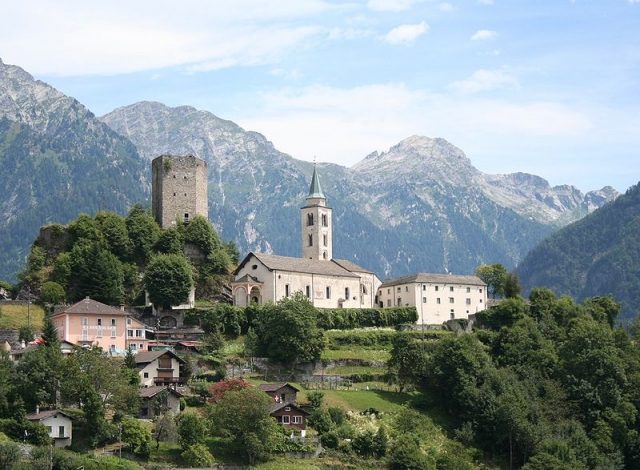
The tower of Sta. Maria in Calanca stands on an elongated plateau, sloping on all sides, above the church of Sta. Maria Assunta in the village of Santa Maria in Calanca in the Calanca Valley in Switzerland.
Construction+
The externally pentagonal residential tower with three floors has an internal rectangular floor plan. The second and third floors each contain a vaulted living room with a surrounding stone bench and fireplace, whose flues merge below the roof. To the left and right of the fireplace, there is a loophole-shaped window niche. The floors are connected by stairs built into the wall. On the west side, there is a continuous latrine shaft with one seating niche per floor. Access to the tower was via a high entrance on the west wall, which led directly to the second floor. The ground floor served as a cistern.
Erwin Poeschel suspected an open platform with battlements as the top. In 1932–1933, the tower's top was significantly altered during restoration work. In 1979, further securing work was carried out. Today, the tower is topped by a platform with a parapet wall.
There are no documentary records regarding the construction of the tower. The construction method of the vaults, fireplace system, latrine shaft, and window shape allow for a dating around 1300. It is certain that the tower was built into an already existing complex, of which only minor wall traces are still visible today. It was probably built by a local noble family and consisted of an enclosing wall and a residential wing in the north corner. In 1968, fragments of wall paintings and stove tiles from the 13th to the 15th century were found during excavations. In 1203, a Ser Anricus de Calanca is mentioned in documents, but he cannot be associated with the tower.
The Barons of Sax-Misox are presumed to be the builders of the tower, who around 1300 successfully sought a unified dominion over Misox and thereby displaced local noble families. The unusual construction method, in the style of a French donjon, suggests that foreign specialists were consulted as master builders. In 1291 and 1296, Martin von Sax is mentioned as lord of the Calanca Valley; in 1316, it is the brothers Martin and Heinrich von Sax.
The tower is first mentioned in documents in the 15th century, when it was in the possession of the Sax-Grono family branch. When Count Johann Peter von Sax sold all sovereign rights in Misox and the Calanca Valley to the Milanese condottiere Gian Giacomo Trivulzio on November 20, 1480, the castle of Santa Maria di Calanca was not mentioned. It had probably already been abandoned around the middle of the 15th century.
Take Mobile History with you
You are reading this text for free. Premium adds what matters on the road: descriptions read aloud, sites found through your camera, whole regions taken offline.
- Every description, including the ~17,700 Premium sites
- Audio guide: have descriptions read to you on location
- AR finder: see sites through your camera, with distance and bearing
- Unlimited saved sites
14 days free, then from €2.99 a month. Cancel anytime.
Source: Wikipedia · Licence: CC BY-SA 4.0
This description draws on the facts documented in the linked Wikipedia article; Wikipedia content is licensed under CC BY-SA 4.0. Wording and editing: Mobile History.
Location: 46.2624, 9.1458