The remains of the Castle can be visited
RuinRothenstein
Rothenstein Castle (Ruin)
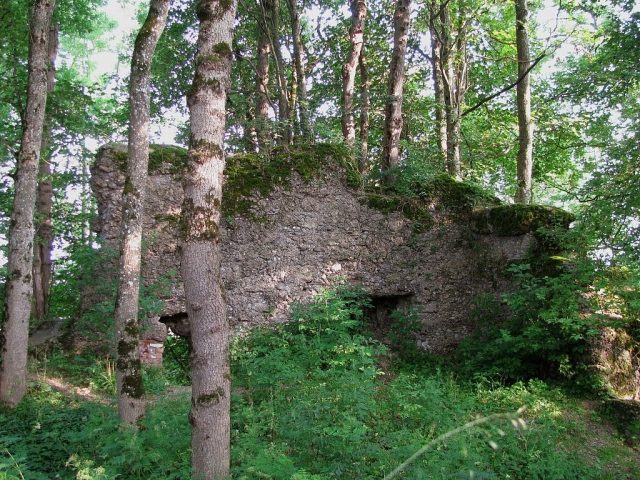
Rothenstein Castle is a castle ruin above the village of Rothenstein, a district of the Bavarian spa town of Bad Grönenbach in the Swabian district of Unterallgäu in Bavaria, Germany.
The spur castle was probably built at the beginning of the 11th century, and was first mentioned in a document in 1037. The builders, the Lords of Rothenstein, were vassals of the Kempten Abbey around 1180. From 1482, the castle came into the possession of the Imperial Marshals of Pappenheim. Philipp von Pappenheim also lived at Rothenstein Castle, and from 1559 he had the first Calvinist sermons held near the castle in Grönenbach. During the Peasants' War in 1525, Rothenstein Castle was captured by rebellious peasants. Marshal Wolfgang von Pappenheim, as well as the widow of Marshal Alexander von Pappenheim, had to flee from Rothenstein Castle to Kempten during the occupation.
During the Thirty Years' War in 1632, Rothenstein Castle, in addition to the Hohes Schloss in Bad Grönenbach, was plundered. In 1646, the castle was the headquarters of the Swedish Field Marshal Carl Gustav Wrangel during the Thirty Years' War. In 1692, the castle was acquired by Gustav von Pappenheim from Kempten Abbey for 65,000 guilders. In 1803, it became Palatine-Bavarian.
On March 9, 1873, the walls and tower of the Rothenstein ruin, which had still been standing until then, collapsed, probably due to a subsidence, and largely fell down the slope. The collapse occurred on a Sunday morning and could be heard as far as Grönenbach, where people were just coming from church.
Description+
Of the medieval complex, essentially only the foundation walls remain today. In the northern part of the complex are remnants of the barrel-vaulted cellar. Larger parts of the western wall are still preserved. In the southern area of the castle was a tall residential building, of which only the foundation walls are still present. A special feature of the complex was the round tower, which was equipped with an onion dome. Today, only the foundation walls of this tower can still be seen.
Take Mobile History with you
You are reading this text for free. Premium adds what matters on the road: descriptions read aloud, sites found through your camera, whole regions taken offline.
- Every description, including the ~17,700 Premium sites
- Audio guide: have descriptions read to you on location
- AR finder: see sites through your camera, with distance and bearing
- Unlimited saved sites
14 days free, then from €2.99 a month. Cancel anytime.
Source: Wikipedia · Licence: CC BY-SA 4.0
This description draws on the facts documented in the linked Wikipedia article; Wikipedia content is licensed under CC BY-SA 4.0. Wording and editing: Mobile History.
Location: 47.8644, 10.2018