The remains of the Castle can be visited
RuinGroßdorf
Rettenberg (Vorderburg) Castle (Ruin)
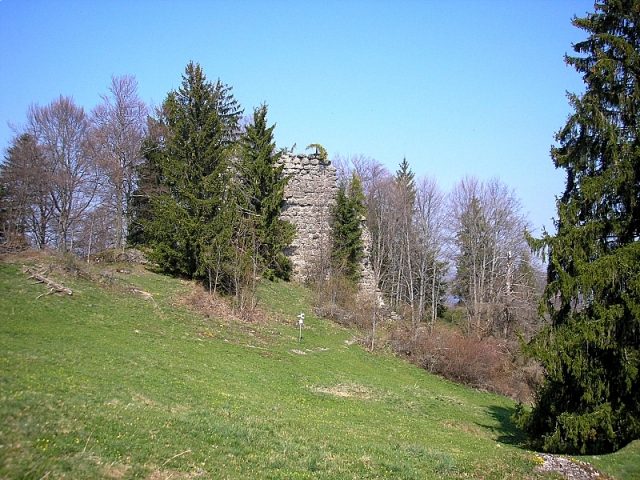
Rettenberg Castle (also: Vorderburg Castle) is located about 600 meters northwest of the village of Großdorf, which belongs to the municipality of Rettenberg, at an altitude of about 1020 meters on the northern end of the Rottachberg ridge in the Oberallgäu district (Bavarian Swabia). The ruins of the High to Late Medieval tower castle are freely accessible.
The hilltop castle above the Iller Valley probably originated around 1100 as the seat of the powerful Lords of Rettenberg. Even before 1130, an Adelprecht von Rotinberch appears in a written source as Vogt (bailiff) of the Augsburg monastery of St. Ulrich and Afra.
The Rettenbergers were probably originally vassals of the Welfs and joined the retinue of the Staufer around 1185. The family is considered the most important noble family in the Oberallgäu, to whom the vogteien (bailiwicks) of numerous monasteries in this region had been entrusted. In the 12th century, the Lords of Trauchburg and Hohenegg branched off from the Rettenbergers. These two families produced some outstanding representatives of Staufer and Habsburg imperial politics in the 13th century.
In addition to their ancestral castle, the Rettenbergers also had several other castle seats in present-day Swabia and the adjacent Tyrolean Außerfern (Castles Vilsegg, Eisenberg, Nesselburg, Burgberg).
The Rettenbergers' retinue included numerous lower noble families, whose residences have partly survived as castle sites in the surrounding area. These vassals resided, for example, in Maiselstein, Burgegg, Hindelang, Wertach, and Haslach.
Around 1350, Heinrich von Rettenberg died without a male heir. The property was divided between the two daughters of the castle lord. Elisabeth, the wife of Georg von Starkenberg, received the lordship of Rettenberg. Her sister Adelheid von Waldburg was assigned the lordship of Burgberg.
Just one year later, the sisters sold their inheritances. Rettenberg went to the Prince-Bishopric of Augsburg for only 1600 pounds of Konstanz pfennigs. The favorable purchase price was probably due to the challenge of the inheritance by Count Wilhelm von Kirchberg. The over-indebted lordship of Burgberg could also be acquired quite cheaply by the Lords of Heimenhofen for 2040 pounds of Konstanz pfennigs.
The Prince-Bishopric of Augsburg occupied Rettenberg Castle with a Pfleger (administrator), who was subordinate to an Ammann (bailiff) and a scribe. Around 1385, the Augsburgers had to temporarily pledge the lordship, but redeemed the pledge before 1400.
In 1525, the peasants of the Rettenberg administration also joined the Allgäu League. The gunpowder of the rebels came, among other things, from Rettenberg Castle, which was apparently plundered. After the defeat of the peasants at Leubas, the victorious Swabian League stored the weapons of the defeated in Rettenberg and Fluhenstein castles. The Pfleger Andreas von Hohenegg was involved in the negotiation of the "Martinszell Treaty" on October 25, which ended the hostilities in the territory of the Prince-Abbey of Kempten.
In 1534, the fortress was restored under Pfleger Hans von Hohenegg zu Vilsegg. The banquet hall in the main building was "paneled", the roofs were re-covered, and the interior and exterior walls were plastered. In total, the renovation cost 1626 guilders.
On September 12, 1562, the castle burned down almost completely due to the carelessness of a drunken cook. The Pfleger Marquard von Schwendi is said to have lost all his household goods and two horses in the fire. An estimate put the complete reconstruction of the burnt-out ruin at 1774 guilders. Due to the high costs, the Prince-Bishopric only commissioned the most necessary repairs.
The seat of the Augsburg Pflegamt (administrative office) was subsequently moved to the nearby Burgberg Castle. However, when the Bishop of Augsburg visited his administration in 1573, his subjects paid homage to him on the meadow in front of Rettenberg Castle.
Even when the Augsburg Cathedral Chapter Rudolf von Rechberg, as administrator of the underage bishop, visited the Augsburg Pflegämter in 1650, an elaborate reception was prepared for the dignitary below the burnt-out ruin.
In 1735, the Prince-Bishopric finally moved the administration of the lordship to the new administrative building in Vorderburg. 50 years later, the residential tower of the castle is described as half-collapsed.
With the rest of the Prince-Bishopric of Augsburg, the Rettenberg administration also passed to the Electorate of Bavaria in 1802/03.
Today, only two high, severely endangered sections of wall remain of one of the oldest tower castles in the Allgäu. While Langenegg Castle, located below in a loop of the Iller, could be secured at the end of the 20th century, no renovation measures are visible at Rettenberg. The ruin has also not yet been included in the catalog of the Allgäu Castle Region. In the medium term, the total loss of one of the most historically significant castle ruins in the Allgäu is to be feared here.
Description+
The castle remains rise on an approximately square rock head (approx. 30 x 30 meters) in the northwest of the summit ridge, which towers about 300 meters above the Iller Valley. To the east, the elongated Rottachberg is accompanied by a high valley. Here, a marked path allows for an easy ascent via the former administrative building in Vorderburg (approx. 20 minutes). The ascent from the Iller Valley takes just under an hour from the Rottachmühle.
On the castle plateau, only in the south and west have remains of the castle complex been preserved. The south wall, about 18 meters long in total, facing the attack side, is windowless. In the west wall (length approx. 9 meters), some window openings can be seen. Here, the vertically sloping castle rock secured the fortress. The wall remains still rise up to 9 meters high. The western building edge is rounded.
The main castle apparently consisted only of a mighty residential tower or tower house, in front of which a narrow gate zwinger (outer ward) was located to the southeast. The outer shell consists of large Nagelfluh (puddingstone) ashlar blocks of local origin, some of which were jointed with small rubble. The Rottachberg is mainly built of Nagelfluh, which is interspersed with other types of rock. Narrow sandstone slabs are inserted between some layers of stone. The inner shell is also built of rolled and broken stones (danger of falling rocks).
The cost estimate from 1562/63 allows for a reconstruction of the condition before the great fire. The main building had a cellar floor, partly cut into the rock. Above it were three floors, crowned by a steep roof (granary).
Inside, each floor contained a large (approx. 10 x 20 meters) hall with massive boundary walls. Smaller chambers with timber-framed walls were attached to these intermediate walls against the outer shell. The ground floor housed the utility rooms, above them the official rooms of the Rettenberg administration officials. The Pfleger himself resided on the upper floor. Here was also the representative main hall, the "große Soller".
A spiral staircase allowed ascent to the attic. A paneled chapel and a stable next to the entrance are also mentioned.
Georg Weidenkeller was still able to document the south wall with the gate in 1837. His two drawings are now in the Kempten City Archives.
The plateau located to the southwest probably bore a small outer bailey, of which no wall remains and only a few traces of the terrain have been preserved.
Take Mobile History with you
You are reading this text for free. Premium adds what matters on the road: descriptions read aloud, sites found through your camera, whole regions taken offline.
- Every description, including the ~17,700 Premium sites
- Audio guide: have descriptions read to you on location
- AR finder: see sites through your camera, with distance and bearing
- Unlimited saved sites
14 days free, then from €2.99 a month. Cancel anytime.
Source: Wikipedia · Licence: CC BY-SA 4.0
This description draws on the facts documented in the linked Wikipedia article; Wikipedia content is licensed under CC BY-SA 4.0. Wording and editing: Mobile History.
Location: 47.6172, 10.3283