The remains of the Castle can be visited
CastleUntervaz
Rappenstein (Untervaz)
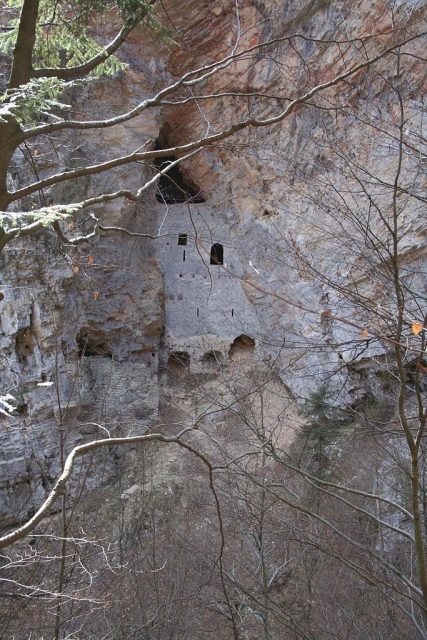
Rappenstein Castle is the ruin of a high medieval cave castle in the difficult-to-access Cosenz Gorge west of Untervaz in the Swiss canton of Graubünden. Rappenstein, alongside Kropfenstein Castle in Surselva, is one of the best-preserved cave castles in Switzerland.
The ruin is located in a rock crevice about ten meters above the stream and is easily accessible via a steep path. Access to the interior is possible through a narrow hatch at the base of the wall.
To this day, it is unknown why Rappenstein was built in such a dark, cold, and damp place, where no ray of sunshine ever reaches. However, it is likely that Rappenstein served only as an occasional retreat and was not a permanent residence. The fact that the wall of the annex was reinforced with a new casing in a second construction phase nevertheless suggests longer-term use.
Who built Rappenstein is unknown; there are no documents in which Rappenstein is mentioned. Structural features and a dendrochronological examination of the beams suggest a construction period in the middle of the 13th century.
How the castle got its name is also unclear. It could go back to the noble merchant family Mötteli, who named themselves after Rappenstein Castle in Martinstobel near St. Gallen and who came into possession of the castle in the gorge near Untervaz around 1450. Thus, the name Rappenstein may have transferred from the Mötteli family to the castle.
The Möttelis were related to the Knights Thumb von Neuburg from Vorarlberg, who owned Neuburg Castle near Koblach. Since Rappenstein is older than Neuburg, which was only built around 1300, Rappenstein could have been the first seat of the Thumb family in Untervaz.
Whether the first owners of the lordship of Neuburg lived in Rappenstein or in another, unknown castle is not known. It is known, however, that Rappenstein was already a ruin in the 15th century, when Neuburg belonged to the Mötteli. When Rudolf Mötteli sold Neuburg and a vineyard to the Bishop of Chur in 1496, he mentioned the hoefli Castrines on the other side of the Cosenzbach, but the castle itself is not mentioned. As a ruin, it no longer had any value and therefore did not have to be listed in the deed of sale.
Rappenstein was abandoned by the 15th century at the latest. The wooden beams, sawn off on both sides of the wall, suggest a systematic reuse of usable material and an orderly evacuation.
Layout+
On the upper floor of the two-story main building was the round-arched high entrance, which was accessed via wooden arcades from an outbuilding leaning against the rock northeast of the main building. Its appearance can no longer be clearly reconstructed. The 1.4-meter-thick front wall made of rubble stone is plastered inside and out in Rasa-Pietra with horizontal trowel joints.
Individual remnants of the wooden roof construction are still preserved. The water supply was provided by two small springs in the rear part of the fifteen-meter-deep cave. The interior design is no longer recognizable, as it is filled with debris that has fallen from the ceiling.
The remains of the walls reveal two construction phases, which suggests a longer period of use, not self-evident given the damp and cold location of the castle.
Take Mobile History with you
You are reading this text for free. Premium adds what matters on the road: descriptions read aloud, sites found through your camera, whole regions taken offline.
- Every description, including the ~17,700 Premium sites
- Audio guide: have descriptions read to you on location
- AR finder: see sites through your camera, with distance and bearing
- Unlimited saved sites
14 days free, then from €2.99 a month. Cancel anytime.
Source: Wikipedia · Licence: CC BY-SA 4.0
This description draws on the facts documented in the linked Wikipedia article; Wikipedia content is licensed under CC BY-SA 4.0. Wording and editing: Mobile History.
Location: 46.9252, 9.5202