The remains of the Castle can be visited
CastleTujetsch
Pontaningen Castle (Ruin) (Tujetsch)
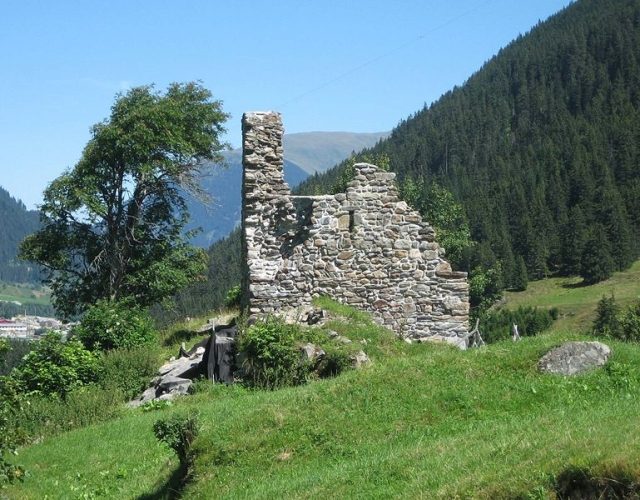
The ruin of Pontaningen Castle is located in the municipality of Tujetsch in the Vorderrhein Valley in the Swiss canton of Graubünden. The ruins of the former Pontaningen Castle are situated below the cantonal road southwest of the Rueras district near Sedrun on a rock ridge that slopes steeply to the east and are easily accessible on foot in a few minutes.
Mainly preserved are the remains of a tower made of rubble stone walls in the form of an irregular quadrangle with a side length of approximately 6 meters. The east and south walls are heavily decayed. Beam holes on the northern outer wall indicate that a low building was leaning against the tower here. The tower, still 7 meters high on the north wall, is separated from the forecourt by a 2.5-meter-wide and approximately 3-meter-deep ditch carved out of the rock. The northwestern corner of the wall is heavily eroded; presumably, the strong corner stones were used for building purposes.
Hardly any traces remain of the western outer bailey and a ring wall on the east side.
There are no written records about the origin of the castle. Based on its construction, a period of origin around 1200 can be assumed.
The ministerial family of Pontaningen is first attested in 1252 with Knight Wilhelm (1252-78). They were frequently documented in the service of Disentis Monastery as witnesses, guarantors, mediators, and envoys, and in 1278 with Wilhelm and his son Hugo also among the enemies of the monastery, who, alongside Walter von Vaz, encroached upon monastic property. In 1391, Heinrich was the monastic Vogt (... junkher Heinr. von Puntningen vogt Thisentis) and Wilhelm was Ammann of Disentis at the beginning of the 15th century.
The most significant representative of the family was Peter, who was Abbot of Disentis from 1402 to 1438 and participated in the formation of the Upper League, which led to the creation of the Grey League in 1424. In 1339, Hugo, and in 1363, Ulrich, served as Ammann in the monastic dominion in the Urseren Valley beyond the Oberalp Pass.
The castle is mentioned only once in documents: in 1300, Abbot Nikolaus of Disentis transferred serfs to Wettingen Monastery: ... ante castrum Bultringen. The family of Pontaningen can be traced until the middle of the 16th century.
Take Mobile History with you
You are reading this text for free. Premium adds what matters on the road: descriptions read aloud, sites found through your camera, whole regions taken offline.
- Every description, including the ~17,700 Premium sites
- Audio guide: have descriptions read to you on location
- AR finder: see sites through your camera, with distance and bearing
- Unlimited saved sites
14 days free, then from €2.99 a month. Cancel anytime.
Source: Wikipedia · Licence: CC BY-SA 4.0
This description draws on the facts documented in the linked Wikipedia article; Wikipedia content is licensed under CC BY-SA 4.0. Wording and editing: Mobile History.
Location: 46.6705, 8.7469