The remains of the Castle can be visited
RuinPfalzpaint
Pfalzpaint Castle (Ruin)
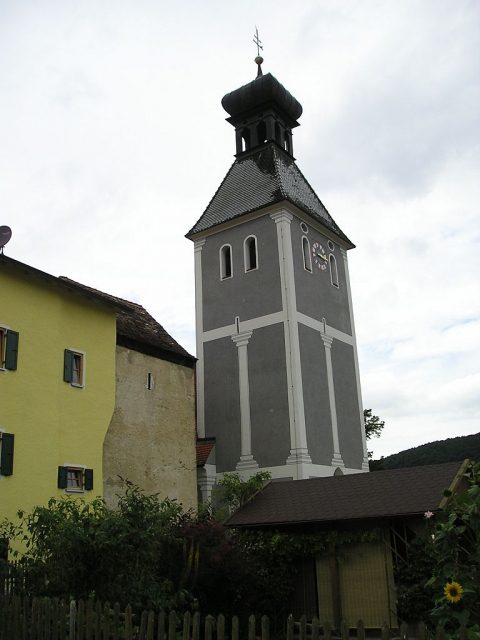
Pfalzpaint Castle is a castle ruin located at 388 m above sea level, immediately south of the church in the Pfalzpaint district, Kirchweg 3, in the municipality of Walting in the Eichstätt district of Bavaria.
The lowland castle, which formed a defensive unit with the village church, was built in the 13th century as the ancestral seat by the Lords of Pfalzpaint, mentioned since 1194, who were ministeriales of the Counts of Hirschberg. In 1452, Heinrich von Pfalzpaint sold the castle to his brother-in-law Michael Muggenthaler and joined the Teutonic Order, where in 1460 he wrote "Wundarznei", the oldest surgical textbook in German. In 1538, the castle came into the possession of the Nuremberg field captain Haug von Parsberg, who in 1539 converted it into a palace and extended it into the cemetery. When his widow died in 1578, the palace passed as a fief to Georg Wurmrauscher. In 1659, Maria Sponica Wurmrauscher sold the palace to the Prince-Bishopric of Eichstätt, and in 1690 a forestry office was established in the former castle. In 1707, the church of St. Andreas was rebuilt by Jakob Engel and still shows its connection to the palace. The castle received its current appearance when the keep was reduced in 1779, the remaining defensive structures were removed, and the remains of the castle were incorporated into the new construction of a residential building. In 1807, the forestry office was dissolved and the former castle buildings were sold.
Description+
The stump of the Romanesque, square, three-story keep is the only visible remnant of the castle ruin. It is integrated into the current residential building, which still contains remnants of the castle complex with the former palas. The tower can be reached at the height of its original entrance via the third upper floor of the residential building, which has a slate roof.
However, the former fortified village church, which formed a defensive unit with the castle, was completely lost during the church's renovation in 1707. The church furnishings, predominantly in the Baroque style, date from the 16th to 18th centuries.
Take Mobile History with you
You are reading this text for free. Premium adds what matters on the road: descriptions read aloud, sites found through your camera, whole regions taken offline.
- Every description, including the ~17,700 Premium sites
- Audio guide: have descriptions read to you on location
- AR finder: see sites through your camera, with distance and bearing
- Unlimited saved sites
14 days free, then from €2.99 a month. Cancel anytime.
Source: Wikipedia · Licence: CC BY-SA 4.0
This description draws on the facts documented in the linked Wikipedia article; Wikipedia content is licensed under CC BY-SA 4.0. Wording and editing: Mobile History.
Location: 48.9331, 11.3249