The remains of the Castle can be visited
RuinObermurach
Obermurach Castle (Ruin)
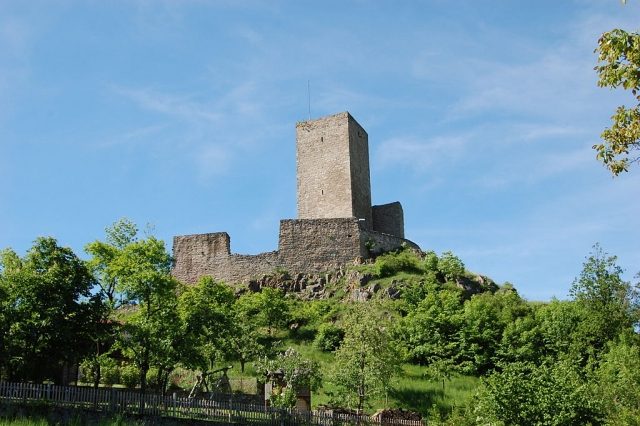
Obermurach Castle, also known as Murach Castle, was first mentioned in the early 12th century and was built to monitor trade routes from Bavaria to Prague and to protect the Bavarian-Bohemian border in the Upper Palatinate Forest. Today, the complex, located near Oberviechtach in the Upper Palatinate district of Schwandorf, is only preserved as a ruin. It lies at an altitude of 585 meters on a hill, southeast of the village of Obermurach. In the Middle Ages, numerous trade routes, known as the Golden Road, led through the surrounding area across the Bohemian border, from where attacks on the newly developed areas of the Bavarian Nordgau repeatedly occurred.
Obermurach Castle served both to protect and control trade routes and to defend against attacks from the east.
The name Haus Murach, as Obermurach Castle is also called, comes from the fact that at the end of the Middle Ages, many castles were used as residential castles, i.e., as a house (hus). This emphasized the permanent residence.
The castle was first mentioned around 1110, with the Count of Sulzbach named as its builder. The Murachers were in the service of the Sulzbachers. The name Murach is historically traceable for the first time in connection with Berengar of Sulzbach. "Gerunch de Mourach" was a companion of Berengar I of Sulzbach in 1110. After the male line of the Sulzbachers died out in 1188, the property was divided among the heiresses. Haus Murach, along with surrounding possessions extending to the Bohemian border, came into the possession of the Counts of Ortenburg through the marriage of Elisabeth of Sulzbach to Rapoto I of Ortenburg. Their youngest son, Heinrich I of Ortenburg, bequeathed the castle in 1238 to his second wife, Richgard of Hohenburg, and his three younger sons, who from then on called themselves Ortenburg-Murach. Heinrich's son from his first marriage, Heinrich II, feared for his inheritance due to this donation and began a years-long conflict with his stepmother and half-brothers. The brothers Gebhard, Diepold, and Rapoto IV consequently found themselves increasingly in financial difficulties. Even after Heinrich II's death in 1257, their situation did not improve, so they were forced to pledge Haus Murach to Ludwig the Strict in 1268. In 1271, they sold numerous possessions around the fortress in the Upper Palatinate for 675 pounds of Passau pfennigs. A year later, they finally sold further estates around the castle. After the death of his siblings in 1285, Rapoto IV finally sold Haus Murach definitively to Ludwig the Strict.
In 1329, the castle passed to the Palatine line of the Wittelsbachs and in 1353 finally to Emperor Charles IV. During the Hussite Wars, Murach was unsuccessfully besieged by Hussite armies in 1428 and 1433.
In 1628, the castle returned to Bavaria and was incorporated into Electoral Bavaria in 1633 along with the occupied Upper Palatinate.
Christoph Gottfried Freiherr von und zu Murach is mentioned as one of the administrators (Pfleger) at Obermurach. His daughter Eva Sophia was the wife of the last Count of Aufseß, Carl Siegmund Graf und Herr von Aufseß.
In 1803, the Murach administrative court (Pfleggericht) was moved to Neunburg vorm Wald, and the castle, no longer needed as an official residence, was sold to a private individual. This person allowed the castle to fall into disrepair, while local residents used the building as a quarry. Only in 1844 was the castle repurchased by the state of Bavaria when the district court (Landgericht) of Oberviechtach was re-established. Provisional conservation measures were carried out by the state.
From 1893 and throughout the 20th century, further renovation work was carried out. In 1970, an operating cabin for a television repeater station was installed.
On the first Sunday of August each year, the Hausen Castle Festival takes place on the castle grounds, which is a folk festival with various show competitions. in the book edition "Die Kunstdenkmäler des Königreichs Bayern, Bezirksamt Oberviechtach" from 1906.
Legends+
Over the centuries, numerous legends developed about Murach Castle.
For example, it was said in the vicinity of the castle that Haus Murach was once inhabited by giants who forced the population to build the castle; among other things, they had to dig the 10-foot-wide well. If a stone accidentally fell into the well shaft, the giants would shout "Gsch, gsch!" because they thought the people were scratching chickens.
Another legend tells of a cruel, hot-tempered knight who was once lord of Haus Murach. Offenses were punished by him with draconian penalties. For example, he had a man dragged around the castle by a horse until he had no shred of clothing left on his body; allegedly, this is how the circular path around the castle came into being.
Visiting+
The castle can still be visited today; keys for the castle gate and the keep can be picked up in the village. A reconstruction of the ruin is located in the Oberviechtach Local History Museum.
Take Mobile History with you
You are reading this text for free. Premium adds what matters on the road: descriptions read aloud, sites found through your camera, whole regions taken offline.
- Every description, including the ~17,700 Premium sites
- Audio guide: have descriptions read to you on location
- AR finder: see sites through your camera, with distance and bearing
- Unlimited saved sites
14 days free, then from €2.99 a month. Cancel anytime.
Source: Wikipedia · Licence: CC BY-SA 4.0
This description draws on the facts documented in the linked Wikipedia article; Wikipedia content is licensed under CC BY-SA 4.0. Wording and editing: Mobile History.
Location: 49.4468, 12.3896