The remains of the Castle can be visited
CastleTrimmis
Upper-Ruchenberg Castle (Ruin) (Trimmis)
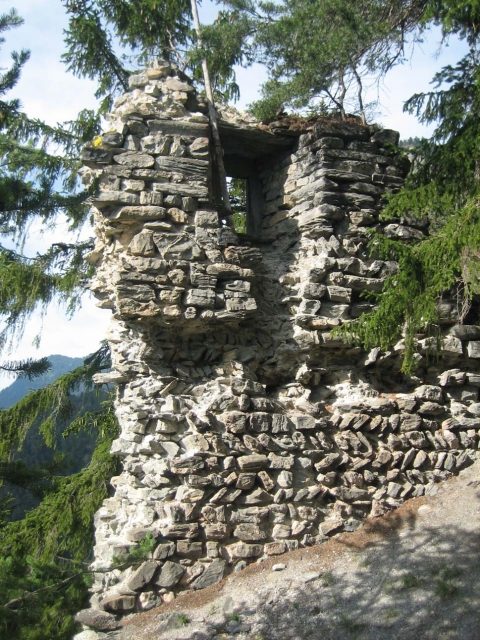
The ruin of Ober-Ruchenberg Castle is located in the municipality of Trimmis in the Swiss canton of Graubünden. The ruin lies high above the hiking trail from Trimmis to Chur on a prominent wooded hill. It can be easily reached from the upper edge of the village in just under an hour via a steep path. Access to the actual castle path is from the upper edge of the Rüfe.
The castle is reached from the south. Through a neck ditch, one reaches a plateau with remains of dry stone walls, which are likely to be outbuildings. The main castle consisted of a tower, a palas, and newer structures, of which hardly any traces remain. The entire structure is approximately 20 meters long. Partially plastered inside with Rasa Pietra, outside with joint pointing.
The approximately 15-meter-high tower has a shifted rectangular footprint of approximately 9.5 by 10.5 meters, with wall thicknesses between 1.5 and 2.3 meters. Four stories are discernible; the high entrance is located at the break in the western wall; remnants of the door frame are still preserved. The living quarters with small window openings, latrine bay, storage niches, and smoke vent were on the 2nd and 3rd floors. Inside the tower, traces of a staircase are visible on the wall. Beam holes with beam remnants indicate the floors. Nothing is known about the roof shape; battlements and a hipped roof are presumed.
The three-story palas adjoined the tower to the west, but the rubble no longer reveals the structural connection. The southern parts of the tower and palas have slipped away, leaving only minor remnants. The central part of the west wall, where Poeschel still noted a chimney in 1930, has collapsed. Large window openings suggest a hall 8 meters wide, not inhabited year-round. In the lower parts, narrow slit windows are found.
Approximately 30 meters west of the palas lies an artificially leveled terrace with no traces of walls, but certainly belonging to the complex. Excavations inside the tower in 1960 revealed a layer of fire directly on the rock beneath 50 centimeters of wall debris.
According to Clavadetscher and Meyer, the preserved wall sections can hardly be dated before the 13th century. The castle is first mentioned in 1328: ...obiit dominus Arnoldus Sassin sacerdos, qui occisus erat ante castrum Ruchenberg. ("The priest, Lord Arnold Sassin, who was slain before Ruchenberg Castle, died.") In 1399, Ruchenberg is mentioned in connection with a road that led from Chur to the castle: ...so die gmainen obren strass, ala man gat zu der fest Ruhenberg.
The Lords of Ruchenberg, however, appear as early as the 13th century, mostly as witnesses: 1232–41 the brothers Knight Albero and Detrich de Ruhin-berg, 1244–72, the Pfäfers monk Ebo. Further attested are a Dietrich, Rudolf, the Pfäfers abbot Conrad, Simon, Friedrich, and Johann, who killed his sister Katharina in 1370. From a cartulary: ...quod Johannes (de) Ruhenberg sororem suam Katherinam interfecit. The consequence was that various estates with which Johannes von Ruchenberg had been enfeoffed were assigned to Trimmis Fortress. In 1395, the Ruchenbergs still held various episcopal meadows as fiefs, but were no longer in possession of the castle. The family presumably died out shortly thereafter. The Ruchenbergs of the 15th century were likely non-nobles who had inherited the former castle estates.
In 1339, Walter the Meier of Altstätten and Conrad of Unterwegen pledged to protect the merchants on the road from Lake Zurich to Churwalden ...and to do them no harm from the fortress. How the two came into possession of the castle is unknown.
In 1409, Ruchenberg belonged to Dietegen von Marmels; in 1444, a bailiff of the Lords of Sigberg from Vorarlberg resided at Ruchenberg.
After the extinction of the von Sigberg family, a transfer of the castle, together with Neu-Aspermont Castle, to the Schlandersberg family from South Tyrol is conceivable. When Ulrich von Schlandersberg sold the interest from his lordship of Neu-Aspermont to Ludwig Tschudi of Glarus in 1521, he pledged ...the castle site Ruchenberg located above Trimmis together with the forest nearby. In 1522, Josua von Beroldingen, a cousin of Ulrich von Schlandersberg, acquired the castle, which was probably no longer inhabited at that time. Johannes Stumpf mentions Ruchenberg as a ruin in 1548.
Take Mobile History with you
You are reading this text for free. Premium adds what matters on the road: descriptions read aloud, sites found through your camera, whole regions taken offline.
- Every description, including the ~17,700 Premium sites
- Audio guide: have descriptions read to you on location
- AR finder: see sites through your camera, with distance and bearing
- Unlimited saved sites
14 days free, then from €2.99 a month. Cancel anytime.
Source: Wikipedia · Licence: CC BY-SA 4.0
This description draws on the facts documented in the linked Wikipedia article; Wikipedia content is licensed under CC BY-SA 4.0. Wording and editing: Mobile History.
Location: 46.8808, 9.5720