The remains of the Castle can be visited
RuinNordenau
Nordenau Castle (Ruin)
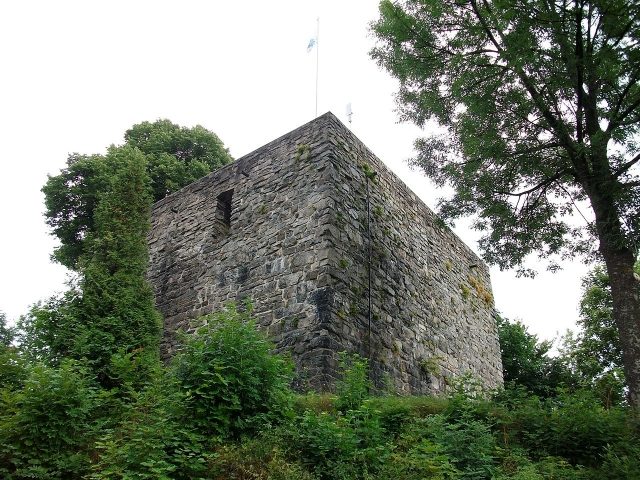
The ruin of Rappelstein Castle (formerly Nordenau Castle or Burg Norderna) is located in Schmallenberg, in the Nordenau district, in the Hochsauerlandkreis in North Rhine-Westphalia.
The ruin of Nordenau hilltop castle is situated on a rock, the so-called Rappelstein, in the center of Nordenau. Nordenau Castle, whose original name was Burg Norderna, was built by the noble lords of Grafschaft on the old Heidenstraße Cologne – Kassel around 1200. The noble family of Grascap, as it was then called, presumably already possessed a ringfort on the Wilzenberg near Grafschaft around 1000, according to popular tradition. After the construction of the castle, the noble lords of Grafschaft also moved their ancestral seat to Nordenau. As hereditary bailiffs of Grafschaft Monastery, however, they continued to exercise bailiwick over the area around Grafschaft.
Nordenau Castle, as the highest castle in Westphalia, was located at a strategically important point. The noble lords and brothers Kraft and Widekind von Grafschaft sold the castle to Count Otto von Waldeck on February 14, 1298. Otto then returned the castle to them as a fief under certain conditions. With this acquisition began the period of Waldeck's partial rule over the castle and its possessions. The financial situation of the noble lords of Grafschaft did not improve in the following years. After the Waldeckers attempted to oust Kraft's widow Agnes from her share of the castle, Archbishop Walram of Cologne came to her aid. From 1343 onwards, there were prolonged disputes between Cologne and Waldeck. Significant battles took place over the castle. The fortress was temporarily besieged during this time. In 1364, an agreement was reached. Subsequently, the castle became joint property of the Archbishop and the Count of Waldeck. In 1471, the noble family of Grascaps acquired a castle in Ober-Ense. Nordenau Castle fell into disrepair from this point onwards. The Grascaps family died out in 1572.
Excavations+
From 1919, there were initial efforts to conduct excavations at the castle ruin. Later, efforts were also made to save the remains of the tower from decay. During this time, however, a hobby archaeologist made a discovery, finding a Hanseatic bowl in the Rappelstein ruin during excavations. The Hanseatic bowl from Nordenau is a flat bronze bowl, about 25 cm in diameter. In its center is the inscription SUR ERBIA and the depiction of a crowned female figure. The Hanseatic bowl with Superbia has been in the possession of the LWL-Landesmuseum for Art and Cultural History in Münster since 1927.
In the following years, efforts intensified to conduct scientific follow-up excavations at the castle ruin or to secure the ruin. This was only realized in 1967/68, when the keep was partially rebuilt and investigations took place by the municipality and the monument authority.
During the investigations, pottery shards, a crossbow, and a 14th-century coin from the Duchy of Westphalia were found. The wood of the tower was subjected to a dendrochronological analysis (via tree rings in the wood). According to this, the castle tower was erected between 1085 and 1110.
Take Mobile History with you
You are reading this text for free. Premium adds what matters on the road: descriptions read aloud, sites found through your camera, whole regions taken offline.
- Every description, including the ~17,700 Premium sites
- Audio guide: have descriptions read to you on location
- AR finder: see sites through your camera, with distance and bearing
- Unlimited saved sites
14 days free, then from €2.99 a month. Cancel anytime.
Source: Wikipedia · Licence: CC BY-SA 4.0
This description draws on the facts documented in the linked Wikipedia article; Wikipedia content is licensed under CC BY-SA 4.0. Wording and editing: Mobile History.
Location: 51.1751, 8.4249