The remains of the Castle can be visited
RuinNeunußberg
Neunußberg Castle (Ruin)
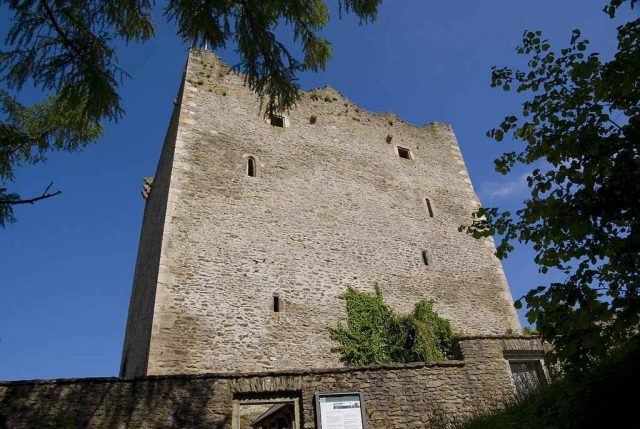
Neunußberg Castle is a former late medieval to early modern noble castle, now preserved only as a ruin, and is located in the eponymous church village of Neunußberg, east of Viechtach in the Lower Bavarian district of Regen in Germany.
Still present today are the mighty square residential tower, remains of the curtain wall with a three-quarter round shell tower, and the renovated castle chapel from the year 1356. The tower has a square floor plan with a side length of about 20 meters and a height of about 25 meters.
The chapel has a Baroque interior. The high altar was created around 1720, and the altarpiece depicts St. Michael. A painting of St. Raphael with Tobias (around 1650), a Mater dolorosa (around 1700), and a simple statue of St. Michael (17th century) are part of the interior furnishings.
The Lords of Nußberg, who are documented since the first half of the 12th century, were originally ministeriales of the Counts of Bogen. After the extinction of the counts in 1242, they came under the suzerainty of the Wittelsbachs; even under them, the Lords of Nußberg were among the most respected knightly families of the Bavarian Forest. Thus, in 1360, Duke Albrecht I of Lower Bavaria-Straubing granted the family the office of Marshal in Lower Bavaria as a hereditary fief.
From 1340 to 1350, Konrad von Nußberg had Neunußberg Castle built. The family then left their previous ancestral seat at Altnußberg Castle.
In 1466, 41 noblemen of the Bavarian Forest united to protect their rights against Duke Albrecht IV (1465 – 1508). The members of this alliance called themselves "Böckler" after the buck in their coat of arms. Among them were Warmund and Konrad von Nußberg. A campaign by Duke Albrecht IV in 1468/1469 brought a devastating defeat to the alliance in the Böckler War.
Due to the defeat, Warmund and Konrad had to sell Neunußberg Castle to the Duke, Warmund in 1469 for an annual pension, Konrad in 1470 for the small castle of Linden.
In 1564, a lightning strike destroyed the castle, which, after the extinction of the Lords of Nußberg in 1569, came as a ruin with its remaining possessions to the Wittelsbachs.
Already in the second half of the 16th century, the militarily useless complex was no longer inhabited and fell into disrepair.
Recent Development+
On May 21, 1889, the castle was acquired by the then owners Johann and Franziska Fritz through the Viechtach Forest Association, which later became the Viechtach section of the Bavarian Forest Association. In 1939, the first renovation was carried out. Further renovation work secured the preservation of the complex, which developed into a venue for castle festivals with music and dance. Since the summer of 1968, the Castle Festival Plays, based on a text by Karl Gareis, have been performed on the castle grounds, with the historical background being the knight's uprising of 1468.
The tower is accessible upon payment of the "Castle Penny," which is requested as a donation at the ascent to the castle.
Take Mobile History with you
You are reading this text for free. Premium adds what matters on the road: descriptions read aloud, sites found through your camera, whole regions taken offline.
- Every description, including the ~17,700 Premium sites
- Audio guide: have descriptions read to you on location
- AR finder: see sites through your camera, with distance and bearing
- Unlimited saved sites
14 days free, then from €2.99 a month. Cancel anytime.
Source: Wikipedia · Licence: CC BY-SA 4.0
This description draws on the facts documented in the linked Wikipedia article; Wikipedia content is licensed under CC BY-SA 4.0. Wording and editing: Mobile History.
Location: 49.0823, 12.9408