The remains of the Castle can be visited
CastleFrenkendorf
Neu-Schauenburg Castle (Ruin)
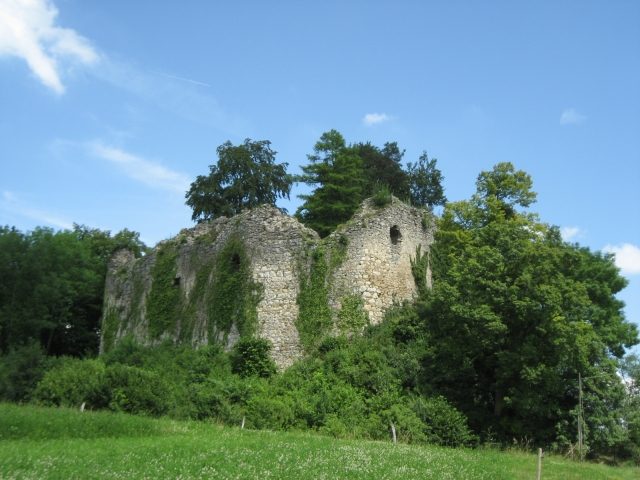
The ruin of Neu-Schauenburg is the older of the two Schauenburg castles west of Frenkendorf in the Swiss canton of Basel-Landschaft. It is located west of Frenkendorf on a rocky outcrop in the middle of a cleared plateau, in the immediate vicinity of the Schauenburgflue.
Layout+
The visible remains of Neu-Schauenburg today date from the 13th century. However, pottery shards from the mid-12th century were also found during construction work. This indicates a predecessor building that was already inhabited in the 12th century (Meyer even suspects the 11th century). A faintly visible ditch, still visible to the west of the Neu-Schauenburg rock outcrop, can probably be attributed to this first castle.
Access to the castle is via a ramp from the west, around the northern corner of the castle to the gate area on the northeastern side. In front of the gate, there are minor wall remains that cannot be truly interpreted. They probably belonged to a Zwinger (outer bailey) or an outer gate. The entire gate area has been heavily modified by modern construction measures. The castle's enceinte follows the irregular edge of the rocky outcrop.
The rocky outcrop has two terraces of different heights, which resulted in a two-part use of the area within the enceinte:
- The lower, western part was largely occupied by a residential wing built against the curtain wall.
- The upper, eastern part probably bore a keep. However, this has been completely replaced by a modern observation pavilion, during the construction of which the old wall remains were completely removed.
The construction of the castle is probably attributable to a branch of the Truchsessen von Rheinfelden, who called themselves Lords of Schauenburg. However, the family can only be reliably traced from the mid-13th century, so probably a century or more after the castle's foundation. This complex was built to secure the allodial cleared land. Through clearing, nobles could acquire their own property within the feudal system, which neighbors often coveted. However, the Schauenburg estate remained a possession without rights (jurisdiction, etc.). In addition to the castle and its associated estates, the Lords of Schauenburg had also received the village of Füllinsdorf as a fief from the Counts of Frohburg. When expanding their own property to the southwest, the Schauenburgers then also built Alt-Schauenburg Castle.
Neu-Schauenburg was repaired after the Basel earthquake in 1356, while Alt-Schauenburg was abandoned. This led to the complex described here receiving the suffix "neu" (new = in operation), although it is actually the older of the two Schauenburg castles.
Towards the end of the 14th century (no later than 1385), the Schauenburgers died out. The castle passed – possibly through inheritance – first to the knightly family Vitztum and then, at the beginning of the 15th century, to the Truchsessen von Rheinfelden. The latter sold the complex in 1418 to Konrad Sintz, a wealthy Basel citizen. Misguided speculations and ostentation led to the man's ruin, and when he tried to save himself with fraud, he had to flee.
Henmann Offenburg bought the castle in 1428 from the bankruptcy estate and was also enfeoffed with the judicial rights by Hans von Falkenstein. This may seem surprising from today's perspective, but even issuing fines could be a quite interesting business. These judicial rights were soon lost again, as Munzach and Liestal were able to prove that these rights already belonged to them.
After the mid-15th century, a religious friary was built to the north of the castle (today the Neu-Schauenburg farm). In 1502, Neu-Schauenburg then fell to the Beguines, who by then operated the "Sisters' House". However, the castle was no longer inhabited and was left to decay.
In the following centuries, the castle (out of interest in the associated estates) passed through many owners' hands. First to the Dräss (Drais), who sold it in 1700 to the Liestal city clerk Johann Friedrich Wettstein and his Kleinbasel brother-in-law Pastor Johann Heinrich Gernler. From these two families, the property was resold in 1748 to the Liestal gardener Johannes Gysin, whose family sold it in 1792 to Daniel Iselin-Weiss. The latter bequeathed the estate to Achilles Forcaret-Iselin. Later, Neu-Schauenburg appeared in the possession of Mrs. Marie Riggenbach-Burckhardt and H. L. Miescher-Riggenbach.
Take Mobile History with you
You are reading this text for free. Premium adds what matters on the road: descriptions read aloud, sites found through your camera, whole regions taken offline.
- Every description, including the ~17,700 Premium sites
- Audio guide: have descriptions read to you on location
- AR finder: see sites through your camera, with distance and bearing
- Unlimited saved sites
14 days free, then from €2.99 a month. Cancel anytime.
Source: Wikipedia · Licence: CC BY-SA 4.0
This description draws on the facts documented in the linked Wikipedia article; Wikipedia content is licensed under CC BY-SA 4.0. Wording and editing: Mobile History.
Location: 47.5006, 7.6824