The remains of the Castle can be visited
RuinMellnau
Mellnau Castle (Ruin)
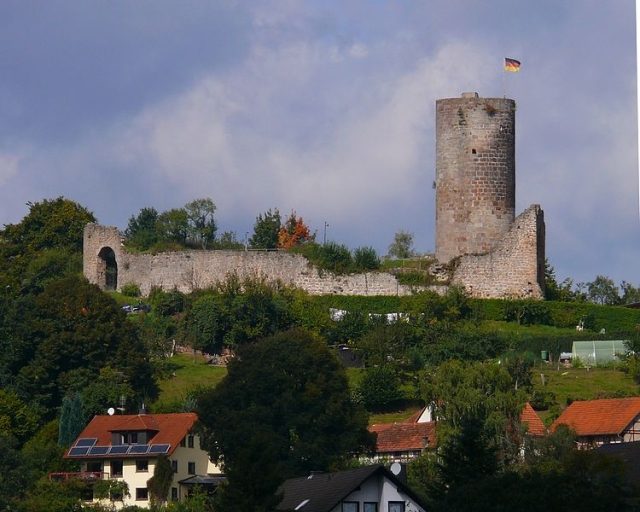
The ruin of Mellnau Castle is located on a mountain above the village of Mellnau, a district of Wetter in the Marburg-Biedenkopf district in Hesse.
The castle was first mentioned in a document in 1263 as “Elenhouch” and was thereafter mostly referred to as “Elnhoch”. The name “Mellnau” for the castle only appeared around 1500. The builder is likely Mainz Archbishop Siegfried III von Eppstein, who had the castle built around 1248 as a replacement for the destroyed Hollende Castle to protect the Wetter Abbey. The 19-meter-high keep was built in the years 1329–1331.
In an agreement between Hesse and the Mainz Archbishop Werner von Eppstein in 1263, it was stipulated, among other things, that the castle remained within the sphere of influence of the Archbishopric.
In the “Rhenish Toll War” between King Albrecht I and the Archbishoprics of Cologne, Mainz, and Trier, as well as the Count Palatine of the Rhine, the castle was conquered in 1301 by the Imperial Vogt Ulrich I von Hanau. Subsequently, the castle was pledged several times. In 1342, the Mainz Archbishop Heinrich III von Virneburg redeemed the castle again.
In 1381, there was an unsuccessful siege by Landgrave Hermann II of Hesse. As a result of the Mainz Diocesan Feud, in 1464, the archiepiscopal share of the Wetter Abbey and thus also Mellnau Castle was pledged to the Landgraves of Hesse. The castle then remained Hessian and lost its military significance. It became a fief of the Lords Milchling von Schönstadt, but from 1510 onwards, it was no longer occupied by castle men, as the seat of the Hessian bailiff was moved to the town of Wetter. Thereafter, the unused complex gradually fell into disrepair. With the allodification of the fiefs in the 19th century, the castle became Milchling private property.
Architectural Description+
Of the almost oval medieval core castle, the curtain wall is still largely preserved today. In the southwest, the curtain wall is interrupted by a younger gate system; the original, now walled-up gate was located immediately east of the keep. In the north – at the height of the keep – the curtain wall is extended into a shield wall. On the southeast side of the curtain wall is the ruin of the palas.
The round keep – built around 1329 – stands freely in the eastern part of the core castle. It has a diameter of 9.5 meters with walls up to 3 meters thick, and today serves as an observation tower.
Take Mobile History with you
You are reading this text for free. Premium adds what matters on the road: descriptions read aloud, sites found through your camera, whole regions taken offline.
- Every description, including the ~17,700 Premium sites
- Audio guide: have descriptions read to you on location
- AR finder: see sites through your camera, with distance and bearing
- Unlimited saved sites
14 days free, then from €2.99 a month. Cancel anytime.
Source: Wikipedia · Licence: CC BY-SA 4.0
This description draws on the facts documented in the linked Wikipedia article; Wikipedia content is licensed under CC BY-SA 4.0. Wording and editing: Mobile History.
Location: 50.9294, 8.7482