The remains of the Castle can be visited
RuinSchwäbisch Hall
Limpurg Castle (Ruin)
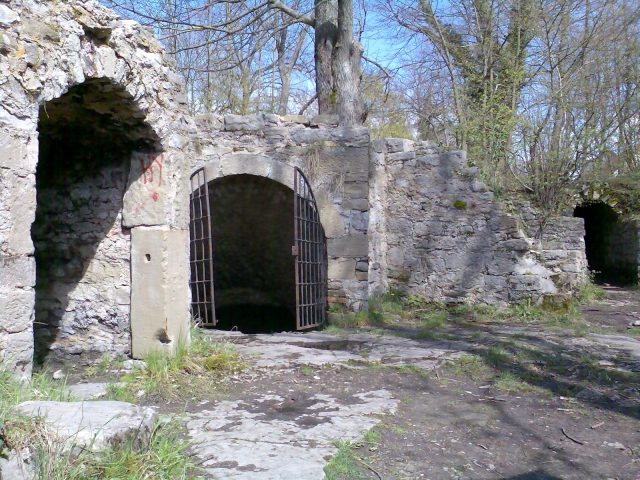
Limpurg Castle was the ancestral seat of the Lords of Limpurg, later elevated to counts, also known as Schenken von Limpurg. Its ruins still stand today on the southern outskirts of Schwäbisch Hall.
Limpurg is located about 1 km southeast of the center of Schwäbisch Hall's old town, above the suburb of Unterlimpurg, on a spur of the Haller Plain projecting westward, in front of the present-day Oberlimpurg estate, within a presumably prehistoric (possibly Celtic) fortification, of which a ditch to the south towards the upper edge of the slope, next to a bend in a field path, is still clearly visible in nature.
From the fortification running about 150 m east of the castle area, a section of a rampart, about 40 m long and up to 4 m high, with a ditch in front, abutting the southwestern valley edge, has been preserved. Finds, mostly made during construction work and predominantly from the area of the Oberlimpurg estate located within the rampart, prove the existence of a settlement and were initially attributed to the Late Neolithic Michelsberg culture (4,400–3,500 BC). However, according to recent research, they rather belong to a "Late Neolithic mixed culture" that is difficult to classify stylistically and chronologically. Only a few finds from the La Tène period (500/450 BC to around the birth of Christ) support the theory that a Stone Age fortification already existed here, which was used or expanded by the Celts. A connection between these traces and the Celtic saltworks proven in the area of Schwäbisch Hall's old town is plausible, but can only be assumed based on current knowledge. The section of the rampart itself is not yet datable and could also be of medieval origin (e.g., for the protection of the estate belonging to the castle).
Before 1230, Walter (I.) Schenk von Limpurg (1226, † 1249) must have probably built Limpurg on his own property. The Schenken von Limpurg sold the castle in 1541 to the once powerful imperial city of Schwäbisch Hall after centuries of disputes; the people of Hall then had the castle razed to prevent its use by robber bands. The Limpurger family had since resided in Obersontheim Castle and the Old Castle of Gaildorf.
Take Mobile History with you
You are reading this text for free. Premium adds what matters on the road: descriptions read aloud, sites found through your camera, whole regions taken offline.
- Every description, including the ~17,700 Premium sites
- Audio guide: have descriptions read to you on location
- AR finder: see sites through your camera, with distance and bearing
- Unlimited saved sites
14 days free, then from €2.99 a month. Cancel anytime.
Source: Wikipedia · Licence: CC BY-SA 4.0
This description draws on the facts documented in the linked Wikipedia article; Wikipedia content is licensed under CC BY-SA 4.0. Wording and editing: Mobile History.
Location: 49.1062, 9.7450