The remains of the Castle can be visited
RuinBörninghausen
Limburg Castle (Ruin) (Börninghausen)
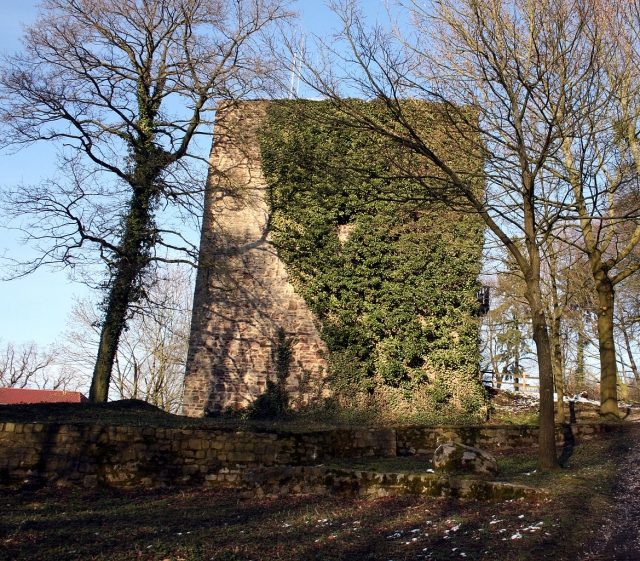
Limberg Castle is the ruin of a hilltop castle on the 190-meter-high Limberg (Wiehengebirge) near the district of Börninghausen in the city of Preußisch Oldendorf in the Minden-Lübbecke district in North Rhine-Westphalia.
The castle was probably built in the 13th century by the Bishop of Minden at a strategically favorable location on the border of the dioceses of Minden and Osnabrück. However, a castle or fortification is said to have stood there even before, where Duke Widukind also stayed. Around 1300, the castle became the property of the Counts of Ravensberg as a fief and was expanded by them. In 1319, the castle was first mentioned in a document. With the death of the last Count of Ravensberg, Bernhard, in 1346, Limberg, along with the County of Ravensberg, fell to the later Duke of Jülich and Berg. In 1554, Limberg Castle was damaged by a fire but was restored. As a result of the Jülich-Cleves War of Succession, the castle was assigned to the Elector of Brandenburg in the Treaty of Xanten in 1614, who – after it was conquered by the Count Palatine of Neuburg for several years during the Thirty Years' War – had it occupied by a small contingent in 1647. During the Thirty Years' War, a thirty-man strong troop was actually supposed to guarantee the integrity of the castle from 1623 onwards, but they were reassigned to the siege of Lippstadt, so that the conquest was not difficult for the Count Palatine of Neuburg. In 1662, the castle's garrison of twenty men was transferred to Sparrenburg Castle, thus ending the castle's history as a military station. Regardless of the respective suzerainty, however, various pledge lords, bailiffs, or stewards were always stationed at the castle. By the end of the 17th century, the castle increasingly fell into disrepair and was hardly usable for military purposes. In 1695, a rescript from Elector Friedrich III to the Ravensberg Chamber of Offices recommended that the house Limberg, which no one could inhabit due to dilapidation, should be demolished. The wording stated that the house Limberg, which no one could inhabit due to dilapidation, should be demolished, as it was of no benefit to the public and the country, because it was not located at any pass, but could only serve the enemy as a nest of robbers in times of war. Until 1805, the tower still served as a prison, and in 1832, the complex was finally sold. In the 1980s, an association was founded to preserve the castle ruin.
Description+
The square twelve-meter-high keep (residential tower) with a side length of twelve meters was restored around 1989 and can be visited. Otherwise, some ramparts, remnants of the palace walls, and parts of the curtain wall, as well as the moat, are still preserved. Also worth seeing is the 600-year-old "Gogerichtslinde" (Gau Court Linden tree) standing at the castle, which formerly served as a court site.
Take Mobile History with you
You are reading this text for free. Premium adds what matters on the road: descriptions read aloud, sites found through your camera, whole regions taken offline.
- Every description, including the ~17,700 Premium sites
- Audio guide: have descriptions read to you on location
- AR finder: see sites through your camera, with distance and bearing
- Unlimited saved sites
14 days free, then from €2.99 a month. Cancel anytime.
Source: Wikipedia · Licence: CC BY-SA 4.0
This description draws on the facts documented in the linked Wikipedia article; Wikipedia content is licensed under CC BY-SA 4.0. Wording and editing: Mobile History.
Location: 52.2801, 8.5077