The remains of the Castle can be visited
RuinNeufra
Lichtenstein Castle (Ruin)
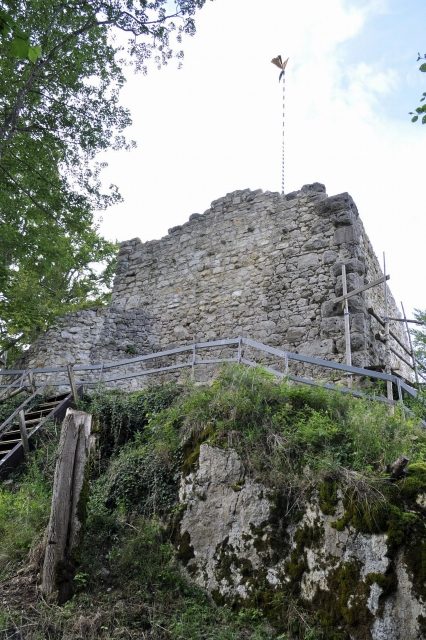
The Lichtenstein ruin is a castle ruin near Neufra in the Sigmaringen district in Baden-Württemberg, Germany. The double castle is divided into Vorderlichtenstein, also known as Bubenhofen, and Hinterlichtenstein. On the right side above the Fehlatal, a wooded ridge facing west rises, on which Vorderlichtenstein and about 500 m west of it, Hinterlichtenstein are located. Vorderlichtenstein lies at about 845 meters, Hinterlichtenstein slightly higher at 849.5 meters above sea level. South of the castle ruins is the steeply sloping area known as "Burghalde".
Hinterlichtenstein Castle
The freely accessible ruin of the castle complex had an east-west orientation. Remains of the keep of the former core castle of Hinterlichtenstein have been preserved, which still dominates the ruin, enthroned on a rock. To the west, the castle was fronted by a rampart and an outer ditch, behind which the main ditch connected. It also protected the palas, whose wall remains rise behind it.
To the south, slightly below the core castle, lay the former outer bailey.
From the east, from Vorderlichtenstein, a modern ascent leads through the possible location of a building of the core castle to the ruin. South of it was the former ascent via a ramp. Access to the castle courtyard was via a gate tower connected to the ramp. In the north of the complex, an intermediate building with a kind of terrace can be identified.
Vorderlichtenstein Castle
The freely accessible ruin of Vorderlichtenstein Castle, dating from the second half of the 12th century, is characterized by its polygonal layout. The core castle itself lies on a rock, with the eastern and western outer baileys slightly below it.
The eastern outer bailey of the complex was protected by an arched rampart with an adjoining ditch (Eastern Ditch).
From the west, coming from Hinterlichtenstein, the ascending access to the western forecourt passes a rampart on the right. The ascent to the core castle leads over a narrow rock ledge through the former gate in the enceinte. In the small castle courtyard of the core castle, the possible location of the cistern is found in the southeastern corner and the possible location of the palas in the southwest. The square keep stands a few meters higher than the castle courtyard. It has a square base of 8.5 x 8.5 meters.
The zwinger was secured against the western forecourt by the already mentioned rampart and a wide ditch, whose spoil is clearly visible in the southern part of the complex. The zwinger could be entered via the eastern forecourt.
The ring wall has a thickness of 1.6 meters, that of the shield wall is 2.2 meters. In addition, a curtain wall up to 6 meters high is still preserved from the castle.
The history of Vorder- and Hinterlichtenstein is strongly linked to the history of Neufra. It was the seat of the Lords of Lichtenstein. Their residence on the present castle ruin Lichtenstein is attested at least in the years from 1332 to 1447.
A first documentary mention of Neufra as Nufiron, a possession of the Counts of Gammertingen, dates from 1138 in the chronicle of Berthold of Zwiefalten. The ancestors of the Lichtensteiners could be the brothers Heinrich and Milo, who were described by a Zwiefalten chronicler around 1140 as noble servants of Count Ulrich of Gammertingen.
The origin of Vorderlichtenstein Castle is dated to around 1150 to 1180.
In 1182, the Lords of Lichtenstein in Neufra were first mentioned. A Gerhard von Lichtenstein is mentioned as a vassal (Ministeriale) of Margrave Heinrich von Ronsberg, the heir of the Counts of Gammertingen, who donates goods in Altingen near Herrenberg to Ottobeuren Abbey. Margrave Heinrich von Ronsperg came into possession of the lordship through the heiress Udilhild von Gammertingen. His wife is Adelheid von Achalm-Gammertingen.
The origin of Hinterlichtenstein Castle is dated to around 1200.
The two castles in Neufra owned a relatively large estate: the abandoned hamlet of Unterlichtenstein, the village of Bitz, estates and the court in Mägerkingen and Hausen a. L. Below the castles was also a fish pond, the "Seelein unter Lichtenstein", which was abandoned in the 16th century.
After the extinction of the Ronspergers, the Lichtensteiners became vassals of the Counts of Württemberg. Between the Ronspergers and Württembergers, a Count Ulrich I von Berg (near Ehingen, circa 1160-1210) briefly held the lordship. He was married to a daughter of the Count of Ronsperg named Udilhild.
The already mentioned Gebhard von Lichtenstein was probably the father or grandfather of the brothers Gero, Gebhard, Swenger and Ludwig von Lichtenstein, who were named in 1243. One of these brothers (or a descendant) probably built Lichtenstein Castle (not the present castle) near Honau. This was destroyed by the Reutlingers in 1310 and 1377 respectively.
A Heinrich von Lichtenstein is mentioned in 1251, a Ludwig von Lichtenstein in 1262. In the same document, a Gero von Lichtenstein, son of Swenger von Lichtenstein, is also mentioned. The information about the Lichtensteiners is too sparse to create a coherent family tree.
In 1332, a Swenger von Lichtenstein founded the Nikolaus Chapel in the then cemetery of Neufra. It is located in the present village center and is preserved in the southern part of the tithe barn from 1534. In 1386, Schweikhart the Younger, Lord of Lichtenstein, sold the village of Bitz to the city of Ebingen. This is probably identical with the previously mentioned Swenger. Depending on the dating, in 1392 or 1396, a Swenger von Lichtenstein is a sealer in a deed of sale for the churchwardens Auberlin Frech and Kun Eberhards Sohn zu Melchingen.
In the 14th to 15th centuries, the hamlet of Unterlichtenstein was abandoned.
From 1407, a Hans von Lichtenstein is named as the owner of Vorderlichtenstein and half of Neufra. Heinrich von Rechberg owns half of Hinterlichtenstein, which he inherited from his uncle Count Wölflin von Veringen. In contradiction to this is the pledging known from 1411. Count Eberhard von Württemberg pledges Vorderlichtenstein Castle, half of Hinterlichtenstein Castle, Neufra and Mägerkingen to Heinrich von Rechberg zu Hohenrechberg for 1000 guilders.
It is known, however, that in 1420 a Wolf von Lichtenstein owned the second half of Hinterlichtenstein Castle. Since the first half of the 15th century, there were no more Lichtensteiners in the area. They probably moved away after selling their possessions, or one or the other line may have died out. There were also Lichtensteiners in Reutlingen itself. The line of the Neckarhausen Lichtensteiners survived the longest. An ensign Anton von Lichtenstein, the last of his family, fell in Upper Hungary in 1688.
During the division of the country in 1442, Vorderlichtenstein and half of Hinterlichtenstein went to Count Ludwig I of Württemberg. In 1447, Hans von Rechberg zu Hohenrechberg sold his half of Hinterlichtenstein, already referred to as a "Burgstall" (castle site), to Count Ulrich of Württemberg, brother of Ludwig of Württemberg, for 18,500 guilders. It must therefore have been uninhabited at that time.
Württemberg was again in possession of Vorderlichtenstein and half of Hinterlichtenstein in 1454. At that time, Vorderlichtenstein included the court of Mägerkingen and Hausen. In 1457, Benz von Hausen, Württembergian castle bailiff, inhabited Vorderlichtenstein Castle.
In 1468, Count Ulrich of Württemberg sold the lordship of Gammertingen with Neufra to Hans and Konrad von Bubenhofen. The acquisition of the lordship of Gammertingen included the lordship of Gammertingen-Hettingen and half of Hinterlichtenstein.
From 1474, depending on the source, there is another contradiction: Count Ulrich of Württemberg is said to have sold Vorderlichtenstein and half of Hinterlichtenstein to his Landhofmeister Hans Caspar von Bubenhofen. However, Count Eberhard the Elder of Württemberg is said to have given the "Burgstall" Vorderlichtenstein and the other half of Hinterlichtenstein to his Landhofmeister Hans Caspar von Bubenhofen as a fief. Vorderlichtenstein must therefore also have been uninhabited at this time. In 1507, Hans Caspar von Bubenhofen sold the fief, the lordship of Gammertingen-Hettingen with Neufra, to his creditors. In 1524, they ceded Vorder- and Hinterlichtenstein to the Württembergian Obervogt of Urach Dietrich von Speth von Zwiefalten.
In 1534, Ulrich of Württemberg occupied the lordship of Gammertingen, with which he was at enmity, and introduced the Reformation. In 1547, the Württembergers were expelled and the re-Catholicization began.
Between 1632 and 1639, Neufra experienced the worst years of the Thirty Years' War with looting, hunger, plague, and billeting of a Swedish occupation. These were attacked by outsiders in 1632, for which the inhabitants of the village had to pay. In 1635, the plague raged in Neufra, claiming, among others, both local pastors.
In 1690, Hans Dietrich von Speth had the "Schlössle" (small castle) built as a residence.
In 1827, the possession of Vorder- and Hinterlichtenstein passed to the Principality of Hohenzollern-Sigmaringen.
In 1996, the Vorderlichtenstein castle ruin, a ground monument, was topographically surveyed by the State Office for Monument Preservation.
Association for the Preservation of the Lichtenstein Ruin e.V.+
In 1996, 44 citizens from Neufra founded the Association for the Preservation of the Lichtenstein Ruin e.V. Renovation work began with the repair of the southwest corner of the wall, followed by the reinforcement of the south wall, which was in danger of collapsing. The volunteer restorers had to use historical building materials, masonry made of fieldstones and unslaked lime as a binder. The work is accompanied by the State Office for Monument Preservation Baden-Württemberg.
The association now has 49 members who work on the ruin almost every week when the weather is good. The association also relies on grants from state funds and the monument office for the extensive work. The renovation/restoration of Vorderlichtenstein has now been completed since mid-October 2010. In total, they have performed around 14,000 hours of volunteer work and about 100 tons of mortar have been processed to make the castle an attractive hiking destination again.
Trivia+
In reference to the history of the Lords of Lichtenstein, the "Burgnarren" (Castle Jesters) were founded on August 31, 1984. The jester figures take up the superstition prevalent among the population in earlier times regarding the castle ghosts, which led to no one daring to enter the "Burgstall" (castle site) for a long time.
The coat of arms of the Lords of Lichtenstein shows a silver wing on a blue background. Today it forms part of the municipal coat of arms of Neufra.
Take Mobile History with you
You are reading this text for free. Premium adds what matters on the road: descriptions read aloud, sites found through your camera, whole regions taken offline.
- Every description, including the ~17,700 Premium sites
- Audio guide: have descriptions read to you on location
- AR finder: see sites through your camera, with distance and bearing
- Unlimited saved sites
14 days free, then from €2.99 a month. Cancel anytime.
Source: Wikipedia · Licence: CC BY-SA 4.0
This description draws on the facts documented in the linked Wikipedia article; Wikipedia content is licensed under CC BY-SA 4.0. Wording and editing: Mobile History.
Location: 48.2601, 9.1635