The remains of the Castle can be visited
RuinLöhnberg
Laneburg Castle (Ruin) (Löhnberg)
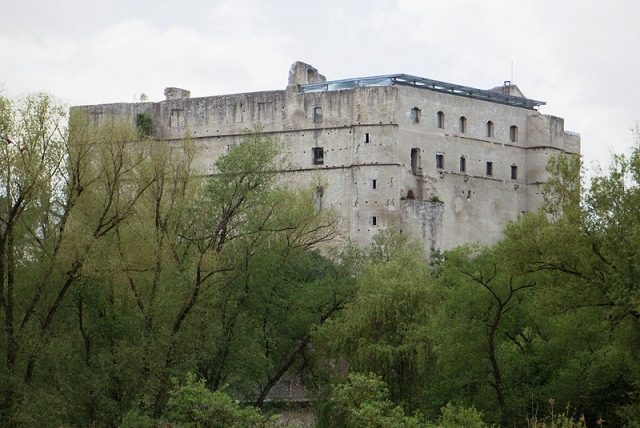
The castle ruin Laneburg in Löhnberg is located in the middle Lahn valley between the old imperial city of Wetzlar, where the Nassau counts long exercised the right of Vogt, and Weilburg, the ancestral seat of the Walramian line of the House of Nassau. The ruin lies above the Lahn at the point where the river enters a narrow rocky valley from the wide valley of the Löhnberg basin. In numismatic circles, the Laneburg became known through a coin hoard, the so-called "Treasure of Laneburg", discovered during renovation work in 2000.
The Laneburg, founded by the Ottonian line of the Nassaus, is located at the southern end of their former dominion, which stretched from Siegen via Dillenburg and Beilstein to the Lahn. Its origin goes back to a Frankish settlement in the valley floor, near the Löhnberg junction of today's B 49. This place "Heimau", first mentioned in 1254, already existed around 500 AD, as discovered Frankish graves prove. The place came to the Counts of Nassau after 1100. In the Nassau fraternal division of 1255, the Heimau court fell to Otto I of Nassau, the founder of the Ottonian line of the House of Nassau. His son Johann mit der Haube had the Laneburg built on the rocky spur of the Schletsberg above the village between 1321 and 1324.
As early as 1324, a document was sealed in this castle, on which the name "Laneburg" appears. The document deals with the various rights of the neighbors and cousins of Laneburg and Weilburg. After Count Johann of Nassau-Dillenburg fell in 1328 towards the end of the Dernbach Feud in a battle against Landgrave Heinrich II of Hesse near Wetzlar, the castle came to his brother Heinrich of Nassau-Siegen. In 1344, he pledged the castle and town of Laneburg to Nassau-Weilburg and others.
At the end of the 16th century, the Counts of Nassau-Beilstein/Dillenburg began to convert the castle into a Renaissance palace. This led to disputes with the co-owners, so Georg of Nassau-Dillenburg felt compelled to place soldiers and heavy artillery in the Laneburg to secure the progress of the construction work. The originally planned rectangular building with an inner courtyard was not completed.
In 1773, the House of Nassau-Weilburg exchanged the village and the Laneburg for three villages in the Westerwald from Nassau-Dillenburg. During the conversion of the castle into a tithe barn in 1782, the large windows were bricked up.
During the Nassau administrative reform of 1816, Löhnberg lost its official function. The castle was sold, partly to the municipality and partly to private individuals; it continued to be used as a barn and stable.
On September 5, 1900, the castle burned down and was not rebuilt. Towards the end of World War II, an aerial bomb destroyed the stair tower and the vault of the wine cellar.
Renovation and Coin Discovery+
In 1968, the municipality began to secure and cover the walls. The "Rheingold" singing association carried out initial renovation work in the 1960s, converted the cellars for gastronomic use, and organized the 1st Castle Festival in 1970.
From the end of the 1990s, further renovation of the Laneburg took place. In the course of this renovation, which lasted until 2001, the castle grounds became the scene of an archaeological find in 2000, the "Coin Treasure of Laneburg". The find occurred during the external inspection of the masonry near the so-called "Landgrave's Tower", when a hole was discovered there. The coin treasure, which was hidden behind it and deposited from inside the building in the area of a latrine, comprises 211 silver coins and consists of varieties of different currencies. The treasure must have been hidden from 1687 onwards.
Current Use+
Until recently, a castle festival took place annually at Laneburg. In addition, the building is used for a Christmas market, numerous cabaret performances, and events by local associations, companies, and private individuals, as the knight's hall, wine and sparkling wine cellars, and the entire castle complex can be rented. There is also a wedding room where many bridal couples from all over Germany are civilly married each year. In addition to monument protection, the castle has received protection status for wartime according to the Hague Convention.
Take Mobile History with you
You are reading this text for free. Premium adds what matters on the road: descriptions read aloud, sites found through your camera, whole regions taken offline.
- Every description, including the ~17,700 Premium sites
- Audio guide: have descriptions read to you on location
- AR finder: see sites through your camera, with distance and bearing
- Unlimited saved sites
14 days free, then from €2.99 a month. Cancel anytime.
Source: Wikipedia · Licence: CC BY-SA 4.0
This description draws on the facts documented in the linked Wikipedia article; Wikipedia content is licensed under CC BY-SA 4.0. Wording and editing: Mobile History.
Location: 50.5115, 8.2767