The remains of the Castle can be visited
RuinLaaber
Laaber Castle (Ruin)
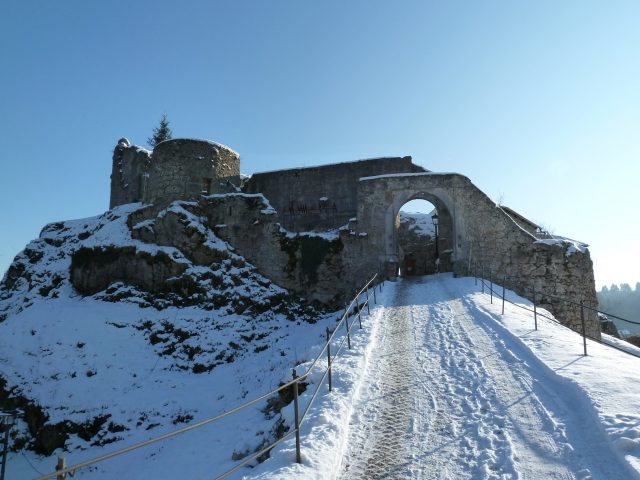
The castle ruin of Laaber is a castle ruin on a rock above the center of the market town of Laaber in the district of Regensburg in Bavaria.
The hilltop castle was built at the end of the 12th century by the Knights of Laaber, who are first mentioned in a document in connection with the founding of Reichenbach Monastery in 1118, to control the river crossings and the "Königsstraße" (King's Road) in the Laber Valley on behalf of the Staufer Emperor Frederick II, which brought the knights, who also owned Prunn Castle and Breitenegg Castle, a significant position of power.
In 1367, Hadamar IV von Laaber, son of the famous minnesinger Hadamar III von Laber, was mayor of the imperial city of Regensburg and, after resigning his office, lived in constant feud with the city, which led the city to attack and damage Laaber Castle in 1389.
After the Lords of Laaber fell into difficulties in the 15th century, the castle was sold to the Wittelsbachs, but was returned to Ulrich von Laaber in 1466 and, after the extinction of the Laaber family, came to the Duchy of Lower Bavaria and in 1505 to the Duchy of Palatinate-Neuburg, which maintained a bailiwick at the castle. In 1597, the castle was expanded into a palace-like structure, the towers were demolished in 1720, and from 1805, in the possession of the municipality, the castle fell into disrepair in the 19th century.
Layout+
The castle complex was separated from the mountain ridge by a deep neck ditch, which in the Middle Ages had a wooden bridge with a drawbridge, protected by a semicircular tower followed by a gate system with a Gothic gatehouse. The second gate and the third gate, which leads through a several-meter-thick curtain wall, show mighty ashlar masonry.
The mighty stump of the rectangular keep, with the castle chapel behind it, shows large, precisely hewn ashlar masonry typical of the period around 1200, and to the south and east of the complex are still the walls of the residential buildings with windows from the Romanesque period. There was a cistern in the castle courtyard.
Take Mobile History with you
You are reading this text for free. Premium adds what matters on the road: descriptions read aloud, sites found through your camera, whole regions taken offline.
- Every description, including the ~17,700 Premium sites
- Audio guide: have descriptions read to you on location
- AR finder: see sites through your camera, with distance and bearing
- Unlimited saved sites
14 days free, then from €2.99 a month. Cancel anytime.
Source: Wikipedia · Licence: CC BY-SA 4.0
This description draws on the facts documented in the linked Wikipedia article; Wikipedia content is licensed under CC BY-SA 4.0. Wording and editing: Mobile History.
Location: 49.0659, 11.8867