To be privately owned
RuinKohlstädt
Kohlstädt Castle (Ruin)
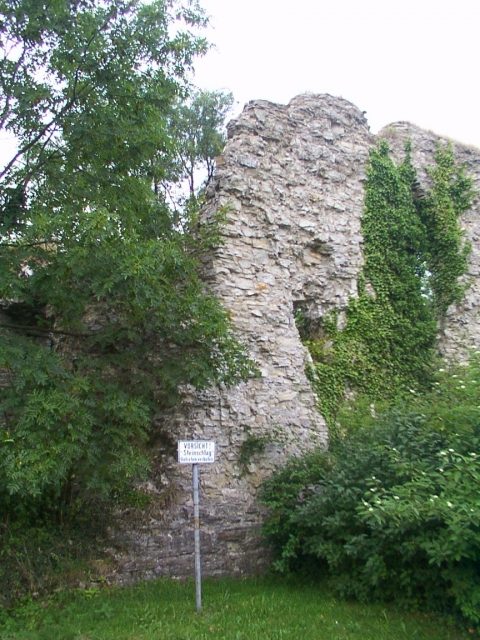
The castle ruin Kohlstädt, also known as Kleine Herrenburg, was presumably built between 1000 and 1200 AD in the Frankish-Norman style. Its location is in the southern Teutoburg Forest, more precisely in the Lippian village of Kohlstädt in the municipality of Schlangen near the banks of the Strothe stream.
The ruin is privately owned and may not be entered due to the risk of falling rocks.
The masonry technique and archaeological finds, especially the results of Nebelsiek's partial excavations from 1932, indicate that the castle was built around 1100. It was probably erected by the Counts of Schwalenberg, the protective vogts of Corvey Monastery. In 1365, the castle passed into the hands of the noble Lords of Lippe and offered them protection towards Paderborn. Since the Herrenburg was abandoned by its inhabitants already at the end of the 14th century and subsequently left to steady decay, only a ruin remains today.
Usage+
Over the centuries, there have always been various interpretations of the castle's use. On the one hand, very practical ones such as an iron smelter or lime kiln. On the other hand, also mythical ones such as a heathen church from pre-Christian times or the Tower of Veleda. In 1704, treasure hunters who promised themselves special success through superstitious ceremonies were punished. Today, it is known as a former customs and supply station that once protected and controlled the pass over the Kleine Egge with the crossing point at the Sennehellweg.
Construction+
As a visible remnant, the stable, almost 2.40m thick masonry stands out, in which originally 15 cm wide and 1 m high slits were left out for defensive purposes. These walls were built with a special technique, the so-called false herringbone pattern, and are still up to 12 m high. They form the remains of a square keep, which has an access on the first floor. The upper floors were reached by means of a spiral staircase. Furthermore, the foundations of an outbuilding connected to the side of the tower are still present. For reasons of better defense, the entire castle complex was once built on a hill (see Motte). This is hardly recognizable today.
Take Mobile History with you
You are reading this text for free. Premium adds what matters on the road: descriptions read aloud, sites found through your camera, whole regions taken offline.
- Every description, including the ~17,700 Premium sites
- Audio guide: have descriptions read to you on location
- AR finder: see sites through your camera, with distance and bearing
- Unlimited saved sites
14 days free, then from €2.99 a month. Cancel anytime.
Source: Wikipedia · Licence: CC BY-SA 4.0
This description draws on the facts documented in the linked Wikipedia article; Wikipedia content is licensed under CC BY-SA 4.0. Wording and editing: Mobile History.
Location: 51.8250, 8.8606