The remains of the Castle can be visited
RuinKönigsberg
Königsberg Castle (Ruin)
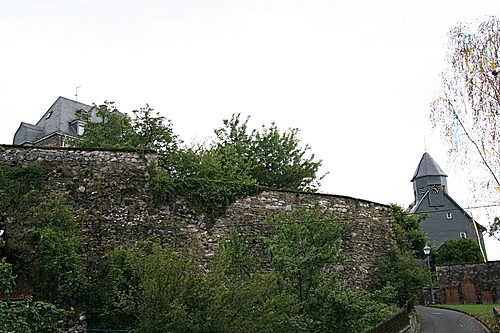
Königsberg Castle was built on a peak above the Königsberg district of the municipality of Biebertal in the Gießen district of Hesse in the mid to late 13th century by the Counts of Solms.
Presumably, the hilltop castle was built by Count Marquard von Solms (1225–55) to secure an old road and control the dominion. Around 1250, the county was divided into the territories of Solms-Königsberg (until 1363), Solms-Burgsolms (until 1416), and Solms-Braunfels. Soon after, presumably due to the distance from the more southern possessions, a separate line of the family formed, as Marquard's son, Count Reinbold von Solms (1255–73), called himself Count of Cunigesberg in 1257 (and again in 1266).
Due to the Hesse-friendly policy of this line, the relationship with the cousins from Braunfels and Burgsolms was always strained. Königsberg Castle increasingly lost its importance as a stronghold, so that between 1321 and 1323, Hohensolms Castle was built directly opposite Königsberg.
In 1331, Count Philipp von Solms opened his castles Solms and Königsberg to Archbishop Balduin of Trier, the administrator of the Mainz diocese. In 1350, Landgrave Heinrich II acquired the castle for 2000 guilders. The Landgrave was allowed to live in the castle until his death. With him, the Solms-Königsberg line died out in 1364. The castle itself was garrisoned with burgmannen and thus became the seat of a Hessian office.
The castle was pledged to the Counts of Solms again from 1468–1517.
In 1500, the settlement that had grown up next to the castle was first documented as a "city". During the Thirty Years' War (1647), the city and castle were burned down by Swedish troops. In 1820/27, the Königsberg office was abolished. After that, a chief forestry office was located in the "castle".
In 1840, the castle still consisted of an office building with an annex, an office barn, a tithe barn, a granary, and two pigsties. The city of Königsberg bought these buildings from the Prince of Braunfels and had them demolished in 1873/74 due to dilapidation. The stones from the demolition could be used by private individuals.
The site with all building remains was sold in 1922 by the Prince of Solms-Lich to the teacher Christian Haibach for 2000 Goldmark.
Teacher Hermann Tamschick planned the construction of a two-story, villa-like building, with the conservator at the Gießen building authority stipulating that a "castle-like" building be created. Thus, on the remaining high retaining walls, the cellar vaults, the section of the curtain wall with the remains of the round tower, and the foundation remains of the palas, a two-story residential building was erected, which is today referred to as "the castle".
Of the former hilltop castle, only the circular outer bailey and curtain wall, as well as an old defensive tower, remain.
Take Mobile History with you
You are reading this text for free. Premium adds what matters on the road: descriptions read aloud, sites found through your camera, whole regions taken offline.
- Every description, including the ~17,700 Premium sites
- Audio guide: have descriptions read to you on location
- AR finder: see sites through your camera, with distance and bearing
- Unlimited saved sites
14 days free, then from €2.99 a month. Cancel anytime.
Source: Wikipedia · Licence: CC BY-SA 4.0
This description draws on the facts documented in the linked Wikipedia article; Wikipedia content is licensed under CC BY-SA 4.0. Wording and editing: Mobile History.
Location: 50.6444, 8.5353