The remains of the Castle can be visited
RuinKönigsberg
Königsberg Castle (Ruin)
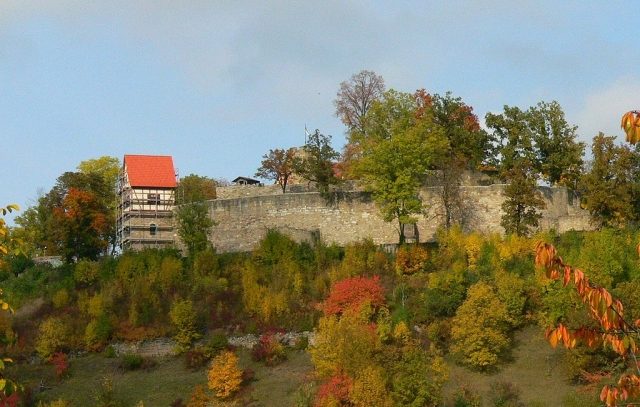
Königsberg Castle is the ruin of a former high medieval imperial castle above the town of Königsberg in Bavaria, located in the Lower Franconian district of Haßberge in Bavaria. The complex was fundamentally renovated and partially rebuilt at the end of the 20th century. The castle ruin, a spur castle, can be visited.
The castle ruin is located in the Franconian Haßberge Nature Park on the 355-meter-high Schlossberg (Castle Hill) in a spur position on the height referred to in a medieval document as "King's Vineyard," high to the east above the historic old town of Königsberg, about 7 kilometers northeast of the town of Hassfurt. Nearby are the Bramberg ruin and Bettenburg mountain castle.
Description+
The castle was connected to the town fortifications by flank walls. The southern wall section leading down to the Catholic Church of St. Josef is still clearly visible. Against the eastern plateau, an approximately eight-meter-deep, stone-lined neck ditch protects the castle. The ditch then continues around the entire curtain wall, only up to two meters deep.
The masonry of the oval curtain wall was extensively refaced and rebuilt. The stumps of the two gun rondels on the south side show more original substance. The tall tower with the half-timbered superstructure in the west is, apart from the base, a complete new construction from the last decades of the 20th century.
On the castle plateau, only a few wall remnants and the castle well remain of the former interior buildings. The well is equipped with a spotlight, so that one can see to the bottom. Today, it only carries water after very heavy rainfall. After its cleaning in the 1920s and 1930s, the well was measured and found to be 80 meters deep. Today, after some rubble has accumulated again, the number is likely to be lower. Remarkable are the relatively large diameter of the well and the precision of its execution. The castle restaurant and the small observation tower are additions from the 19th/20th centuries.
From today's perspective, the renovation of the significant castle ruin by the active castle association is viewed rather critically by scientific castle research. In the course of the expansion of the Haßberge Castle Trail, the neighboring castle ruins were partially archaeologically investigated according to the most modern scientific criteria and carefully renovated. Here, additions and historicizing extensions, which particularly characterize the appearance of Königsberg Castle today, were deliberately avoided.
Tourism+
The castle is easily accessible on foot and by car and has parking spaces and a restaurant with good home-style cooking. In good weather, visitors can enjoy a magnificent view down into the town and the Haßgau region. The observation tower and the castle well can be visited; the association only asks for a voluntary donation. Since the terrain is relatively easy to walk on, events have been taking place there more frequently in recent years. For example, the "Rose and Garden Fair" attracts hundreds of visitors to Königsberg once a year. As part of the "German Castle Corner," the ruins in the northern Haßberge district are to be upgraded for tourism. For Königsberg, it is planned to particularly highlight the impressive castle well.
Foundation and First Owners
After Bramberg Castle, also located in the Haßberge district, was previously razed by order of Emperor Frederick Barbarossa, this castle complex was built after 1168 on the "King's Vineyard."
The high medieval core castle became a fief of the Andechs-Meranians. In 1192, a "Bertoldus de Kunigesberc" first appears in documents. In 1227, Würzburg servants resided in the castle ("Ulrich and Friedrich de Bruege"), and from 1249, "Kynegesperch" Castle belonged to the possessions of Count Hermann I of Henneberg. Through Sophie, the daughter of Countess Jutta, the town and castle of Königsberg came to Burgrave Albrecht of Nuremberg in 1374. His daughter Anna brought these possessions into her marriage with Duke Swantibor of Pomerania, who sold them to the Bishop of Würzburg in 1394. The latter, in turn, sold them in 1400 to Balthasar of Thuringia, who assigned Königsberg to the Franconian territories. From then on, a princely bailiff or official resided in the castle.
Medieval Expansions
The core castle consisted of a Romanesque curtain wall, a keep moved close to this wall near the gate, various utility buildings, a heated chamber first mentioned in 1317, and probably a hall building. Cellar foundations of the latter two buildings still exist.
Towards the end of the 14th or beginning of the 15th century - perhaps during the Hussite Wars - a second, high curtain wall was built, creating outer bailey areas. The dry moat was partially surrounded by another wall as early as 1442, as an inscription once attested, but mostly only between 1498 and 1511. Until then, the moat had been secured by a fence.
An impressive deep castle well (approx. 60 m), still existing today, may also have been excavated in the 15th century. A treadwheel was used to draw water. During the Saxon Fratricidal War, Königsberg, as part of the Franconian territories, briefly belonged to Apel Vitzthum.
16th Century
Unlike many other castles, Königsberg was spared from the Peasants' War. Königsberg had been Protestant since 1523. At the beginning of the 16th century, the outer curtain wall was provided with 6 rondels for fortification reasons. Their upper floors were vaulted.
The "hohe Kemenate" (high heated chamber) was located on the site of today's restaurant. It was three stories high, with the two lowest made of stone and the upper one a half-timbered construction. On the second floor were the court parlor, an antechamber, and chambers. The half-timbered floor contained the ballroom in its entire length and width. Access to these rooms was provided by an octagonal stair tower, which was rebuilt as an observation tower in 1860 on the remains of the old tower.
The "alte Kemenate" (old heated chamber), on the other hand, was an approximately square medieval stone building that had only one upper floor. Today, an open-air stage stands there, which was primarily used for folkloric performances in the 1930s.
Behind the "alte Kemenate" was the castle kitchen. Subsequently, horse and cow stables were set up behind it. These buildings used the high medieval curtain wall as an outer wall; towards the inner courtyard, the stables were made of wood.
In 1547, during the Schmalkaldic War, Albrecht Alcibiades of Brandenburg-Kulmbach conquered Königsberg Castle and town. In 1549, he was enfeoffed with it but pledged it to Wilhelm von Grumbach. From him, the castle and town came to Elector Moritz in 1551, who sold them to Würzburg the following year.
The Würzburg officials built a new official's residence with an office and kitchen in the northwestern outer bailey. This building incorporated two rondels. In the eastern one, now called "Seckendorffturm," Friedrich Heinrich Reichsgraf von Seckendorff was born on July 5, 1673.
In 1569, Königsberg returned to Saxon possession. Subsequently, the castle complex fell into disrepair, so extensive reconstruction and renovation measures became necessary from 1595. For example, a square watchtower with a half-timbered upper floor was built in place of a dilapidated rondel.
17th Century: Expansion into a Small Palace
The beginning of the 17th century was primarily characterized by renovation and reconstruction measures. In 1611, the old heated chamber, which had been under construction since 1596, was demolished, and by 1614, a new, five-story building with an archive, chambers, and parlors was erected. In the chambers located there, the princely rulers subsequently resided when they visited Königsberg. Since 1613, an approximately 2 km long wooden pipe system supplied the "mountain castle" with running water.
From 1615 to 1621, at the initiative of Duchess Dorothea Maria of Saxe-Weimar, the old castle church and the dining hall were renovated. All interior rooms have disappeared after the demolition and decay of the complex. Only foundation remnants remain. The restaurant is now located on the site of the castle church.
On January 27, 1626, Duke Wilhelm IV of Saxe-Weimar, who had recently been released from captivity, celebrated communion for the first time since his release in this castle church built by his mother. In remembrance, he endowed a thanksgiving sermon and a castle festival. Even today, this event of the Thirty Years' War is commemorated as part of the so-called "Herzog-Wilhelm-Kettenfeier" (Duke Wilhelm Chain Celebration), though no longer at the castle, but in the Protestant community hall in the town.
During the Thirty Years' War, the castle was conquered several times, plundered, and parts of the interior were destroyed. Consequently, access to the castle was relocated. Previously, one reached the gate, which was located between the two inhabited rondels with the official's residence, via a bridge into the outer bailey area and from there finally into the castle courtyard.
From 1640, the bridge was located where it is today. The stone pillars with yokes were rebuilt in 1666. The gate was protected by a drawbridge. To the left of the gate, a triangular bastion protrudes into the moat. The building located there was initially a guardroom; later, the bathhouse was moved there from the castle core.
For pedestrians, there was another access in the west. From the "Upper Gate" of the town fortifications, one reached the "Black Gate," secured by a drawbridge, via a staircase. It was located next to the watchtower, approximately where a staircase now leads into the moat.
From 1653 to 1660, the "Röhrenbrunnen" (pipe well) made of tree trunks, destroyed in the war in 1634, was repaired. The upper floor of the stair tower received a striking clock in 1657.
During the 17th century, lightning struck the tall keep several times, so its upper stories were removed in 1664. On its ground floor was a silver chamber, and above it, prisons.
Sale and Decay
Already at the beginning of the 18th century, the princely rulers no longer resided in the castle during their visits, but in the town. In 1757, the official also moved out of his residence.
From 1764, materials from the severely dilapidated buildings were sold, for example, several loads of sandstone from which the buildings were constructed, as well as wood and bricks. The first roofs began to collapse. In 1773, the widow of the old watchman had to move out of the watchtower due to the risk of collapse. Both the keep and the watchtower were partially demolished manually by masons and their journeymen. Through auctions, the building materials came into the possession of the citizens of Königsberg. After 1780, the area served as a free quarry. In 1790, the last intact roof collapsed. By 1834, practically nothing remained of the former complex.
From then on, the "Schloßberg" was discovered as a romantic backdrop for walks and festivals. A Königsberg innkeeper operated a summer establishment with a bowling alley and target shooting on the premises.
In 1854, the state government (Saxe-Coburg and Gotha) sold the Schlossberg to the privateer and later mayor of Königsberg, Franz Ronge. He had arbors built on the site and erected an observation tower in 1860/61 on the remains of the former bell tower. It can be visited for a voluntary donation to the Schlossberg community.
20th Century
After Ronge's death (Franz Ronge, brother of Johannes Ronge), the Schlossberg belonged to the Sattler family. One of their workers rediscovered the castle well, which had been sealed with a stone slab in 1716 and then buried under rubble. It was opened, covered with a well house in the 1920s, and can now be visited for a voluntary donation to the association.
In 1904, the town of Königsberg finally bought the Schlossberg. However, it lacked the means to maintain the severely dilapidated walls. In 1921, a citizens' initiative, the "Schlossberggemeinde," was formed, which from then on took care of the preservation and reconstruction of the castle complex. This association uncovered the cellars in the 1920s and had parts of the still preserved wall sections in the castle courtyard renovated by the Coburg architect Oelenheinz, as well as a new well house built. The old bridge pillars from 1666 were also renewed, and a new wooden bridge was built. On the cellar vault that formerly supported the castle church, a wooden hall was built in the 1930s, also according to the plans of Prof. Oelenheinz ("Heim der Hitlerjugend"). In place of the war-damaged building, a restaurant was built in 1949/50, which is now owned by the town of Königsberg and leased out.
The "Schloßberggemeinde Königsberg e.V." is a registered, non-profit association and is still active today. It primarily takes care of the maintenance of the old building fabric and keeping the sightlines clear. The Schlossberggemeinde is financed exclusively by donations, membership fees, and income from association festivals. All members work voluntarily.
Owners at a Glance
- approx. 1180 - 1208: Dukes of Andechs-Merania
- 1227 - 1234: Diocese of Würzburg
- 1234 - 1249: Diocese of Bamberg
- 1249 - 1353: Counts of Henneberg
- 1353 - 1374: Burgrave Albrecht of Nuremberg
- 1374 - 1394: Duke Swantibor of Pomerania
- 1394 - 1400: Diocese of Würzburg
- 1400 - 1440: Balthasar of Thuringia, Frederick the Simple
- 1445 - 1447: Duke Wilhelm III
- 1447 - 1451: Apel Vitzthum
- from 1485: Ernestines
- 1542 - 1547: Duke Johann Ernst of Saxe-Coburg
- 1547 - 1551: Margrave Alcibiades of Brandenburg-Kulmbach, then Wilhelm von Grumbach
- 1551 - 1552: Elector Moritz of Saxony
- 1552 - 1569: Diocese of Würzburg
- 1569 - 1634: Duchy of Saxe-Weimar
- 1634 - 1675: Duchy of Saxe-Gotha
- 1675 - 1683: Duchy of Saxe-Römhild
- 1683 - 1826: Duchy of Saxe-Hildburghausen
- 1826 - 1854: Duchy of Saxe-Coburg-Gotha
- 1854 - 1904: Franz Ronge and heirs
- 1904 - today: Town of Königsberg i. Bay.
Take Mobile History with you
You are reading this text for free. Premium adds what matters on the road: descriptions read aloud, sites found through your camera, whole regions taken offline.
- Every description, including the ~17,700 Premium sites
- Audio guide: have descriptions read to you on location
- AR finder: see sites through your camera, with distance and bearing
- Unlimited saved sites
14 days free, then from €2.99 a month. Cancel anytime.
Source: Wikipedia · Licence: CC BY-SA 4.0
This description draws on the facts documented in the linked Wikipedia article; Wikipedia content is licensed under CC BY-SA 4.0. Wording and editing: Mobile History.
Location: 50.0799, 10.5743