The remains of the Castle can be visited
RuinMünchhausen
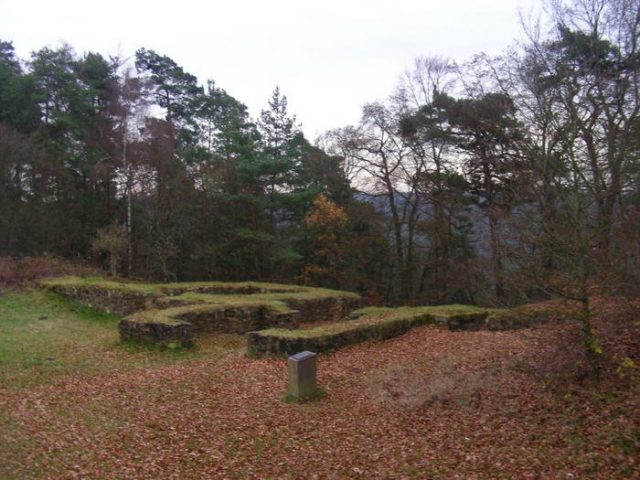
Kesterburg Castle (Ruin) (Münchhausen)
The Historic Building: A Journey Through Time+
From Roman Origins to Medieval Fortress+
The history of the building, often referred to as "Schloss Wartenstein," dates back much further than its current appearance suggests. Archaeological findings indicate that the site was already settled in Roman times. A Roman watchtower likely stood here, strategically positioned to monitor the trade routes along the river.
With the decline of the Roman Empire, the site's importance diminished for a time. However, in the early Middle Ages, the strategic location once again attracted attention. It is believed that a first fortification, possibly a wooden motte-and-bailey castle, was erected here in the 9th or 10th century by local nobility.
The High Middle Ages: Expansion and Power+
The 11th and 12th centuries marked a period of significant expansion for the castle. Under the rule of the powerful Counts of Wartenstein, the wooden structures were gradually replaced by stone. A massive keep, curtain walls, and several residential buildings were constructed, transforming the site into a formidable fortress.
Schloss Wartenstein became the administrative and economic center of the region. The Counts of Wartenstein exercised considerable influence, controlling vast lands and collecting tolls from passing merchants. Their power was reflected in the castle's architecture, which showcased the latest in defensive and residential building techniques.
The Late Middle Ages and Early Modern Period: Decline and Transformation+
The 14th and 15th centuries brought new challenges. Feuds with neighboring lords, changing warfare tactics, and economic shifts gradually eroded the power of the Counts of Wartenstein. The castle suffered damage during various conflicts and was partially rebuilt and adapted to new defensive needs.
By the 16th century, the castle had lost much of its strategic importance. The rise of gunpowder artillery rendered many medieval fortifications obsolete. The Wartenstein family, facing financial difficulties, began to neglect the castle. Parts of it fell into disrepair, and some sections were even dismantled for building materials.
From Ruin to Romantic Residence: The 19th Century Revival+
The 19th century witnessed a renewed interest in medieval castles, fueled by Romanticism. Schloss Wartenstein, by then largely a ruin, caught the eye of wealthy industrialist Johann von Wartenstein (a distant relative of the original counts). He acquired the property in 1850 with the vision of restoring it to its former glory.
Under his patronage, extensive reconstruction work began. While some efforts aimed at historical accuracy, many additions reflected the Romantic ideal of a medieval castle rather than strict historical fact. Towers were heightened, battlements added, and interiors lavishly decorated, transforming the ruin into a picturesque residence.
The 20th Century and Beyond: Public Access and Preservation+
In the early 20th century, Schloss Wartenstein passed into the hands of the state. It was opened to the public, allowing visitors to explore its rich history and admire its unique architecture. Throughout the century, various preservation efforts were undertaken to maintain the building's structural integrity and protect its historical substance.
Today, Schloss Wartenstein stands as a testament to centuries of history. It serves as a museum, hosting exhibitions and cultural events, and remains a popular destination for tourists and history enthusiasts alike. Ongoing research and conservation projects ensure that this magnificent building will continue to tell its story for generations to come.
Key Dates in the History of Schloss Wartenstein:
- Roman Times: Probable site of a Roman watchtower.
- 9th/10th Century: First medieval fortification (likely wooden).
- 11th/12th Century: Construction of stone castle under the Counts of Wartenstein.
- 14th/15th Century: Decline of the Counts, damage and partial rebuilding of the castle.
- 16th Century: Castle loses strategic importance, falls into disrepair.
- 1850: Acquired by Johann von Wartenstein, extensive Romantic-era reconstruction begins.
- Early 20th Century: Castle becomes state property and is opened to the public.
Take Mobile History with you
You are reading this text for free. Premium adds what matters on the road: descriptions read aloud, sites found through your camera, whole regions taken offline.
- Every description, including the ~17,700 Premium sites
- Audio guide: have descriptions read to you on location
- AR finder: see sites through your camera, with distance and bearing
- Unlimited saved sites
14 days free, then from €2.99 a month. Cancel anytime.
Source: Wikipedia · Licence: CC BY-SA 4.0
This description draws on the facts documented in the linked Wikipedia article; Wikipedia content is licensed under CC BY-SA 4.0. Wording and editing: Mobile History.
Location: 50.9536, 8.7494