The remains of the Castle can be visited
RuinBuchheim
Kallenberg Castle (Ruin)
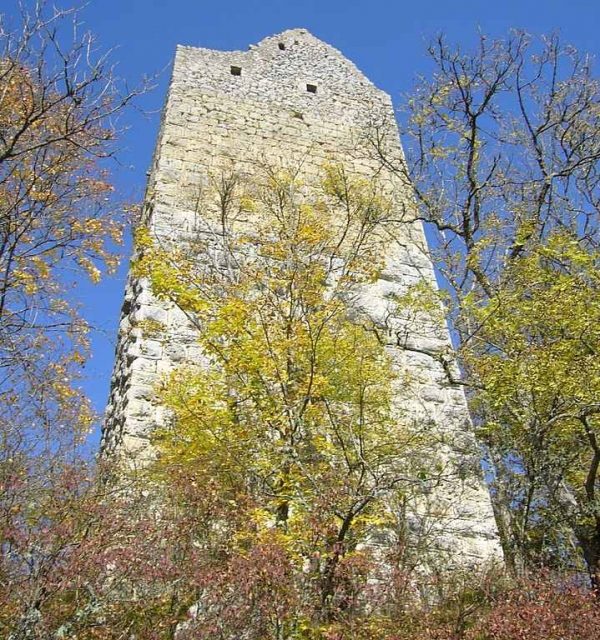
The Kallenberg castle ruin is a high medieval ruin in the Upper Danube Nature Park between Fridingen and Beuron in the municipality of Buchheim in the district of Tuttlingen in Baden-Württemberg (Germany). It is, alongside Falkenstein, the most significant ruin in the Danube Valley.
The freely accessible ruin is located at around 776 m a.s.l. as a hilltop castle on a steep hill above the Danube. Below the keep is the Kallenberg Cave with a cave castle. From the ruin, there is a good view over the Danube breakthrough valley to Bronnen Castle.
The castle was probably built around 1200 and first named after the noble family of Kallenberg in 1225. Kallenberg was mentioned in 1334 as property of the Counts of Hohenberg. In 1381, the castle was sold to the House of Habsburg. Subsequently, there were numerous pledge owners: among others, von Kallenberg, the Truchsessen von Waldburg (1401-1695), Ulm-Erbach (since 1702 pledge and enfeoffed property). From around 1800, the castle slowly began to decay. In 1907, the ruin came into the possession of Baron von Ow-Wachendorf. Since 1974, it has been owned by the district of Tuttlingen.
The former Kallenberg dominion included not only the castle but also the villages of Gründelbuch, Nusplingen, Obernheim, Dormettingen, Bronnhaupten, and Erlaheim.
Architectural Description+
The well-preserved keep, built from carefully hewn bossage ashlar (in the lower half), has a square floor plan with sides of approximately 8 meters and a height of 20 meters. It features a high entrance with a three-part lintel. Below the worn plinth block, which serves as the threshold, there are beam holes for the suspension of the former entrance platform.
Kallenberg Cave+
Approximately 100 meters east of the castle complex is a cave castle belonging to the ensemble. In front of the cave entrance, there are still remnants of the entrance portal's walls. The castle and cave were used simultaneously and should be considered a single unit. While findings at the castle suggest a construction period around the year 1200, discoveries from the Celtic period have been made in the cave.
Take Mobile History with you
You are reading this text for free. Premium adds what matters on the road: descriptions read aloud, sites found through your camera, whole regions taken offline.
- Every description, including the ~17,700 Premium sites
- Audio guide: have descriptions read to you on location
- AR finder: see sites through your camera, with distance and bearing
- Unlimited saved sites
14 days free, then from €2.99 a month. Cancel anytime.
Source: Wikipedia · Licence: CC BY-SA 4.0
This description draws on the facts documented in the linked Wikipedia article; Wikipedia content is licensed under CC BY-SA 4.0. Wording and editing: Mobile History.
Location: 48.0091, 8.9486