The remains of the Castle can be visited
RuinThalitter
Itterburgen Castle (Ruin) (Thalitter)
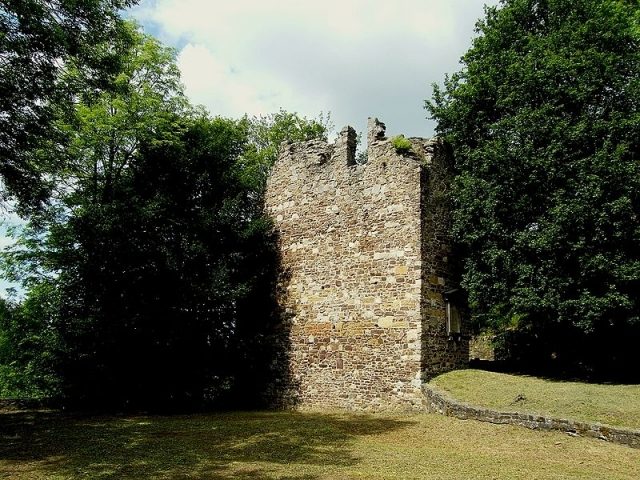
The Itterburg, also known as Löwensteiner Burgsitz, is a freely accessible castle ruin on an elongated mountain ridge north above the district of Thalitter in the Hessian municipality of Vöhl on the Edersee in the district of Waldeck-Frankenberg. The occasionally mentioned name Steuerburg refers only to the small outer bailey.
In 793, the "Haupthof Ittera" in the Ittergau was first mentioned in a document. The Lords of Itter probably built the Itterburg at the same location in the 11th century. This Itterburg was first mentioned in a document in 1126, when the sisters Rilind and Frederun von Itter, nieces and heiresses of Folkmar von Itter, who died in 1123, enfeoffed the allodial parts of the Lordship of Itter inherited from him to the Abbot of Corvey. Around 1190, Archbishop Philipp I acquired the castle with 200 hides from Wittekind II von Schwalenberg for 200 marks for the Archdiocese of Cologne. The last Lord of Itter living here, Heinemann III. († 1356), is said to have been stabbed here by one of his relatives - which, although claimed by old historians, is not documented and is not substantiated by subsequent events.
At this time, the Lordship of Itter included the following places: Dorfitter, Thalitter, Obernburg, Hof Lauterbach, Oberwerba, Vöhl, Basdorf, Asel, Marienhagen, Herzhausen, Harbshausen, Kirchlotheim, Schmittlotheim, Altenlotheim, Ederbringhausen, Niederorke, Oberorke and Buchenberg.
After the death of Heinemann III, the Archdiocese of Mainz and the Landgraviate of Hesse jointly took possession of his, by far the larger, part of the Lordship of Itter in 1357 and each paid his widow Margarethe 900 marks of pure silver for it. In 1359, Mainz pledged its half of the lordship to Count Otto II of Waldeck, who further pledged it to Thile Wolff von Gudenberg in 1381. In 1383, the Hessian Landgraves also pledged their half to Thile, whereby the castle and almost the entire Lordship of Itter came into his pledge possession. Thile then moved his residence to Vöhl, where he had a castle built south of the village. In 1542, the Waldeckers redeemed their pledge, and in 1562, finally, the Landgraves of Hesse also redeemed theirs.
Itter Castle fell into disrepair from the middle of the 15th century and was completely destroyed in the Thirty Years' War. In 1815, Prince Gustav of Sweden, living in Switzerland, bought the ruin and now called himself Count of Itterburg. From 1820, extensive excavations were carried out and the remaining building fabric was uncovered. In 1951, the municipality of Vöhl bought the castle grounds for 18,000 DM.
Layout+
The Itterburg was a castellan castle with a square floor plan within an oval outer bailey. The presumed keep had a base area of 11 x 11 meters and a wall thickness of 2 meters. The total area is about 8 hectares.
Take Mobile History with you
You are reading this text for free. Premium adds what matters on the road: descriptions read aloud, sites found through your camera, whole regions taken offline.
- Every description, including the ~17,700 Premium sites
- Audio guide: have descriptions read to you on location
- AR finder: see sites through your camera, with distance and bearing
- Unlimited saved sites
14 days free, then from €2.99 a month. Cancel anytime.
Source: Wikipedia · Licence: CC BY-SA 4.0
This description draws on the facts documented in the linked Wikipedia article; Wikipedia content is licensed under CC BY-SA 4.0. Wording and editing: Mobile History.
Location: 51.2214, 8.8957