The remains of the Castle can be visited
RuinHopfen
Hopfen Castle (Ruin)
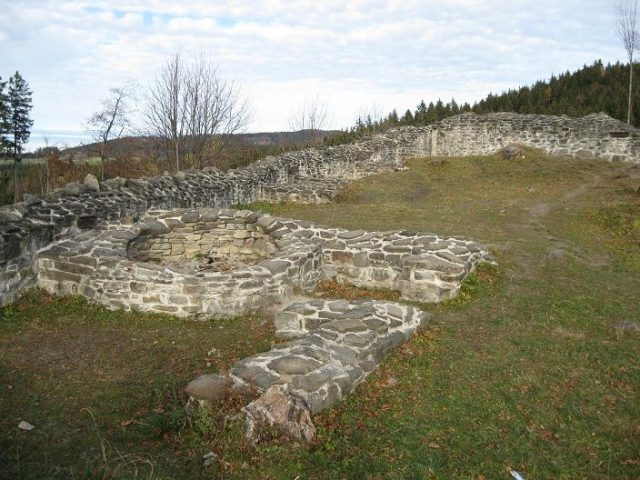
The ruin of Hopfen Castle is located on a hill above the Füssen district of Hopfen am See in the Ostallgäu district in Bavarian Swabia. Some wall remains of the high medieval castle complex have been preserved.
The origins of Hopfen Castle are unclear. It may be identical to the "fortified castle" where the Augsburg anti-bishop Wigolt retreated in 1078 during the Investiture Controversy.
From 1172 to 1191, a Welf ministerialis family, who named themselves after the castle, resided in the fortress. Subsequently, the complex passed to the Prince-Bishopric of Augsburg and served as the official residence of the Füssen provost until 1322.
Due to the new construction of the Hohes Schloss in Füssen, the castle seems to have become dispensable and began to decay.
At the beginning of the 18th century, the ruin was exploited as a quarry for the reconstruction of the Füssen monastery of St. Mang.
In 1999, the city of Füssen began the careful renovation of the castle remains under the expert guidance of a medieval archaeologist. The conservation measures will continue in the coming years.
Description+
In the course of the renovation measures, the meter-thick layers of rubble over the castle grounds were cleared away and the exposed masonry was conserved. The wall remains are still preserved up to three meters high. For structural reasons, some wall breaches had to be supplemented.
The layout of the castle complex is now clearly recognizable again. The slightly elevated core castle with its tower-like main building (residential tower) and a chapel was fronted to the east by a large forecourt. In the northeast, two section ditches and an outer bailey protected the fortress, which was secured on the other sides by steep drops.
Hopfen Castle, as the earliest stone castle in the Allgäu, is of particular importance for castle research. The simple ring wall is not yet fortified by towers or bastions.
Today, however, the renovated castle ruin is mainly visited for the view of the Ammergau Alps and the Tannheim Mountains. It has also been included in a cross-border marketing concept that aims to utilize the wealth of castles in the Ostallgäu-Ausserfern region for tourism.
Take Mobile History with you
You are reading this text for free. Premium adds what matters on the road: descriptions read aloud, sites found through your camera, whole regions taken offline.
- Every description, including the ~17,700 Premium sites
- Audio guide: have descriptions read to you on location
- AR finder: see sites through your camera, with distance and bearing
- Unlimited saved sites
14 days free, then from €2.99 a month. Cancel anytime.
Source: Wikipedia · Licence: CC BY-SA 4.0
This description draws on the facts documented in the linked Wikipedia article; Wikipedia content is licensed under CC BY-SA 4.0. Wording and editing: Mobile History.
Location: 47.6105, 10.6714