The remains of the Castle can be visited
RuinObermässing
Hofberg Castle (Ruin)
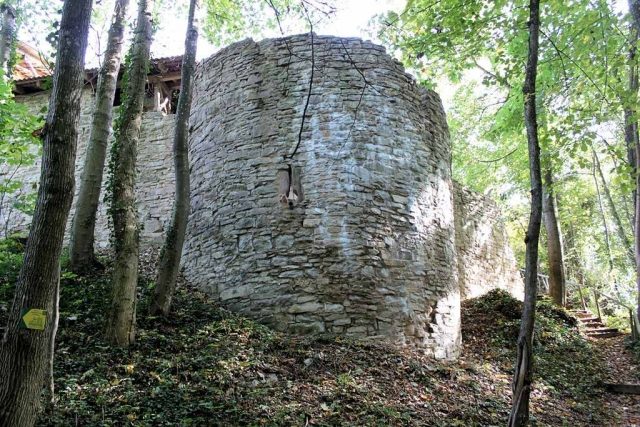
The castle ruin Hofberg, also called Hofburg, Hofberg Castle, or Obermässing Castle Ruin, is a castle ruin on the slope of the "Hofberg" above the Schwarzach valley near the district of Obermässing in the town of Greding in the Middle Franconian district of Roth in Bavaria.
The hillside castle was built at the beginning of the 13th century by the Lords of Mässingen, first mentioned in 1068, who were ministeriales of the Counts of Hirschberg, and was first mentioned in 1281. The castle served as an administrative seat and protected the trade route passing through the Schwarzach valley.
Berthold von Mässingen, who remained childless, bequeathed the castle and the village of Obermässing to the Teutonic Order in 1285, which established a commandery here belonging to the Bailiwick of Franconia. In 1465, Prince-Bishop Wilhelm von Reichenau acquired the castle for the Prince-Bishopric of Eichstätt, established his summer residence here, a bailiwick in Obermässing, and had the castle's fortifications strengthened in 1490 with a new curtain wall and 5 corner towers.
During the German Peasants' War in 1525, the "Mässinger Haufe" occupied the castle and plundered it without destruction. In 1670, the castle was converted into a residential palace by Prince-Bishop Marquard, and after the secularization of 1803, the palace came into private ownership, was demolished, and used as a quarry. Around 2000, renovation work began by the Association for Culture and Local History Greding e. V.
Construction History and Layout+
The castle complex featured an outer bailey with rural farm buildings and a gate tower dating to the 15th century. The core castle with a large palas made of ashlar masonry, a castle chapel (St. George's Chapel), and presumably a keep, was protected by steep slopes, a neck ditch, an inner zwinger system, a curtain wall, a gatehouse, and a drawbridge. The curtain wall was reinforced in 1490 and equipped with five round semi-open corner towers, which had loopholes for arquebuses.
The late medieval second ring wall with the corner towers is still well preserved. The remains of the high medieval palas and the 15th-century gate tower are now heavily overgrown.
Take Mobile History with you
You are reading this text for free. Premium adds what matters on the road: descriptions read aloud, sites found through your camera, whole regions taken offline.
- Every description, including the ~17,700 Premium sites
- Audio guide: have descriptions read to you on location
- AR finder: see sites through your camera, with distance and bearing
- Unlimited saved sites
14 days free, then from €2.99 a month. Cancel anytime.
Source: Wikipedia · Licence: CC BY-SA 4.0
This description draws on the facts documented in the linked Wikipedia article; Wikipedia content is licensed under CC BY-SA 4.0. Wording and editing: Mobile History.
Location: 49.1167, 11.3017