The Ruin can be vistited
RuinHürnheim
Hochhaus Castle (Ruin)
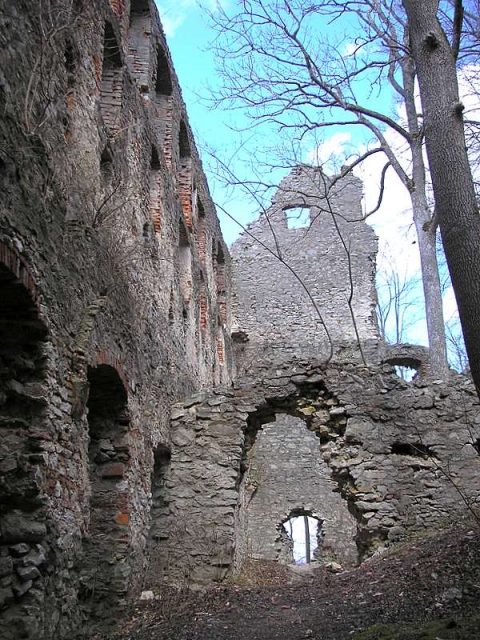
Hochhaus Castle is the ruin of an originally High Medieval hilltop castle above the Kartäustal valley, on the edge of the Ries crater near Hohenaltheim in Swabia (Donau-Ries district). The highly endangered castle ruin is located within a large older rampart system, about one kilometer from the neighboring Niederhaus Castle.
The castle was probably built around 1200 as the ancestral seat of a collateral line of the noble family of Hürnheim, who subsequently named themselves after the castle (de alta domo, meaning to or from the high house). In 1236, Rudolf I von Hochhaus is mentioned as a witness to a document.
In 1347, the complex was sold by Konrad II for 3000 pounds to the Counts of Oettingen-Oettingen. The last of the Lords of Hochhaus died in 1353 without heirs, which was likely a reason for the sale of the castle. The Counts used the castle as an administrative seat, which was modernized and militarily reinforced in the 15th and 16th centuries.
In 1719, the old castle complex was finally converted into a palace, but the fortifications and the old palas largely remained. This palace building burned down in 1749, and reconstruction was omitted.
Between 1787 and 1792, the journalist and enlightener Wilhelm Ludwig Wekhrlin was imprisoned at Hochhaus. While in custody, he wrote articles for his political magazines Das graue Ungeheur, Hyperboreische Briefe, and Paragrafen.
The old palas continued to be used as an administrative building by the Oettingen-Wallerstein line until 1807 and was then also left to decay. This decay was intentionally accelerated for romantic reasons; the castle ruin was intended – like the neighboring Niederhaus Castle – to serve as picturesque landscape scenery in the Karthäustal valley. Nevertheless, the ruin apparently remained inhabited for a longer period: In 1839, the city council of Nördlingen granted Helene le Bret from Hochhaus, a court councilor, permission to move to the city.
In the 1960s, the counterscarp of the neck ditch was secured (already partially collapsed again), but no other preservation measures on the building fabric are discernible.
Description+
The Hochhauser Berg is fortified by extensive section fortifications of various periods. Approximately 300 meters in front of the neck ditch of the actual castle, the plateau is sealed off from the hinterland by an approximately 200-meter-long rampart and ditch, with another ditch system in between. The middle ditch partially extends down the slope; possibly the outer bailey of Hochhaus was behind this ditch, but no structural remains or traces of terrain have been preserved.
The outer wall (counterscarp) of the neck ditch is partly bricked, behind it rise the few remains of the baroque, four-winged palace building above the old curtain wall.
The ground plan of the main castle is an irregular quadrangle of approximately 60 x 70 meters in circumference. West of the meager palace remains lies the three-story preserved old palas (danger of collapse) with its large window openings. To the south adjoins the gate zwinger, where the remains of a flanking tower are still found; the main gate has disappeared.
The best-preserved part of the former palace building is the slender, southwestern corner tower, in front of which is a low, elongated gun tower.
Two preserved oil paintings (around 1750/60), now kept at Harburg Castle, give a good impression of the castle and palace complex before its decay. One shows the complex from the northwest, the other the southwest view. According to these paintings, the main building of the palace had a half-timbered upper floor with a stone or plastered turret, and the lower side wings were crowned by small ogee gables. The slender corner tower reached the roof ridge of the main building.
Due to the acute danger of collapse, entering the complex is not recommended, but essential structural components can be viewed from the outside.
Take Mobile History with you
You are reading this text for free. Premium adds what matters on the road: descriptions read aloud, sites found through your camera, whole regions taken offline.
- Every description, including the ~17,700 Premium sites
- Audio guide: have descriptions read to you on location
- AR finder: see sites through your camera, with distance and bearing
- Unlimited saved sites
14 days free, then from €2.99 a month. Cancel anytime.
Source: Wikipedia · Licence: CC BY-SA 4.0
This description draws on the facts documented in the linked Wikipedia article; Wikipedia content is licensed under CC BY-SA 4.0. Wording and editing: Mobile History.
Location: 48.7872, 10.4870