The remains of the Castle can be visited
RuinHerrenzimmern
Herrenzimmern Castle (Ruin)
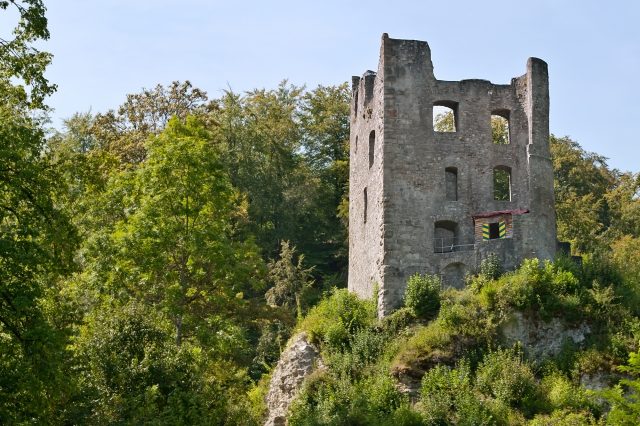
Herrenzimmern Castle, also known as the Lower Castle, was a castle of the Barons, later Counts of Zimmern. The ruins of the spur castle are located in the Herrenzimmern district of the municipality of Bösingen in the Rottweil district.
Within sight of the castle, east-south-east, about 500 meters as the crow flies, above Talhausen, lies a castle site called Nussburg, which could represent the remains of a predecessor castle. This is probably identical with the Lusburg described in the Zimmerische Chronik, page 20.
According to the Zimmerische Chronik, there were already an upper castle and a lower castle in Herrenzimmern in the second half of the 11th century.
At the time of the Werdenberg Feud, the castle was owned by Gottfried Freiherr von Zimmern († May 10, 1508) and thus remained in family possession. In 1501, he transferred it to his bastard son Heinrich, who was declared legitimate and noble at the Imperial Diet in Augsburg in 1500. Heinrich henceforth called himself von Zimmern.
It burned down in 1504, when, as the Zimmerische Chronik notes elsewhere, Heinrich was careless with fire while bathing. It was rebuilt by Heinrich von Zimmern, who initially managed to expand his fortune by utilizing the vogteien (bailiwicks) transferred to him by his father.
In 1508, Heinrich von Zimmern's seat at Herrenzimmern was confirmed in a contract concluded in Rottweil between Gottfried von Zimmern's nephews and heirs. Soon, however, he fell so deeply into debt that he had to cede Herrenzimmern to Wilhelm Werner von Zimmern (1485-1575).
Wilhelm Werner further expanded the castle. Here was the extensive library and cabinet of curiosities that he had collected. His nephew Count Froben Christoph von Zimmern (1519-1566), who resided in Meßkirch, was able to find extensive source material for his Zimmerische Chronik here through detailed discussions and research.
The Zimmern family died out with the last male descendant, Count Wilhelm (1549-1594), Froben Christoph's son. Count Wilhelm sold the cabinet of curiosities to Ferdinand II (Tyrol), although Wilhelm Werner had stipulated in his will that it should be unsaleable. Today it forms one of the cornerstones of the Ambras Collection, although it is no longer identified as such there.
His eight sisters sold the castle to the city of Rottweil on May 10, 1594.
However, by then it had already become obsolete as a fortress. Due to its location, it is situated on a spur extending into the valley, but which is overlooked by both sides of the valley, it would not have been able to withstand artillery fire from above. Useless and stripped of its art treasures, it was spared in all wars and fell into general decay.
From 1805 it served as an inn and was reacquired by the municipality of Herrenzimmern in 1810 for 1,700 guilders.
Layout+
The Herrenzimmern History and Culture Association e.V., together with the State Office for Monument Preservation Baden-Württemberg, is working to preserve the ruin.
The main building of the original spur castle consisted of a substructure with brick outer walls and timbered floors, and a cantilevered half-timbered house built on top of it. A type of construction that can still be seen today at Topplerschlösschen, near Rothenburg ob der Tauber, or at Zollernschloss Balingen.
The Zimmerische Chronik describes this and also points out the danger inherent in such a construction:
The large stone structure of the castle had a wooden house on top of it, built into the framework and projecting several feet on all sides, as was customary in ancient times. However, in this warlike structure there was no vault, but only wooden platforms, several of them one above the other, and one could go up and down from one floor to another by wooden stairs. But upstairs in the framework, above the structure, there was the actual dwelling together with the kitchen. This floor was either covered with tiles for fire protection, or, as in the kitchen, covered with a clay screed. But when the unmarried Zimmerer, Junker Heinrich, lost his first wife from Heckelbach, he had such a dissolute household at Zimmern that the screed in the kitchen was damaged by half a hand's breadth. This could have been repaired with a little clay, but it was left for so long that in the aforementioned year some coals fell from the hearth there, which ignited the house from below. Heinrich was not at home at the time, but had provided the household with servants and dissolute, disobedient children. And so it happened; the castle burned down completely from below, so that nothing escaped but the people who were on it, everything else burned in it, many old letters, registers, speeches and other things that were of great importance to the Zimmern family and name, beautiful old armaments of shields, weapons, tournament equipment also perished. (Zimmerische Chronik, Volume 2, page 28 f.)
Take Mobile History with you
You are reading this text for free. Premium adds what matters on the road: descriptions read aloud, sites found through your camera, whole regions taken offline.
- Every description, including the ~17,700 Premium sites
- Audio guide: have descriptions read to you on location
- AR finder: see sites through your camera, with distance and bearing
- Unlimited saved sites
14 days free, then from €2.99 a month. Cancel anytime.
Source: Wikipedia · Licence: CC BY-SA 4.0
This description draws on the facts documented in the linked Wikipedia article; Wikipedia content is licensed under CC BY-SA 4.0. Wording and editing: Mobile History.
Location: 48.2239, 8.5878