The remains of the Castle can be visited
RuinHerrenbröl
Herrenbröl Castle (Ruin)
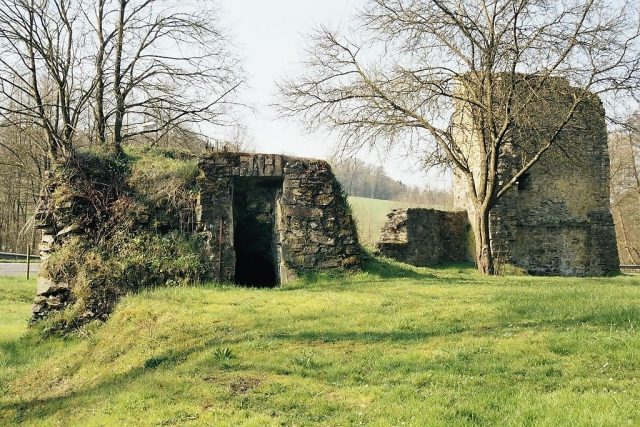
The castle ruin Herrenbröl is a small castle ruin in North Rhine-Westphalia. It belongs to the municipality of Ruppichteroth and is located in the Rhein-Sieg district in the Bergisches Land. The lowland castle lies in the valley of the Waldbrölbach at an altitude of just over 150 meters above sea level between the districts of Ruppichteroth and Schönenberg, north of the Nutscheid ridge.
The history of the castle is largely obscure. The complex was probably built as a knight's seat as early as the 13th century. Few remains from this period, such as the castle well, still exist.
The castle is first mentioned in a document on October 8, 1417, in connection with estates and rights in the parish of Eitorf. In the 15th century, the tower and other parts of the castle complex were probably built by the Lords of Scheidt.
Lords of Martial
In the mid-18th century, the castle came into the possession of Baron Carl Georg von Martial zu Birlinghoven, the grandson of Field Marshal and Adjutant General to Elector Palatine Johann Wilhelm, Maximilian Carl von Martial zu Veynau, through the marriage of Imperial Baroness Maria Caroline von Neukirchen, née Nievenheim. The inheritance of Franz Ferdinand Clemens von Martial (* October 6, 1780 Birlinghoven, † May 14, 1831 Herrenbröl) was half of Herrenbröl. Eight weeks after the death of his first wife Anna Catharina, née Stahl, he married Anna Gertrud Happ, with whom he had a daughter, Johanna Magdalena. After his death, both inherited half of his estate. When the daughter died at the age of eight, the widow received three shares of the daughter's inheritance, the other 9 shares went to the still living children of the deceased brother-in-law Franz Adolph von Martial. The entire estate, including the residential building, outbuildings, and 40 acres of land, was sold on May 2, 1833, to Carl Hundhausen from Ruppichteroth-Oeleroth for 750 Taler. Of this, 510 Taler went directly to creditors, and the notary expressed concerns because the shares of two underage children were also sold. Instead of cash, the widow conditionally received the property of Wilhelm Heimann in Ruppichteroth-Kammerich, so that the partial ownership of Herrenbröl Castle became immediately free. She handed over this property on November 30, 1837, along with her remaining assets, to her brother-in-law Anton Hemmerle, who was to care for her. On November 23, 1833, Hundhausen resold the property to the farmer Conrad Becker from Breitscheidt for 1,070 Taler. Conrad Becker's children sold their shares of the inheritance, as did the children of Franz Adolph von Martial, who had each inherited only 10 Taler and were also indebted from the start. When one of the children, the seamstress Gertrud von Martial, came of age, she obtained legal aid through poverty law and persistently sued for damages for the forced sale, arguing that the buildings would have been worth more and that there was limestone worth 3,000 Taler on the property that could be quarried. A settlement was reached between Carl Hundhausen and Gertrud von Martial, who sold her recovered share for 30 Taler to her brother Josef von Martial, who also could not hold the property due to the general decline of the lower nobility.
Complex+
Sacred
A small chapel once stood on the castle grounds, where the last wedding of a Martial was celebrated in 1796. Furthermore, the Lords of Herrenbröl held the patronage over the collegiate church in Schönenberg until 1826.
Municipal Property
In 1994, the municipality of Ruppichteroth acquired parts of the site with the castle ruin and had the house, built by Carl Georg von Martial or his sons at the beginning of the 19th century, which stood on the cellar of the former, destroyed manor house of the castle, demolished.
Monument Preservation
The Office for Soil and Monument Preservation of the State of NRW then began excavations on the castle grounds and measured the old complex.
It was found that the castle was much larger than assumed and that remains would probably also be found on neighboring properties not owned by the city. It is also certain that there was a moat on the south side, which still existed as a pond in the mid-19th century.
The castle was never of political or strategic importance and was destroyed by the French at the latest during the occupation of the Rhineland around 1807.
Today, the still approximately seven-meter-high remains of a castle tower are the dominant feature of the castle. In addition, only rather modest ruins of the castle buildings, an approximately 23-meter-long enclosing wall, and a vaulted cellar built of quarry stone, as well as some wall foundations, have been preserved. The ruin, located in a valley bottom, is generally freely accessible at all times and is a protected monument.
Take Mobile History with you
You are reading this text for free. Premium adds what matters on the road: descriptions read aloud, sites found through your camera, whole regions taken offline.
- Every description, including the ~17,700 Premium sites
- Audio guide: have descriptions read to you on location
- AR finder: see sites through your camera, with distance and bearing
- Unlimited saved sites
14 days free, then from €2.99 a month. Cancel anytime.
Source: Wikipedia · Licence: CC BY-SA 4.0
This description draws on the facts documented in the linked Wikipedia article; Wikipedia content is licensed under CC BY-SA 4.0. Wording and editing: Mobile History.
Location: 50.8379, 7.4508