The remains of the Castle can be visited
RuinLengenfeld
Helfenberg Castle (Ruin)
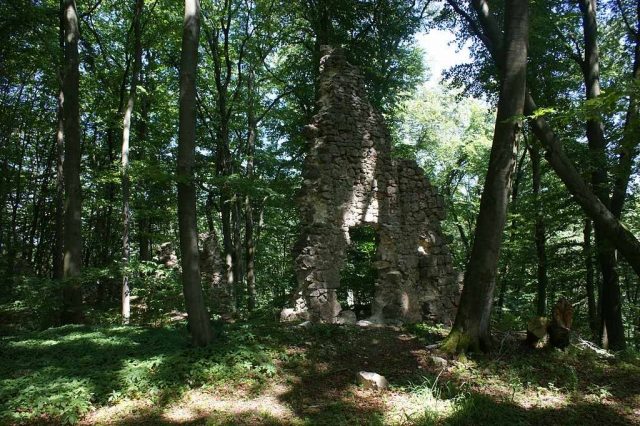
The castle ruin Helfenberg (also referred to as Helfenburg) is located near Velburg in the Upper Palatinate. The ruin of the hilltop castle stands on the Helfenberg, a 613-meter-high mountain in the Upper Palatinate Jura, east of the Velburg district of Lengenfeld, directly on the Bundesautobahn 3. A parking lot with a map board is located on the connecting road between Lengenfeld and Velburg. From there, the publicly accessible ruin can be reached in approximately 15–20 minutes.
Bronze Age burial sites around the mountain suggest that a fortified ring wall already existed on the mountain in prehistoric times.
According to unconfirmed assumptions, the castle is said to originate from a family of Helfenberg, ministeriales in the service of the Counts of Velburg, to whom the castle reverted after the extinction of the Helfenberg line. The beginnings of the castle are probably to be sought in the 11th century. A first written mention occurred in 1230, when a Ulrich von Velburg transferred the castle to the Prince-Bishopric of Regensburg. From there, it went in 1232 as a fief to the Hohenfelser, a ministerial family of the Regensburg bishops, who changed their name after a failed assassination attempt by Konrad von Hohenfels on the Roman-German King Konrad IV and called themselves Ehrenfelser after one of their castles. After 1370, Count Palatine Ruprecht I of the Palatinate acquired the castle. It was burned down in the Landshut War of Succession. In the Thirty Years' War, the castle, like all Palatine possessions in the Upper Palatinate, fell to the Bavarian Duke Maximilian in 1628, who gifted the castle and lordship to his commander Johann t'Serclaes Count of Tilly in 1632. From 1699–1707, Count Ferdinand Lorenz Xaver Tilly converted the castle into a Baroque palace. The Munich painter Hans Georg Asam, father of the Asam brothers, was involved in the interior decoration.
The representative palace building stood for only about a hundred years. After the extinction of the Tilly family, the palace fell to the Bavarian Elector, who appointed a caretaker. In 1796, French revolutionary troops plundered the palace, which has stood abandoned ever since. In 1807, it was sold for 200 guilders for demolition; parts were gradually dismantled. The stones served as material for buildings in the surrounding area.
Only the foundations and remnants of the outer walls of the former palace remain. The ruin is overgrown by forest. No measures have been taken to secure the structural remains. A few pieces of furniture have been preserved and can be viewed in the Gasthof Winkler in Lengenfeld. The altarpiece of the former palace church, which was created by Georg Asam, is located in the church of Lengenfeld.
Take Mobile History with you
You are reading this text for free. Premium adds what matters on the road: descriptions read aloud, sites found through your camera, whole regions taken offline.
- Every description, including the ~17,700 Premium sites
- Audio guide: have descriptions read to you on location
- AR finder: see sites through your camera, with distance and bearing
- Unlimited saved sites
14 days free, then from €2.99 a month. Cancel anytime.
Source: Wikipedia · Licence: CC BY-SA 4.0
This description draws on the facts documented in the linked Wikipedia article; Wikipedia content is licensed under CC BY-SA 4.0. Wording and editing: Mobile History.
Location: 49.2396, 11.6414