The remains of the Castle can be visited
RuinOberstoppel
Hauneck Castle (Ruin) (Oberstoppel)
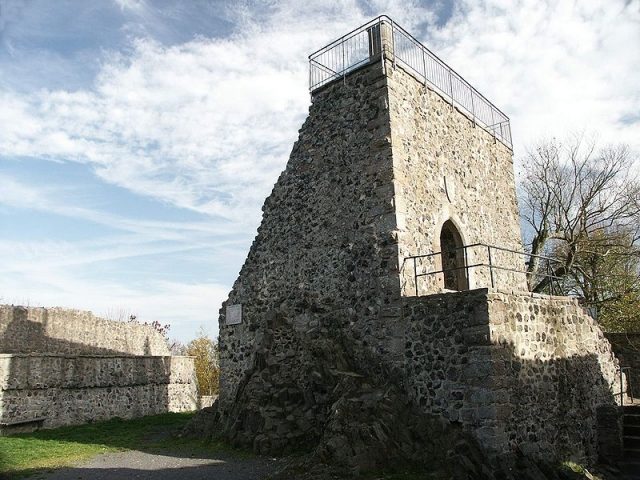
The castle ruin Hauneck is located within the district of Oberstoppel, a part of the municipality Haunetal in the Hersfeld-Rotenburg district in Hesse.
The ruin lies on the summit of the 524 m high Stoppelsberg in the Kuppenrhön, the remnant of a volcanic vent that formed in the Miocene. The keep of Hauneck Castle is founded on hexagonal basalt columns, which formed during the cooling of the lava; they are exposed at the base of the keep.
The hilltop castle was built of basalt stone and has an approximately square footprint. Partially, the gate and window lintels, corner and bossed ashlar blocks are made of white sandstone. They originate from the natural monument Lange Steine. All buildings are attributable to the new construction from the 15th century. Only the keep still dates from the first known castle complex from the 14th century.
The approximately 1.5 meter thick curtain wall encloses the entire summit of the Stoppelsberg. The walls of the buildings are still up to 15 meters high. The gatehouse with the double gate is located on the southeastern side of the complex. Of the building above the gate, only the outer walls remain, which are still somewhat higher than the gate arches. The internal gate hinge stones are still preserved.
Over the southern corner of the castle, to the southwest, adjoins the palas with a Gothic gate. Judging by the remains of the outer wall, this building had at least two stories. It had a length of about 17.5 meters and a width of 3.5 meters. On the ground floor are some loopholes and ceiling support stones. In the northwest, next to the stairs to the kitchen wing, is the entrance to the cellar with a barrel vault. It was a storage cellar, from which one also had access to the cistern, which was located in the inner courtyard next to the kitchen wing. Between this cellar access and the stairs to the kitchen wing was the central fireplace, which led to a tiled stove on the second floor. On the second floor was the Dürnitz, which was accessible via an external staircase directly next to the gatehouse.
In the northwestern direction, the kitchen wing was added to the palas. There is also a Gothic gate to the kitchen from the castle courtyard. Here, originals of the hearth base, the sink stone, and the paved floor can still be seen. Furthermore, one can still see the column foundation of the cooking fireplace, remnants of the chimney flue, and the start of a narrow spiral staircase that led from the kitchen to the Dürnitz. From the kitchen wing, the curtain wall, with the lower battlements still partially preserved, leads back to the gatehouse. No further building remains can be identified here. However, it is to be assumed that there were still wooden buildings (e.g., horse stables) along this wall.
In the middle of the castle courtyard, the remains of the rectangular keep still stand. From there, one has a panoramic view over the Kuppenrhön, the Seulingswald, and the Knüll. A trigonometric point is located on the keep.
The castle was probably built in the 14th century by the Knights of Haune. Their ancestral castle was located in Burghaun, about 3 km away, in the Haune valley. Which of the two castles was built first can no longer be determined from the available sources. Since the name of the mountain was not lost due to the castle name, it can be assumed that the first castle complex on the mountain only existed in the 14th century. The castle was probably built to protect the valley castle in Burghaun. Furthermore, the lords of the castle could control the old road Antsanvia from here, which led not far through the Hessisches Kegelspiel and the Kuppenrhön.
In 1397 (possibly also only 1402 or 1403), the first written mention of the castle occurred. At this time, the Knights of Haune, together with other Buchenau knights, undertook an invasion of Lower Hesse. However, they were defeated by Landgrave Hermann II of Hesse near Homberg. He pursued the survivors into Fulda territory and conquered the castle, which was partially destroyed.
The castle was also strategically interesting for the Landgrave. It was located on the border with Fulda territory, on the old road from Würzburg to Fulda, and near the Antsanvia. So the castle was repaired, and the Landgrave forced Heinrich von Haune in 1409 to sell him the castle. With this purchase, the villages of Ober- and Unterstoppel also came into Hessian possession. Hauneck became a Hessian judicial and administrative seat.
During the division of the Landgraviate of Hesse after the death of Ludwig I, Hauneck fell to Hesse-Marburg, but the soon-following Hessian Fratricidal War in 1469 led to the second destruction of the castle. Ludwig II of Hesse-Kassel tried to gain influence with the important knightly family of Buchenau. For this purpose, his marshal, Simon von Wallenstein, demanded entry into this clan. This led to a dispute within the Buchenau family between the proponent of this entry, Simon von Buchenau, and the opponents of the matter, Bosso and Georg von Buchenau. In 1469, Heinrich III of Hesse-Marburg, with the support of Fulda troops, tried to expel Simon von Buchenau. He marched with 4000 men to besiege the castle in Buchenau (predecessor of the palace). Thereupon, Ludwig II came with a relief army to help the distressed Simon. Heinrich's siege troops fled when the relief army approached. Simon then took revenge on Heinrich III by destroying Hauneck Castle.
Only between 1482 and 1490 did Wilhelm III have the castle rebuilt by the fortress master builder Hans Jakob von Ettlingen. It became the seat of an Amtmann, who was appointed by the House of Hesse-Marburg (later of Hesse-Kassel). The first Amtmann was Hans Jakob von Ettlingen. In 1499, Engelhard von Buchenau called himself "Amtmann zu Hauneck". The administrative seat was moved to Holzheim (today a district of Haunetal) in 1560.
Due to the renewed Hessian inheritance division after the death of Landgrave Philipp the Magnanimous, the castle fell to Ludwig III of Hesse-Marburg in 1567. In 1572, a Jakob Schröder was still mentioned as "Voigt uff Hauneck". From this time on, the castle was no longer mentioned in any document. It is therefore to be assumed that it was already uninhabited in the last quarter of the 16th century and has since fallen into disrepair. It is also to be assumed that it suffered considerable damage in the Thirty Years' War.
The castle ruin had to be closed on August 1, 1981, due to the danger of collapse. The secured ruin was reopened with an accessible keep on May 20, 1982.
Take Mobile History with you
You are reading this text for free. Premium adds what matters on the road: descriptions read aloud, sites found through your camera, whole regions taken offline.
- Every description, including the ~17,700 Premium sites
- Audio guide: have descriptions read to you on location
- AR finder: see sites through your camera, with distance and bearing
- Unlimited saved sites
14 days free, then from €2.99 a month. Cancel anytime.
Source: Wikipedia · Licence: CC BY-SA 4.0
This description draws on the facts documented in the linked Wikipedia article; Wikipedia content is licensed under CC BY-SA 4.0. Wording and editing: Mobile History.
Location: 50.7515, 9.7011