The remains of the Castle can be visited
RuinDorsten
Hagenbeck Castle (Ruin) (Dorsten)
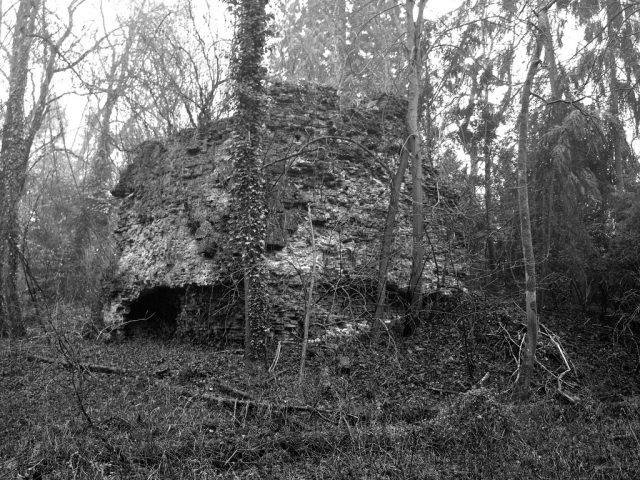
Haus Hagenbeck is the ruin of a former knight's seat in Dorsten. It is located on the north bank of the Lippe in the southwest of the Holsterhausen district.
Place Name and Administrative History+
"Hagenbeke" is first documented around 1150 in the urbarium of the Benedictine abbey of Werden an der Ruhr with the possession of two farms. The name refers to the separation of a Schultehof, the main court of the Counts of Dahle, from the common Mark on the Lippe and Bieberbach (later Mühlenbach). The farming community named after the court belonged to the parish of Hervest in the 12th century. After the chapel in the village of Holsterhausen was elevated to an independent parish (1443), the parish name supplanted the name Hagenbeck, which has since been restricted to the knight's seat, later estate district (from 1734). The Prussian municipality of Holsterhausen (1815 – 1943) was incorporated into the city of Dorsten and, since 1975, together with the farming community of Emmelkamp, located north of Hagenbeck/Holsterhausen, forms the district of Holsterhausen. The coat of arms of Haus Hagenbeck (1351), three rings in a 2:1 ratio, became the municipal coat of arms of Holsterhausen.
The Knights of Hagenbeck+
As a member of a noble family, "Gerhardus de Hagenbeck" is first mentioned in 1217 as a witness to a transfer of property to the Marienborn monastery. In the 14th century, the documentary tradition becomes rich, especially in documents of the Bishop of Münster, squires and knights of Hagenbeck appear as witnesses in numerous contracts. In addition to their local possessions, the knights were endowed with spiritual fiefs from the monasteries of Werden and Marienborn in the "Herrlichkeit Lembeck" and with Münster spiritual fiefs in the wider Diocese of Münster. In 1315 (June 23), the brothers Everhard and Tillmann von Hagenbeck, with the consent of their heirs, sold Hagenbeck Castle for 150 marks of Münster denarii to Bishop Ludwig of Münster as an "Offenhaus" (open house). However, the bishop's rights of use mentioned in the contract (fixed place, administrative seat, and building rights) were never exercised later. - The Hagenbeck knights were ministeriales of the Bishops of Münster.
The Castle+
Hagenbeck Castle was located at a Lippe ford at the southwesternmost border point of the Prince-Bishopric of Münster, bordered to the west by the County of Kleve and to the south of the Lippe by the Electorate of Cologne's Vest Recklinghausen. The border location gained importance when Münster and Cologne concluded the treaty on the Lippe as the border of their territories in 1322, and the Counts of Kleve sought an active and successful territorial expansion on the right bank of the Rhine from the 1330s onwards.
The treaty of 1315 and later inheritance division contracts provide information about the buildings and fortifications of the castle, its owners and possessions. The castle with its outer bailey and moats is located in a former Lippe meander in the island terrace. Strong floods reached the castle grounds. Nearby was a Lippe ford, which lost its importance due to the bridge near the town of Dorsten. Fortification-wise, the extensive castle grounds were secured with ramparts and moats. Until 1410, the castle was always a family castle, in which two Hagenbeck families owned separate houses. The original motte-and-bailey castles ("Motten") in the island terrace were replaced by new houses after 1338.
The Politics of the Knights of Hagenbeck+
The line of "Johan de olde" (+ before March 16, 1364) aligned its politics with the tradition of the Prince-Bishopric of Münster, while his nephew "Johan de jonge" (+ before June 25, 1383) turned west, towards the Counts of Kleve. In 1338, Johan de jonge transferred his share of the castle to Count Dietrich of Kleve as an "Offenhaus," with the exception of against the Bishop of Münster; the Count also received the forest countship in the Emmelkämper Mark and fishing rights in the old waters of the Lippe. However, Johan de jonge received these rights back as a male fief. Johan de jonge von Hagenbeck called Count Dietrich of Kleve and later also his successor Count Johann (1347-1368) "his dear lord." Thus, Johan de jonge became a vassal of the Count and defected from the Bishop of Münster.
Already in 1340, Johan de jonge was involved in the war against Duke Rainald II of Geldern. The Duke sent his troops against Hagenbeck Castle. For the damages caused, Johan de olde, as an uninvolved co-owner, was compensated with 80 marks and contractually obliged to make the castle available to the Duke of Geldern as an "Offenhaus" for the duration of the war and to prevent his nephew from using it against the Duke. Between 1354 and 1365, Johan de Jonge served as Amtmann of the Kleve office [Neu-] Schermbeck.
Johan de Jonge was also involved in the Guelders War of Succession, including the decisive battle on May 25, 1361, as a member of the Münster cathedral nobility who had defected from Bishop Adolf of Münster. The Bishop's brother, Count Engelbert III of the Mark, fought against the disloyal. Already in July 1361, decisions were made against Johan de jonge, and in the subsequent war, Hagenbeck Castle was besieged in March 1362. Johan de jonge lost his shares in the castle and lordship, which were transferred on May 31, 1362, to Wessel, the son of Johan de olde, as an hereditary castle fief. However, Johan de jonge asserted his property rights before the ministerial court in Lembeck, and in 1373, a settlement was reached between the two Hagenbeck lines by contract.
Acquisition of Property and the Founding of the Village of Holsterhausen+
The local property of Haus Hagenbeck comprised the castle and allodial lands north of the Lippe between Hohenkamp and Schermbeck (from Werth to Loh, approx. 2.5 km in E-W and 1.5 km in N-S direction). The castle also included the manorial lordship in the Hagenbeck farming community (later Holsterhausen parish). This included the Kreskenhof as a fishing farm for the use of fishing rights in the Lippe. In the Emmelkämper Mark, where the Hagenbecks held the office of Mark judge, they operated a quarry, which they leased to the city of Dorsten. From this, among other things, stones were extracted for the city's large buildings (ring wall and church), but also for the new construction of Haus Hagenbeck. In addition, there was extensive other feudal property. Johan de jonge acquired, among other things, further fields on the Lippe from Haus Gahlen and rights in the Hünxer Mark and in the Hünxe parish from Johan van den Berghe. With this, he took over the property of the knights van den Berghe and advanced into Kleve territory. In 1350, he bought seven serfs from Sweder von Ringenberg and another 10 serfs before the court in Wesel. The settlement of these laborers formed the village of Holsterhausen, whose founding date is 1350. - In contrast to "Holzhausen," there are only three "Holsterhausen" (settlement of woodworkers) in Germany: Dorsten-, Essen- and Herne-Holsterhausen, all located within the sphere of Kleve's dominion and near the rivers Lippe, Emscher and Ruhr, with the purpose of supplying wood to the Lower Rhine. - The acquisitions were countered by the inheritance divisions, which caused considerable financial burdens in two lines with several heirs in each generation. Despite sales and pledges, including to the city of Dorsten, the property could usually be reunited. However, towards the end of the 14th century, when many small knightly families perished, this was no longer possible. In particular, Johan de jonge's successors separated from their Hagenbeck possessions.
Collateral Lines of the Hagenbecks+
There were several collateral lines of the Hagenbecks, some of which outlived the older lines on the ancestral castle. For example, in 1301, two brothers became owners of Sythen Castle, which remained in the possession of the Hagenbecks until 1450. Tilmann was the bailiff of the Nünning fiefdom of the Essen convent (until 1342), and a Johann von Hagenbek was enfeoffed by the Archbishop of Cologne with estates in Binsheim (Lordship of Moers) in 1375. Bernd von Hagenbeck was a partisan of the Archbishop in the war against Bernt von Strünkede and was compensated in 1410. In 1444, a Johann von Hagenbeck was a spiritual rector. A Hagenbeck family has been resident in Reval since 1415. Dietrich particularly stands out: in 1457 as a Blackheads brother, in 1467 as a councilor, in 1479 as mayor. Dietrich's brothers are Hans and Thomas (1483). Two sisters are married in Duisburg. Claus is still attested in Reval in 1491.
The Succession at Haus Hagenbeck+
The House of Heyden
At Haus Hagenbeck, the male line of succession died out with the death of Wessel von Hagenbeck (son of Johan de olde, + before 1403). With the heiress Woltera (Woltharda), the castle passed to the House of Heiden. Wennemar the Elder (+ 1448), married to Woltera since 1404, enfeoffed by the Bishop in 1410, was able to regain the lost possessions from both former lines. He founded the Holsterhausen parish, to which Bishop Heinrich II granted rights on August 21, 1443. Haus Hagenbeck held the patronage. Wennemar built the Hagenbeck mill, for which there was a milling obligation in Holsterhausen. Temporarily, there was a Lippe ferry in place of the older ford. In 1488, the House of Heyden was involved in the founding of the Franciscan monastery in the city of Dorsten. The Spanish invasion during the war against the Netherlands in 1587 caused considerable damage to the castle and the village. In 1620, the castle was in severe disrepair. Lubbert, the last of Heyden at Hagenbeck, could not raise the funds for repairs. His heiress Cordula Margareta Magdalena was married to Baron Lothar von Metternich, electoral councilor and Amtmann in Montabaur.
The House of Velen
After inheritance disputes between the related houses of Heyden, Metternich, and Vehlen, Mrs. von Metternich was compensated with 38,000 Reichstalers, and after her death in 1642, the property passed to Alexander II von Velen. As Generalfeldzeugmeister, he was involved in the siege of the Hessian-occupied fortress of Dorsten by imperial troops in the summer of 1641 and had his quarters in the Hagenbeck Tiergarten. The general, known as the "Westphalian Wallenstein," was elevated to the hereditary countship in 1641. In 1645, he began restoring and modernizing the castle. This third complex followed the usual type of a three-winged main castle with an outer bailey. Ramparts and moats formed a slightly trapezoidal rectangle with external dimensions of approx. 160 m N-S and approx. 100 m E-W. The inner area measured 82 x 40 m. Even before Alexander's death (+ 1675), his son secretly sold parts of the expected inheritance to the House of Westerholt zu Lembeck from 1661 onwards. The heir lived as an officer at the imperial court in Vienna from 1664. At the time of his father's death (1675), the entire inheritance was squandered. Citing the reserved right of repurchase, the grandson Alexander Otto Graf von Velen briefly reacquired Haus Hagenbeck. In 1734, Hagenbeck finally passed into the possession of Baron Theodor von Merveldt, who, as a result of his marriage to the heiress of the extinct line of Westerholt-Lembeck, had been the owner of Lembeck Castle and Lordship since 1708.
Afterlife+
The already heavily damaged castle – whether by an explosion and fire or by the effects of the Lippe floods is disputed – was not restored, as it had become dysfunctional. The property was operated as an outwork, an agricultural estate, and for this purpose, the outer bailey was repaired. Therefore, only the gatehouse and a chapel from the castle period have survived, the former castle only in ruined remains. The estate owner of Hagenbeck had the right of representation in the provincial parliament during the Prussian era (1823-1875). In 1909, Hagenbeck was sold. Large parts of the lands were used for early industrialization, especially for the Baldur mine. The remaining estate was acquired by the Dorsten district judge Thomas. Since the late 20th century, further areas have been used for settlement and the construction of the A31 motorway running to the east. The bearers of the family name Hagenbeck trace their lineage back to the knightly family. With the adoption of bourgeois professions, the noble status was abandoned. The most famous branch, through zoos and circuses, is the Hagenbeck family in Hamburg. The "Hagenbeck-Verbond" in the Netherlands cultivates the family tradition. In the "Holsterhauser Feld" and near the Kreskenhof, numerous Roman marching camps from the years 11 BC to 16 AD have been discovered since 1952.
Take Mobile History with you
You are reading this text for free. Premium adds what matters on the road: descriptions read aloud, sites found through your camera, whole regions taken offline.
- Every description, including the ~17,700 Premium sites
- Audio guide: have descriptions read to you on location
- AR finder: see sites through your camera, with distance and bearing
- Unlimited saved sites
14 days free, then from €2.99 a month. Cancel anytime.
Source: Wikipedia · Licence: CC BY-SA 4.0
This description draws on the facts documented in the linked Wikipedia article; Wikipedia content is licensed under CC BY-SA 4.0. Wording and editing: Mobile History.
Location: 51.6677, 6.9139