The remains of the Castle can be visited
RuinWaldshut-Tiengen-Aichen
Gutenburg Castle (Ruin)
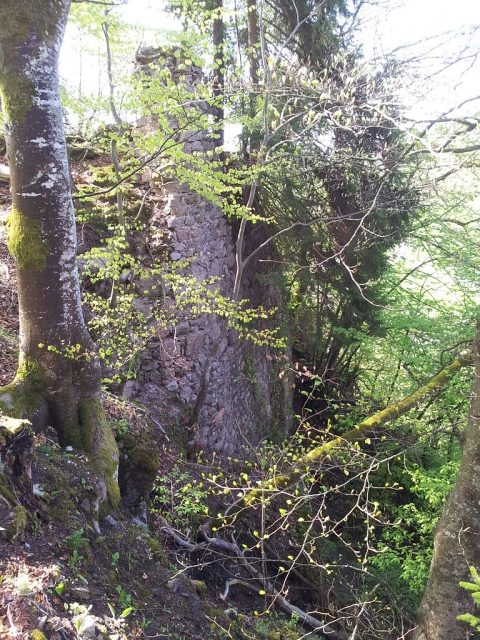
The Gutenburg, also called Gutenberg, is a castle ruin and belongs to the district of the same name in the Aichen district of the city of Waldshut-Tiengen in Baden-Württemberg, Germany.
The castle ruin of the hilltop castle is located at the foot of the Southern Black Forest at the lower end of the deep valley incision of the Schlücht. A natural hill with a hard, rocky core of the old granites of the Black Forest basement survived the erosion of the Schlücht and served as a strategically favorable location for the castle. A little further downstream, the valley opens up and forms the transition to the Klettgau.
In the 10th century, the first known structure, a tower, was built by the Abbey of St. Gallen (Switzerland). This served as a base and protective structure for the extensive possessions that the monastery had between the years 900 and 1000 in the area between the Black Forest rivers Alb and Schlücht.
In 1128, the Abbey of St. Gallen granted the tower, along with its possessions and rights there, as a fief to an unnamed noble family. This noble family subsequently built a castle around the tower, which they then, together with surrounding estates, considered their property. However, the tower continued to be considered a fief. In the same year, a Rudolfus de Gutenburch appears in a document together with Heinrich von Krenkingen and the knights of Dogern and Berau as a witness to Meier Tschudi of the Damenstift Säckingen. However, it remains open whether this allows a conclusion to be drawn about the noble family of Gutenburg, who were enfeoffed in 1128.
In 1187, the property passed to the Lords of Gutenburg. These were a noble free ministerial family from the Swiss Aargau (presumably Oberaargau, Canton Bern, see Gutenburg BE). The Gutenburg probably only received its name from this point onwards and was adopted from the name of the Gutenburg family or their ancestral rule, today's Swiss Gutenburg-Lotzwil.
It is possible that the minnesinger Ulrich von Gutenburg, who lived in the 13th century, and the Ulrich von Gutenburg who appears several times in documents, are one and the same person.
In 1276, Conrad (also called Insenhart or Ynsenhart) and Berchthold von Gutenburg sold numerous estates to the Abbey of St. Blasien, from which the St. Blasien office of Gutenberg later emerged.
At the beginning of the 14th century (probably 1302), due to financial difficulties of the descendants of Rudolfus von Gutenburg, Ulrich and Eberhard von Gutenburg, the castle passed to Heinrich II von Kränkingen (today Krenkingen - a district of the city of Waldshut-Tiengen).
In 1357, Heinrich and Johann von Blumenegg exchanged the village of Herbolzheim, a fief of the Diocese of Strasbourg through Bishop Johann von Lichtenberg, from the possession of the Krenkingers for Gutenburg Castle with Count Hug von Fürstenberg, son-in-law of Lütold von Krenkingen.
In 1361, the Gutenburg was again pledged to the brothers Walther and Burkart von Hohenfels due to the financial difficulties of the Krenkingen family and was not redeemed.
In 1393, the castle passed to the Zurich knight Heinrich Gessler.
In 1407, ownership changed to the knight Wilhelm Im Thurn zu Schaffhausen, who in the same year also acquired the pledge rights over Hauenstein Castle.
In 1447, the castle passed from Rüdiger Im Thurn zu Schaffhausen to the knight Heinrich von Rumlang.
In 1480, Abbot Christoph of St. Blasien Abbey acquired the lordship of Gutenburg with the castle site, castle, and the associated villages of Weilheim, Ühlingen, and Krenkingen from Knight Dietrich von Rumlang.
In May 1525, some rebels under Hans Müller (Peasants' War), with the support of the city of Waldshut, temporarily took possession of the castle until they were ultimately defeated and had to evacuate it again.
In 1526, after the defeat, the peasants had to pay damages.
In 1612, St. Blasien also acquired the sovereign rights over the Gutenburg, by purchase from Maximilian von Pappenheim. During the Thirty Years' War, the owners changed frequently, and it was used as a base to plunder the surrounding area.
In 1638, Bernhard von Weimar occupied the castle; under Baron and Field Marshal Lieutenant Georg Druckmüller von Mühlburg zu Prunn und Rottenstein, it was recaptured with 4000 men, who found rich Swedish supplies. Afterwards, it fell back into Swedish hands.
In 1640, Abbot Franz I of St. Blasien had the castle set on fire and destroyed by his own people so that it could no longer be used as a robber's nest; it has been a ruin ever since, and the official residence was moved to Gurtweil. The feudal rights over the tower zu Gutenburg in der vesty and the hof zu Wilhain with court, twingen and bännen formally remained with St. Gallen Abbey until 1773.
As early as 1538, a "Schloßmüli zu Guttenpurg" belonging to the Gutenburg is mentioned. In 1660, St. Blasien Abbey, with the agreement of Count Ludwig von Sulz, established an iron smelter with a hammer forge and wire drawing plant here, as a tested bean ore was found in large quantities in the neighboring Klettgau, while the necessary wood was sufficiently available and conveniently supplied in the forest under the monastery's jurisdiction. With the establishment of the Albbruck ironworks, the small Gutenburg plant ceased operations in 1698. The GUTEX wood fiber board factory has been located near the castle ruin since 1932.
Prehistoric bone remains and a bronze axe were found beneath a wall vault.
Layout+
Later, the lordship of Gutenburg consisted of two Meierhöfe (manor farms), a grain mill on the Schlücht, and areas west of the Schlücht and the Schwarza with the associated villages of Schnörringen, Dietlingen, Weillheim, and Nöggenschwiel. Later, a sawmill and the villages of Indlekofen, Bürgeln, and Gurtweil were added.
Coat of Arms+
The coat of arms of the Gutenburg family is described in the necrology book of Einsiedeln Abbey:
"The seal of Abbot Nikolaus I von Gutenburg shows a seated abbot, covered with an inful (mitre), holding the staff in his left hand, while raising his right hand in blessing, below it the family coat of arms, a St. Andrew's cross charged with five lanterns. The inscription, as far as legible: «NICOLAVS. DEI . . . S. SCE. MARIE. HEREMITAR.
Take Mobile History with you
You are reading this text for free. Premium adds what matters on the road: descriptions read aloud, sites found through your camera, whole regions taken offline.
- Every description, including the ~17,700 Premium sites
- Audio guide: have descriptions read to you on location
- AR finder: see sites through your camera, with distance and bearing
- Unlimited saved sites
14 days free, then from €2.99 a month. Cancel anytime.
Source: Wikipedia · Licence: CC BY-SA 4.0
This description draws on the facts documented in the linked Wikipedia article; Wikipedia content is licensed under CC BY-SA 4.0. Wording and editing: Mobile History.
Location: 47.6553, 8.2503