The remains of the Castle can be visited
CastleFilisur
Greifenstein Castle (Ruin)
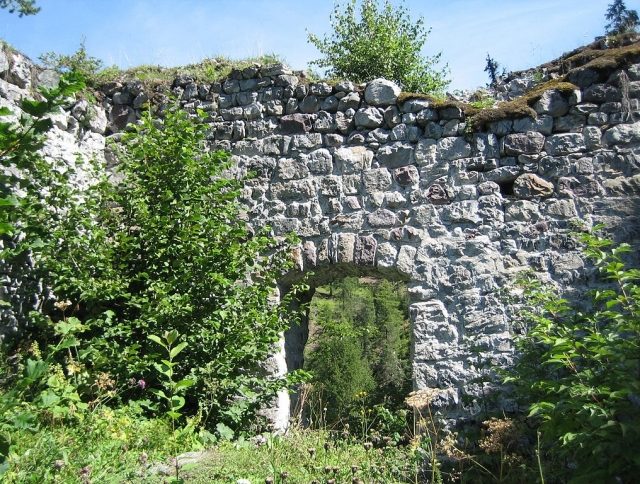
The ruins of Greifenstein Castle lie above Filisur in the Albula Valley in the Swiss canton of Graubünden. The ruin is located high above the village and is easily accessible from the Rhaetian Railway tracks via a forest path in about fifteen minutes. The uppermost part of the complex can now only be climbed with climbing equipment; the path that Clavadetscher/Meyer still mentioned in 1984 is no longer passable.
Nicolin Sererhard wrote around 1740: The old castle Gryfenstein stands on a very high, steep hill.
Complex+
The extensive complex was spread over three levels of terrain with a large difference in height. The structural connections are no longer clear. On the uppermost level, a difficult-to-access rock head falling vertically on all sides, stood a tower-like building with an irregular floor plan. Access was via a staircase carved into the rock with three turns. Holes drilled into the rock suggest a covered wooden gallery.
On the terrace of the middle level lay the main castle, leaning against the vertically rising east wall. Of the originally three floors, the lowest is heavily overgrown and filled with rubble. Remains of a curtain wall following the edge of the plateau have been preserved. Windows, a latrine bay, and a sink are preserved in the west wall. The arrangement of the beam holes in the southwest wall only allows for a floor height of approx. 1.5 m; the reason for this division is unknown.
The location and type of the individual buildings are no longer recognizable. The residential buildings were certainly located here, as well as a chapel leaning against the north wall, whose apse carved into the rock is still well preserved. The paintings, brown bands, and ochre and light blue decorations mentioned by Erwin Poeschel in 1930 are no longer preserved. South below the chapel was the cistern carved out of the rock, which was enclosed by a wall and left a narrow opening for the drawing device. The drawing device with carved beam holes was located above the cistern. The gate to the complex was in the southwest part, which has been removed except for a few remains.
On the lowest level was a spacious terrace. Access was from the east through a narrow entrance, of which wall remains and a channel for a locking beam have been preserved.
Documentary records about the construction of the castle are missing; a construction period from the second half of the 12th century is assumed. Greifenstein was the center of the Lordship of Greifenstein, which included Bergün, Latsch, and Stuls in addition to Filisur. The noble free lords of Greifenstein were, according to their coat of arms, of the same lineage as the lords of Wildenberg and Frauenberg in Ruschein. In 1233, Rudolf von Greifenstein is mentioned, who was involved in the murder of Bishop Berthold and was sent on a crusade as penance; for this, he received an extension until 1237. In 1243, Heinrich and Albert are attested in a Vazer document: ...Hainricus et Albertus de Grifinstain.
Castle and Lordship of Greifenstein passed to the Wildenbergers before 1300; either the Greifensteiners had died out or a branch of them again called themselves after Wildenberg. In 1297, an Ortolf, bailiff in Greifenstein, is mentioned as a witness in a Wildenberg document: Ortolfo ministor in Grifenstein. In 1320, Hugo von Wildenberg and his wife Anna von Wildenberg pledged the castle of Griffenstaein, Bvrguen (Bergün), people and goods for 1150 marks to the Bishopric of Chur.
After several changes of ownership - Planta from Zuoz, Andreas von Marmels, Werdenberg, von Matsch, who attacked Bishop Hartmann from Greifenstein - the castle was conquered by the bishop's troops in 1394 ...and God gave him the fortune that he won the aforementioned three fortresses (Ramosch, Steinsberg and Greifenstein) and defended himself against the Matsch, and it became the episcopal center in the Albula Valley. On February 2, 1396, the bishop promised to preserve the rights of the people of the lordship and received their oath of allegiance ...as we have brought the fortress Griffenstain ... into our power. After further disputes between the Matsch and the bishop, Duke Ernst of Austria decided in 1421 as arbitrator that the castles should remain with the Bishopric, but the bishop had to compensate the Matsch and Toggenburgers for Ramosch and Greifenstein with 2500 marks. In a dispute with Bishop Ortlieb (1458 - 1491), people of the Gotteshausbund occupied Greifenstein, among other places, with Zurich intervening in favor of the bishop.
Until the purchase of the manorial rights by the municipalities in 1537, Greifenstein served as the official residence of the episcopal bailiffs, then it was abandoned and quickly fell into disrepair. Ulrich Campell mentioned it around 1550 as largely destroyed and desolate inside. The roof remained intact until the 19th century. The final decay occurred after 1840, when beams and hewn stones were used for the construction of the schoolhouse.
Take Mobile History with you
You are reading this text for free. Premium adds what matters on the road: descriptions read aloud, sites found through your camera, whole regions taken offline.
- Every description, including the ~17,700 Premium sites
- Audio guide: have descriptions read to you on location
- AR finder: see sites through your camera, with distance and bearing
- Unlimited saved sites
14 days free, then from €2.99 a month. Cancel anytime.
Source: Wikipedia · Licence: CC BY-SA 4.0
This description draws on the facts documented in the linked Wikipedia article; Wikipedia content is licensed under CC BY-SA 4.0. Wording and editing: Mobile History.
Location: 46.6759, 9.6929