The remains of the Castle can be visited
RuinGleiberg
Gleiberg Castle (Ruin)
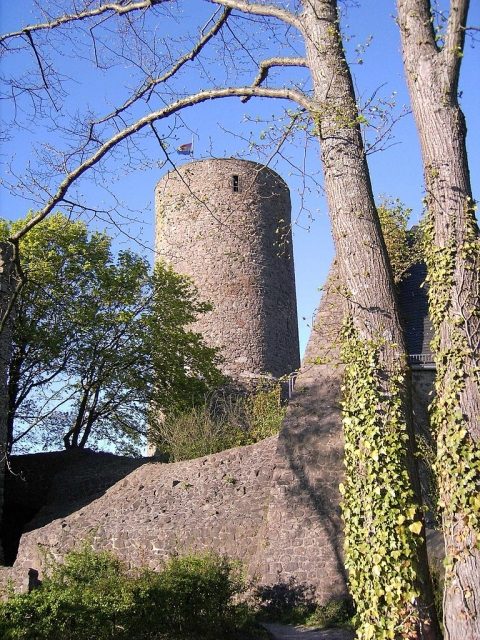
Gleiberg Castle, with the surrounding "Village of Gleiberg", is a namesake part of Krofdorf-Gleiberg and belongs to the municipality of Wettenberg in the district of Gießen. The summit castle is located on the mountain of the same name, "Gleiberg". The basalt cone rises 308 meters above sea level.
Not far away, between Gleiberg and Dünsberg, lies the castle ruin Vetzberg, a former secondary castle of the Counts of Gleiberg.
The Konradiners already used Gleiberg as a castle site. The castle may have been built by Otto, King Konrad's brother, as a fortress against the Popponians.
Heribert von der Wetterau made the castle the residence of his County of Gleiberg in 949. After his death, the castle passed to his son-in-law Friedrich von Luxemburg, the founder of the Luxembourgian comital house. The castle is considered a possible birthplace of Empress Kunigunde around 980.
In 1103, King Heinrich V conquered the castle and had it destroyed. Only after the second line of the Counts of Gleiberg had split off from the Counts of Luxembourg, was the castle rebuilt in the 12th century.
A well-known historical figure from the 12th century is Clementia von Gleiberg. In 1129, she founded the Augustinian Canons' Monastery on the Schiffenberg near Gießen.
With the extinction of the Counts of Gleiberg in the late 12th century, the western half of the castle and the county passed to Hartrad II von Merenberg. The eastern half of the castle and the county went to the Palatine Counts of Tübingen. The Merenbergers were later able to acquire the eastern half of the castle, and it became the seat of the Lords of Merenberg for 150 years.
After the extinction of the Merenbergers with the death of Hartrad VI, the castle fell to the House of Nassau-Weilburg in the 14th century. It became the center of the "Land on the Lahn" but no longer served as a residence.
During the Thirty Years' War, the castle was destroyed in 1646 by troops of the Landgrave of Hessen-Kassel. As it no longer had any military significance, a reconstruction was foregone. On June 30, 1816, the castle passed from the Duchy of Nassau to the Kingdom of Prussia through exchange.
In the 18th and 19th centuries, Gleiberg was often the destination of protest marches by students of the University of Gießen. The inn "Zur Spießpforte" at the foot of the castle, documented since the 16th century, also became well-known. Since about 1860, it has borne the name "Zum schwarzen Walfisch". Here, on August 15, 1852, the Gießen Wingolf was founded. According to tradition, the restaurant "Zum schwarzen Walfisch" was the founding location of the singing club "Hermanus" Gleiberg in 1879, the oldest predecessor club of today's Sängervereinigung Gleiberg.
Layout+
The castle still exists today as an imposing ruin and is a popular excursion destination. The Gleiberg Tower is approx. 31 meters high and offers views of almost the entire Gießen district.
Since 1879, the ruin has been owned by the Gleibergverein, which strives for its preservation. A restaurant and several apartments are located in the lower castle.
Take Mobile History with you
You are reading this text for free. Premium adds what matters on the road: descriptions read aloud, sites found through your camera, whole regions taken offline.
- Every description, including the ~17,700 Premium sites
- Audio guide: have descriptions read to you on location
- AR finder: see sites through your camera, with distance and bearing
- Unlimited saved sites
14 days free, then from €2.99 a month. Cancel anytime.
Source: Wikipedia · Licence: CC BY-SA 4.0
This description draws on the facts documented in the linked Wikipedia article; Wikipedia content is licensed under CC BY-SA 4.0. Wording and editing: Mobile History.
Location: 50.6150, 8.6347