Uninhabited
RuinGeilsdorf
Geilsdorf Castle (Ruin)
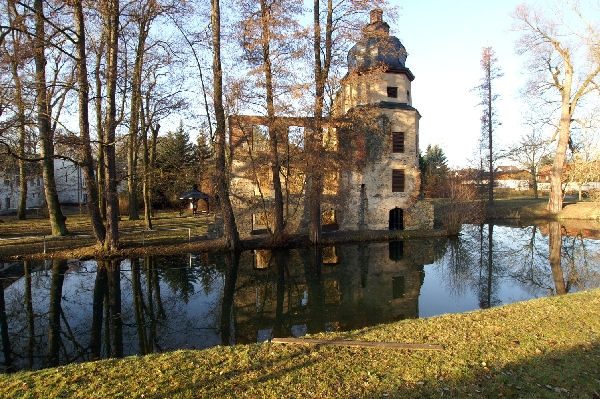
The old moated castle in Geilsdorf was an impressive building in its heyday. The slightly concave roof towered over the Baroque domes of the four corner towers of the massive three-story building, which was adorned with oriels. Its large rooms were furnished with magnificent furniture. A bridge led to the entrance. But the moated castle did not last long. Its decay began after only 200 years.
The moated castle of Geilsdorf was probably built in the 12th century by the Lords of Geilsdorf in the immediate vicinity of an old Slavic hamlet. The castle stood on an earthen mound and was surrounded by a protective moat. Access to the castle was secured by a bridge on the west side.
Geilsdorf is first mentioned in documents in 1328. For many years, the von Sack family owned the manor and the village. Ulrich Sack was mentioned in a document as the owner of the castle in 1382. The family name von Sack (or die Säcke) is the name of several unrelated noble families who were, among others, native to the Vogtland region. In the Vogtland, the Lords of Sack were considered an important family of the lower nobility with extensive landholdings. In the Middle Ages, they expanded their lands and their sphere of influence in the Burgstein area and beyond until the second half of the 16th century. Their possessions included Planschwitz, Türbel, and Sachsgrün Castle. A special honor was bestowed upon the brothers Hans and Caspar Sack from the Mühltroff line when Emperor Charles V granted them and their heirs the title "the Nobles". However, their descendants could not enjoy this title for long, because after the Geilsdorf line died out with Nickel Sack at the end of the 16th century, the "Noble" Mühltroff line also died out five years later with Hans Balthasar.
After the Lords of Sack, the owners changed frequently. Hans Wilhelm von Geilsdorf acquired the old property of his family in 1574, which Peter von Reitzenstein bought in 1578. The von Reitzenstein family lived in Geilsdorf until 1668. Finally, Count Siegmund von Tattenbach acquired the estate from the Reitzenstein family and built the moated castle on the foundations of the old castle. The simple massive building, which had towers at all four corners, rose on a rectangular floor plan. Oriel windows enlivened the facade. The central hall gained particular importance, where negotiations of the manorial court were also held.
The last inhabitants of Geilsdorf moated castle were the family of the Brandenburg Privy Councillor and Landeshauptmann Georg Ehrenfried von Nauendorf, who bought the estates at auction in 1725. But soon his descendants could no longer finance the necessary repairs. Thus, the castle remained uninhabited from 1866. With the demolition of the bridge over the moat, the final decay began. The moat was filled with earth on the west side. Due to the drainage of the water and the associated changes in the subsoil, the oak piles that supported the foundations rotted. At the end of the 20th century, the west tower collapsed, and a few years later, large parts of the main building also collapsed. The end of the moated castle was sealed. Only the northeastern corner tower and remnants of the foundations remained.
However, the residents of the village did not want to accept the collapse of the castle. After the renovation of the building was rejected several times for cost reasons, funds for emergency securing were finally provided in 2003. In the following months, the existing wall remains were rebuilt, the tower framework was renewed, and the Baroque tower dome was renovated. Thus, today a remarkable castle ruin, which does not need to hide its idyll by the remaining castle pond, presents itself in the center of the small village.
Take Mobile History with you
You are reading this text for free. Premium adds what matters on the road: descriptions read aloud, sites found through your camera, whole regions taken offline.
- Every description, including the ~17,700 Premium sites
- Audio guide: have descriptions read to you on location
- AR finder: see sites through your camera, with distance and bearing
- Unlimited saved sites
14 days free, then from €2.99 a month. Cancel anytime.
Source: Wikipedia · Licence: CC BY-SA 4.0
This description draws on the facts documented in the linked Wikipedia article; Wikipedia content is licensed under CC BY-SA 4.0. Wording and editing: Mobile History.
Location: 50.4280, 12.0343