The remains of the Castle can be visited
CastleRuschein
Frauenberg Castle (Ruin) (Ruschein)
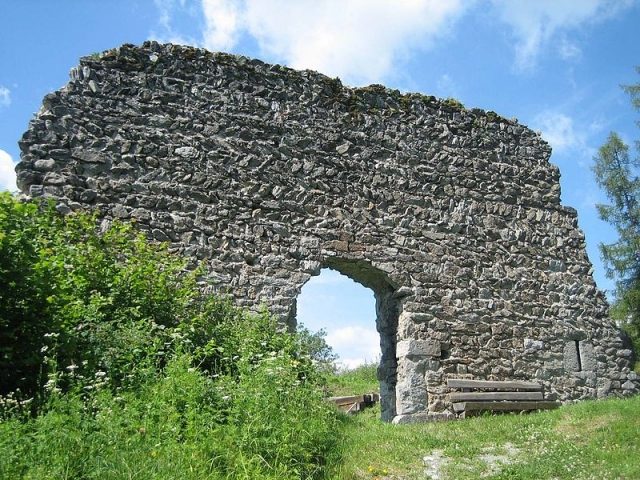
The ruin of the former Frauenberg Castle is located in the municipality of Ruschein in Surselva in the Swiss canton of Graubünden.
The name "Frundsberg", sometimes used today, goes back to an idea of the chronicler Campell (1510 - 1582), who saw the castle as the ancestral seat of the mercenary leader Georg von Frundsberg. However, this theory is now considered untenable. The Frundsberg castle was in Mindelheim in Germany, Georg von Frundsberg himself lived in Southern Bavaria.
The ruin is located on the Plontabuora hill southwest of the village and is easily accessible from the village center in a few minutes.
Of the former castle complex, the remains of a rectangular wall measuring approximately 21 by 16.5 meters are preserved, with a wall thickness of about 1.5 meters. The walls are built in continuous opus spicatum technique. The gate is in the northwestern wall, the jamb stones are broken out. On the plateau there are minor remains of an enclosing wall. An exact dating of the construction is not possible without excavations. The opus spicatum technique and the gate construction point to a period around the turn of the 12th to the 13th century. Less likely is a large covered room, but rather residential buildings leaning against the wall inside; comparable to the complex in Valendas Castle.
The Lords of Frauenberg were probably a branch of the Barons of Sagogn, which had formed around 1250 after an inheritance division. The castle was the ancestral seat of the Lords of Frauenberg, who are first attested in 1257. Their first documented representative was Heinrich von Frauenberg, who is mentioned from 1257 to 1266. He was probably identical with Heinrich von Sagogn. In addition to Frauenberg, the family owned Felsberg Castle as well as estates and rights in Luzein, Castrisch and Falera.
In the history of Raetia, the Frauenbergers played an important role and often appeared as witnesses. The most important representative of the family was probably Heinrich II (attested from 1284 to 1305), the last male Frauenberg. He concluded an alliance with the Bishop of Chur and the Abbot of Disentis with Valais lords and negotiated on behalf of the absent bishop. In 1298 he was in the retinue of King Adolf of Nassau and was defeated with him in 1297 in the Battle of Göllheim. He was also known as a minnesinger. In 1290 he moved his residence to Gutenberg Castle in Liechtenstein, where he died in 1314.
Heinrich II remained without male successors. His daughters Katharina and Margareta married into Austria and into the Werdenberger family. While Gutenberg fell to Austria, the castle of Ruschein came to the Werdenbergers. Since the 15th century, the castle was partially dismantled and the stones used for other buildings.
The castle is mentioned only once in documents: in a Pfäfers urbarium from around 1450, a field in Ruschein is mentioned, which "nebenzuo gen der vesti an die almain" (next to the fortress to the common land) abuts.
Take Mobile History with you
You are reading this text for free. Premium adds what matters on the road: descriptions read aloud, sites found through your camera, whole regions taken offline.
- Every description, including the ~17,700 Premium sites
- Audio guide: have descriptions read to you on location
- AR finder: see sites through your camera, with distance and bearing
- Unlimited saved sites
14 days free, then from €2.99 a month. Cancel anytime.
Source: Wikipedia · Licence: CC BY-SA 4.0
This description draws on the facts documented in the linked Wikipedia article; Wikipedia content is licensed under CC BY-SA 4.0. Wording and editing: Mobile History.
Location: 46.7841, 9.1885