The remains of the Castle can be visited
RuinBerghofen
Fluhenstein Castle (Ruin)
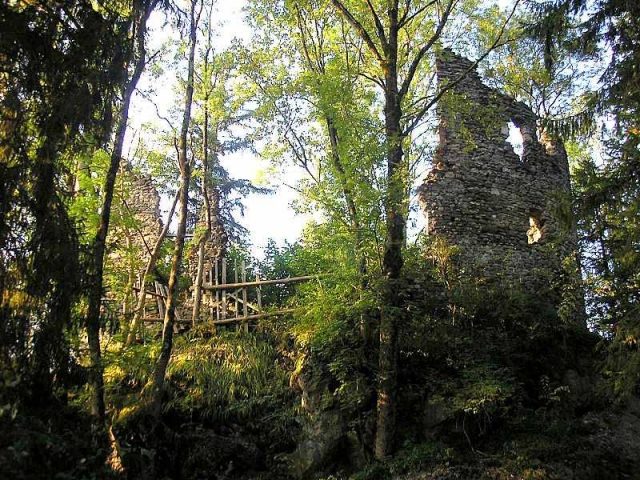
The ruin of Fluhenstein Castle is located on the southern outskirts of Berghofen (Sonthofen, Oberallgäu district, Germany) on the slope of a ridge. The formerly stately castle complex is in a desolate state and can only be viewed from the outside.
The Castle of the Heimenhofeners
In 1361, the brothers Marquard and Oswald von Heimenhofen divided their common property. Marquard kept the Lordship of Burgberg with the Heimenhofener castle of the same name. His brother Oswald acquired the Lordship of Berghofen from the Abbot of Kempten Abbey the following year. Abbot Berthold von Langenegg had bought the property shortly before from the childless Heinrich von Berghofen.
The Lords of Berghofen were servants of Kempten Abbey and originally resided in a small castle east of the village (Burgstall Berghofen). Heinrich von Berghofen had probably left his ancestral seat several years before the sale and lived on his Sedelhof (manor farm).
The new owner Oswald von Heimenhofen moved the castle seat to a rocky outcrop on the slope of the "Walten", a foothill of the Allgäu Alps. The fortress originally consisted essentially of a semicircular residential tower with a spacious western annex on a trapezoidal ground plan.
The lord of the castle systematically expanded his property in the following years by purchasing a mill and two Meierhöfe (manor farms). His son Berthold was in the service of the Dukes of Bavaria in 1398.
In 1413, the brothers Berthold and Ulrich acquired the Lordship of Hohentann and divided the entire property between them. Ulrich von Heimenhofen remained at Fluhenstein, while his brother founded a new family branch in Hohentann. The two noblemen are described in the sources as "poor housekeepers" who had to incur heavy debts.
Berthold's son Erkinger even had to sell his share of the Lordship of Fluhenstein to the Augsburg bishop Peter von Schaumberg in 1440. The purchase price is recorded as 9225 fl.
Four years later, troops of the Prince-Bishopric of Augsburg occupied the poorly defensible castle. Ulrich and Hans von Heimenhofen had slain the episcopal serf Andreas Funk. Ulrich was taken prisoner to Füssen and only released after his father Ulrich the Elder and his brothers Hans and Jörg had sworn an oath of fealty.
From 1462, Ulrich the Younger von Heimenhofen was in a feud with the Imperial City of Kempten. The Heimenhofener wanted to force the Imperial City's shares in his lordship under his jurisdiction. The Diocese of Augsburg and Count Hugo von Montfort zu Rothenfels sided with the city and besieged Fluhenstein in 1463. After its conquest, the lord of the castle was arrested in Kempten. In 1464, however, the Archduke of Austria ordered the reconciliation of the warring parties in Bregenz.
The Official Castle of the Prince-Bishopric of Augsburg
Decades of over-indebtedness of the lordship forced Jörg the Elder to sell the castle to the Diocese of Augsburg in 1477. His family was left with only a house in Sonthofen as a residence.
In 1508 and 1511, the family lost their last inherited possessions to Kempten Abbey. The Fluhenstein line of the Lords of Heimenhofen even reverted to commoner or peasant status. Jörg von Heimenhofen was thereafter only called Jörg Heimenhofer. His brother Kleinhans married the serf Anna Mutzin. The couple's children therefore fell into serfdom.
Fluhenstein Castle was henceforth administered by officials of the Prince-Bishopric of Augsburg. Around 1500, the expansion of the fortress with the north wing began. The new castle chapel of St. Alexius was already consecrated in 1501.
During the German Peasants' War, the rebels plundered the castle in 1525. The Landammann (district administrator) Hans Nachtrueb was able to escape to Dillingen an der Donau, but lost all his household goods and grain supplies.
In 1540, the serf Jakob Heimenhofer refused to pay the head tax and the Shrove Tuesday hen to the Prince-Bishopric. Thereupon he was imprisoned in the castle of his knightly ancestors and only released after acknowledging his obligations.
In 1546, the troops of the Swabian League occupied the fortress. During the Allgäu Peasants' Uprising in 1607, the Rettenberg peasants marched to the castle, cut off the water supply to the garrison, and captured some mercenaries that the Prince-Bishopric had sent to defend the castle. However, the bishopric's troops were able to recapture Fluhenstein shortly thereafter.
In 1633, the complex was again plundered by Swedish soldiers during the Thirty Years' War, who also severely mistreated the Landammann Alexander Straub.
Until 1769, the fortress served as the official residence of the Augsburg Landammänner. Surviving building accounts attest to numerous repairs and alterations, which resulted not least from the destruction caused by wartime actions. Johann Georg Birk was the last Amman of the Prince-Bishopric to reside at Fluhenstein from 1761.
Birk's successors moved into the Pfleghaus in Sonthofen, which was destroyed in 1945. The no longer needed castle was sold for demolition to a farmer by the Bavarian state in 1808 after the secularization of the Prince-Bishopric. The ruin is still in private ownership today.
Description+
Older Castle Part
The hilltop castle is strategically unfavorably located on a small rocky outcrop above the western foot of the "Walten". The fortress could easily be shelled from a higher lying tongue of land. To the east, a neck ditch, partly cut from the rock, separates the complex from the hillside. To the south, this ditch is only about one and a half meters deep.
To the south of the rock mass rise the remains of the older castle of the Heimenhofeners. The residential tower still stands almost at its original height. The surrounding walls to the west have largely disappeared in the 20th century. Larger sections of wall are only still standing in the north and west. The inventory of art monuments from 1964 shows an undated photograph of the castle, in which the south wall is still preserved up to the first floor. The ground floor was broken through by two large round arch openings. Four windows can be seen on the upper floor.
The masonry consists of rubble and broken stones. In some places, layers of larger rubble stones (mostly sandstone) alternate with layers of flat broken stones with small rubble stones. Brick patching can sometimes be seen in the preserved window reveals.
The semicircular residential tower was separated by a transverse wall, which has only survived as a wall stub.
The castle gate in the north wall is partly buried, but its substance is still well preserved. Next to it, larger remains of the original exterior plaster can still be seen.
The Extension around 1500
The north wing, built under the Prince-Bishopric of Augsburg, was connected to the main castle by walls preserved in the west. Access to the entire complex was from the east via a footbridge. The gate was located in a projecting gatehouse, which has completely disappeared. The wall section adjoining to the north was still partially standing around 1936 (postcard, private property). The best preserved part is the north front of the north wing, which is still about ten meters high.
The castle parts erected at the beginning of the 16th century were built from inferior slate rubble stone and are in a precarious condition. The north wing probably once resembled the Hohes Schloss in Füssen with its stepped gables, which was expanded at about the same time.
The small castle chapel of St. Alexius was allegedly located on the first floor of the north wing. The exact location of the sacred space, consecrated in 1501 by Bishop Friedrich von Hohenzollern, can no longer be determined.
Access to the castle has been blocked due to the acute danger of collapse. However, only a low barbed wire fence prevents access to the castle ruin, which is only about five minutes' walk above a children's playground. Especially due to its proximity to the residential areas of the Sonthofen district of Berghofen, securing the remains of the ruins would be urgently necessary. In addition, one of the most important castle complexes in the Oberallgäu could thus be preserved in the long term, otherwise its total loss is to be feared in the coming decades.
In 2007/08, in the course of the development of the "Castle Region Allgäu", a modern information board was erected in front of the neck ditch, on which some historical views and modern reconstructions of the castle complex are also reproduced.
Take Mobile History with you
You are reading this text for free. Premium adds what matters on the road: descriptions read aloud, sites found through your camera, whole regions taken offline.
- Every description, including the ~17,700 Premium sites
- Audio guide: have descriptions read to you on location
- AR finder: see sites through your camera, with distance and bearing
- Unlimited saved sites
14 days free, then from €2.99 a month. Cancel anytime.
Source: Wikipedia · Licence: CC BY-SA 4.0
This description draws on the facts documented in the linked Wikipedia article; Wikipedia content is licensed under CC BY-SA 4.0. Wording and editing: Mobile History.
Location: 47.5175, 10.3008