The remains of the Castle can be visited
RuinDornberg
Dornberg Castle (Ruin)
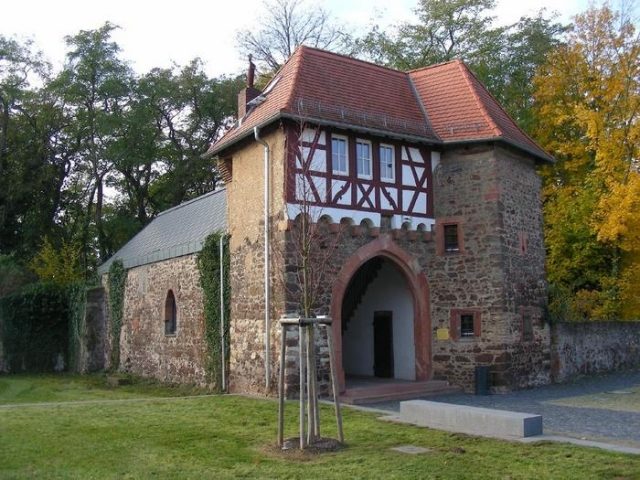
Today's Dornberg Castle (occasionally also Burg Dornberg or Dornburg) is the remnant of a Hessian landgravial castle complex, which originated on the remains of a medieval moated castle. It is located in Dornberg, a district of Groß-Gerau in the district of the same name in Hesse.
Dornberg Castle is located northwest on the edge of an old course of the Neckar river. Today, the Landgraben river flows there in a wide loop around a sand dune, on which, southwest of the castle complex, the Roman fort of Groß-Gerau and the associated Vicus were previously located at a crossroads. The terrain west of the castle was probably as impassable then as it is today and is overgrown with reeds.
Eberhard von Dornburg is first mentioned in a document around 1160. The first mention of the castle as castrum Dorenburg dates to the years 1236/45. The castle complex, probably built by the Lords of Dornberg, was a fief of the Counts of Henneberg. After Conrad von Dornberg died childless in 1257, Diether V. von Katzenelnbogen succeeded in acquiring the fief, as he was related to the Hennebergers on his mother's side.
In the 13th and 14th centuries, the outer bailey was built and the castle was further expanded. The Dornberg Castle became the center of the Katzenelnbogen Upper County. Although this was moved to Darmstadt in 1375, the castle in Dornberg was further expanded in the 15th century. A round residential tower, which had formed the core castle until this time, was demolished in favor of a new castle building.
With the extinction of the Counts of Katzenelnbogen in 1479, the castle fell to Heinrich III. of Hesse, but remained a Henneberg fief and was also pledged at times. Only with the Landshut War of Succession did Wilhelm von Henneberg have to renounce his feudal sovereignty. However, the Hessian landgraves only used the castle for occasional hunting stays. On February 14, 1689, French troops burned down Dornberg Castle in the War of the Palatine Succession. From 1722–26, the stones were reused for the construction of the neighboring pheasantry wall. Only a few remains were preserved, some of which were converted into a hunting lodge. From 1832–1837, it was the seat of the district administration. However, the building was also demolished in the 19th century. The gatehouse, with some newer extensions, served as a youth hostel from 1953, and as a district youth center since 1960/63.
After extensive renovation, the remains of the castle now house the adult education center of the Groß-Gerau district.
Complex+
Parts of a gatehouse at the main building have been preserved. The area of the main castle is not built over as a rubble mound and is heavily overgrown. It had a polygonal floor plan with a diameter of 50–55 m. Much better preserved are large parts of the outer bailey, including another, restored gate building and, to the east towards the Landgraben, remains of the outer bailey's curtain wall.
In the western part of the outer bailey is a Wilhelminian era building that was used as a forestry office. A new building for the adult education center was erected against the former wall towards the village of Dornberg, which takes up the form of the former outer bailey.
Source text: Wikipedia
Take Mobile History with you
You are reading this text for free. Premium adds what matters on the road: descriptions read aloud, sites found through your camera, whole regions taken offline.
- Every description, including the ~17,700 Premium sites
- Audio guide: have descriptions read to you on location
- AR finder: see sites through your camera, with distance and bearing
- Unlimited saved sites
14 days free, then from €2.99 a month. Cancel anytime.
Source: Wikipedia · Licence: CC BY-SA 4.0
This description draws on the facts documented in the linked Wikipedia article; Wikipedia content is licensed under CC BY-SA 4.0. Wording and editing: Mobile History.
Location: 49.9056, 8.4847