The remains of the Castle can be visited
RuinInzigkofen-Dietfurth
Dietfurth Castle (Ruin)
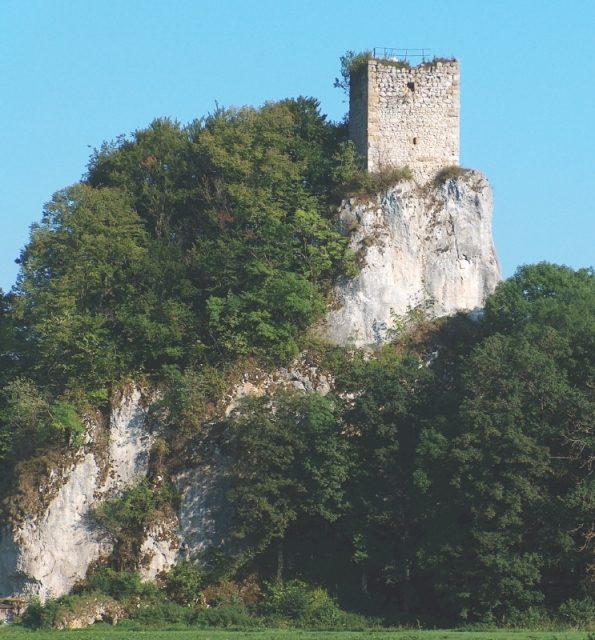
The Dietfurt ruin is a castle ruin in the hamlet of Dietfurt, which belongs to the municipality of Inzigkofen in the district of Sigmaringen in Baden-Württemberg. The Dietfurt Castle Cave, located beneath Dietfurt Castle, is one of the most important archaeological sites in Southern Germany from the Late Upper Paleolithic and Mesolithic periods.
Dietfurt is located between Beuron and Sigmaringen in the Upper Danube Nature Park.
The keep of the hilltop castle, a widely visible remnant of the former castle, rises in an exposed and strategically favorable position on a freestanding rock surrounded by the Danube.
Entering the castle grounds, which are owned by the Sigmaringen Mountain Rescue Service, is prohibited. Access to the castle cave is secured by a locked massive steel door. Visits are possible to a limited extent upon registration at the mountain rescue house near the ruin, at one's own risk.
In the 1920s and 1930s, the area around the Dietfurt ruin was a meeting place for the Neutempler-Orden (New Templar Order). This elite men's society was considered one of the pioneers of Nazi ideology. The castle cave is of particular archaeological importance because continuous human use can be proven from the Stone Age to the 16th century.
Early Settlement
The castle is one of the early castle foundations of the 11th century. However, the rock was settled much earlier. Excavations in the castle cave yielded finds from the late Paleolithic (Old Stone Age), Neolithic (New Stone Age), Middle Bronze Age, Younger Urnfield period, Middle and Late Hallstatt period, Roman epoch, and Middle Ages. The name "Dietfurt" itself, Old High German for Diota, the people, also indicates an early settlement.
Middle Ages
The name Dietfurt was first mentioned in 1095 in connection with the founding of Alpirsbach Monastery, when the brothers Heinrich, Eberhard, and Hermann von Dietfurt were named as witnesses. A renewed mention of the Dietfurt brothers in a document concerning Alpirsbach Monastery is recorded from 1125. In 1132, Berthold, the Truchsess of Waldburg, renounced the imperial fief of Dietfurt in favor of Count Mangold II von Nellenburg in the presence of the king. At this time, the nobles of Dietfurt had already died out.
In 1253, Dietfurt was in the possession of the Truchsessen von Waldburg. A short time later, in 1257, Dietfurt became an imperial fief of Hugo von Montfort. The first documentary mention of the castle dates back to 1274.
In 1421, the brothers Egg and Heinrich von Reischach sold Dietfurt as a Nellenburg fief to Anna, Countess of Werdenberg, daughter of Baron Johann von Zimmern. Anna, Countess of Werdenberg zu Dietfurt, died on March 1, 1445, and was buried in Inzigkofen Monastery. In 1468, during the protective and defensive alliance of the high nobility against the belligerence and feuding of some noblemen, Dietfurt was referred to as a strong castle.
After the extinction of the Counts of Werdenberg, the castle passed to the House of Fürstenberg in 1534, and in 1806 it passed to Hohenzollern-Sigmaringen.
Sigmaringen Mountain Rescue Service
The hut built by the Neutempler in the castle moat was inhabited during wartime by evacuated family members of an order member from bombed-out Berlin. After the war, refugees from the East lived in the hut, before the Mountain Rescue Service took over the hut in the 1950s after a longer period of vacancy. In 1959, the Sigmaringen Mountain Rescue Service leased the ruin. In 2004, the entire area, including the hut, ruin, and castle cave, was purchased by the DRK Sigmaringen. In the same year, the service also undertook the task of renovating the hut itself and carrying out safety measures on the tower. A year later, the renovation of the ruin began.
Since 2007, continuous preservation measures have been carried out on the castle ruin by the Mountain Rescue Service. As rock material crumbled from the ruin was used for surrounding buildings over the centuries, foreign limestone material had to be brought in from other parts of the Danube Valley and the Heuberg. To rule out that this foreign material consists of hewn stones from other castles, only rock from rockfalls and freshly broken material is used.
By July 2010, the Mountain Rescue Service had invested over 50,000 Euros and thousands of working hours in the renovation and maintenance of the masonry. In the summer of 2010, work was underway to reinforce a longer section of the shell wall with trass mortar at the cave entrance. This shell wall, made of large boulders, protected the actual masonry, which was composed of small stones. The remaining 13 meters of this inner masonry will not receive a new shell. Previously, the oak plank floor in the tower was secured to the extent that it can be safely walked on again. In a next step of the preservation and renovation of the ruin, the entrance area is to be enlarged.
In 2011 alone, a total of 597 working hours were spent on self-performed work. Since 2007, the members of the Mountain Rescue Service have installed 73.41 tons of lime mortar, 64.32 tons of limestone, and five tons of wall gravel.
Dietfurt Castle Cave+
The Dietfurt Castle Cave, a limestone cave, is located beneath Dietfurt Castle. It is a through-cave that traverses the rock and has a portal on both sides. The main passage is about 40 meters long from one portal to the other. Three larger halls (with a height of up to 8 meters) are connected by a passage, and the path drops about 10 meters from one portal to the other, which necessitated some stairs. The cave is developed and was formerly electrically lit, but was never a show cave. It lies at 600 and 610 meters above sea level, respectively.
Early History
The cave contains Tertiary deposits. Above these is a one-meter-thick sinter layer, above which, in turn, are lake sediments from the Riss Ice Age. The Riss glacier had blocked the Danube Valley near Vilsingen at that time, leading to the damming of a large lake.
Neutempler-Orden (New Templar Order)
In 1924, the Neutempler-Orden, also known as Ordo Novi Templi (ONT), acquired the two parcels of land "Ruine" (ruin) and "Burggraben" (castle moat). It traces its name back to the medieval Knights Templar, for whom the order's founder had a special fondness. The castle was designated as the Order Knight's Castle of the Neutempler Erzpriorat Staufen. The hut of the Sigmaringen Mountain Rescue Service was the location and accommodation of the ONT from 1928 to 1939. The ONT had built the hut and developed the castle cave into a cultic sacred space between 1928/1929. The former cave portal was walled up except for a small window, and the three rooms were extensively reworked. The main hall was equipped with a large chandelier and an altar.
The ONT was founded by Josef Adolf Lanz (1874–1954), who came from Vienna and, after studying theology and being ordained a priest (order name: Georg), left the Heiligenstift monastery near Vienna, as an anti-Semitic and anti-feminist secret society. Lanz became known as Dr. Jörg Lanz von Liebenfels; the doctorate and noble title were freely invented but were entered by him into the official Austrian registration register.
The Dietfurt Castle Cave is sealed with a wall erected by the Neutempler. Its Romanesque-inspired windows are the first indications of the sacred character of the inner complex. Above the current massive steel door is the coat of arms of the Silesian noble family von Hochberg. A member of the family financed and led the order's establishment as Prior of the "Erzpriorat Staufen," the cover name of the establishment. Another member in Dietfurt was, with high probability, the later Field Marshal Walther von Brauchitsch, who fell out of favor with Hitler during World War II after a steep career. Written evidence is lacking, but contemporary witnesses clearly remember him.
In the cult room, one can still see on the cave ceiling the deflection point of a chandelier with natural candles, installed by the Neutempler, which is now lost. Below it was a stone altar, in whose slab a sacrificial bowl was incorporated. Here, the "services" of the Neutempler took place, which, since Lanz was a priest and had developed his own liturgy, can be imagined as quite similar to a Catholic service.
There are no indications of the significance of the lower cave hall for the Neutempler. The wall that closes the former exit of the cave to the outside (this probably belongs to the castle's escape system) also originates from the Neutempler. In the window was a stained-glass image of St. Michael, who had special significance for the Neutempler. Just as Michael vanquished the dragon, the Neutempler wanted to annihilate the "subhumans."
Current Use
The cave has been made safely accessible by the Sigmaringen Mountain Rescue Service and equipped with electric light. However, the entire area and the cave are not accessible to the public, but in individual cases, visits are possible after consultation with the Mountain Rescue Service.
Archaeological Research
Looting
After World War II, unknown individuals searched the cave for a legendary treasure. This treasure was said to be a golden skittles game. In doing so, they left behind a large pit, one meter wide, four meters long, and five meters deep, destroying prehistoric find layers.
State Excavation Campaigns
After Urnfield, early, and high medieval pottery shards were discovered in this looters' pit in 1970 by employees of the Sigmaringen Mountain Rescue Service, the State Office for Monument Preservation conducted extensive excavations between 1972 and 1995 in cooperation with the University of Cologne. These had become necessary because there had been repeated larger, uncontrolled looting in this cave. Archaeological research found remains from the Middle Stone Age (Mesolithic), Late Stone Age (Paleolithic), and Magdalenian periods. In 1974, an excavation campaign was carried out by Hartmann Reim in the castle cave. Ten years later, in 1984, an excavation by the State Office for Monument Preservation followed. Due to the finds, another excavation by the State Office for Monument Preservation took place in 1987/1988.
The "Burghöhle" became particularly known for the discovery of a Late Bronze Age (Urnfield period) clay plate with concentric circle decorations. This object, also called an altar plate, suggests a cultic use of the cave.
Dating
A particular focus during the excavations was on the find layers from the Late Paleolithic and Mesolithic. In Franz Josef Gietz's publication, the extensive assignment of the finds to the layers from the not always straightforward stratigraphy of the cave is carried out. Three main complexes are distinguished with Late Upper Paleolithic, Early Mesolithic, and Late Mesolithic/Neolithic find horizons. With this differentiated sequence, the cave is one of the most important sites in Southern Germany with findings and finds from the transition from the Ice Age (Pleistocene) to the Post-Ice Age (Holocene).
Take Mobile History with you
You are reading this text for free. Premium adds what matters on the road: descriptions read aloud, sites found through your camera, whole regions taken offline.
- Every description, including the ~17,700 Premium sites
- Audio guide: have descriptions read to you on location
- AR finder: see sites through your camera, with distance and bearing
- Unlimited saved sites
14 days free, then from €2.99 a month. Cancel anytime.
Source: Wikipedia · Licence: CC BY-SA 4.0
This description draws on the facts documented in the linked Wikipedia article; Wikipedia content is licensed under CC BY-SA 4.0. Wording and editing: Mobile History.
Location: 48.0782, 9.1393