The remains of the Castle can be visited
RuinDernbach
Dernbach Castle (Ruin)
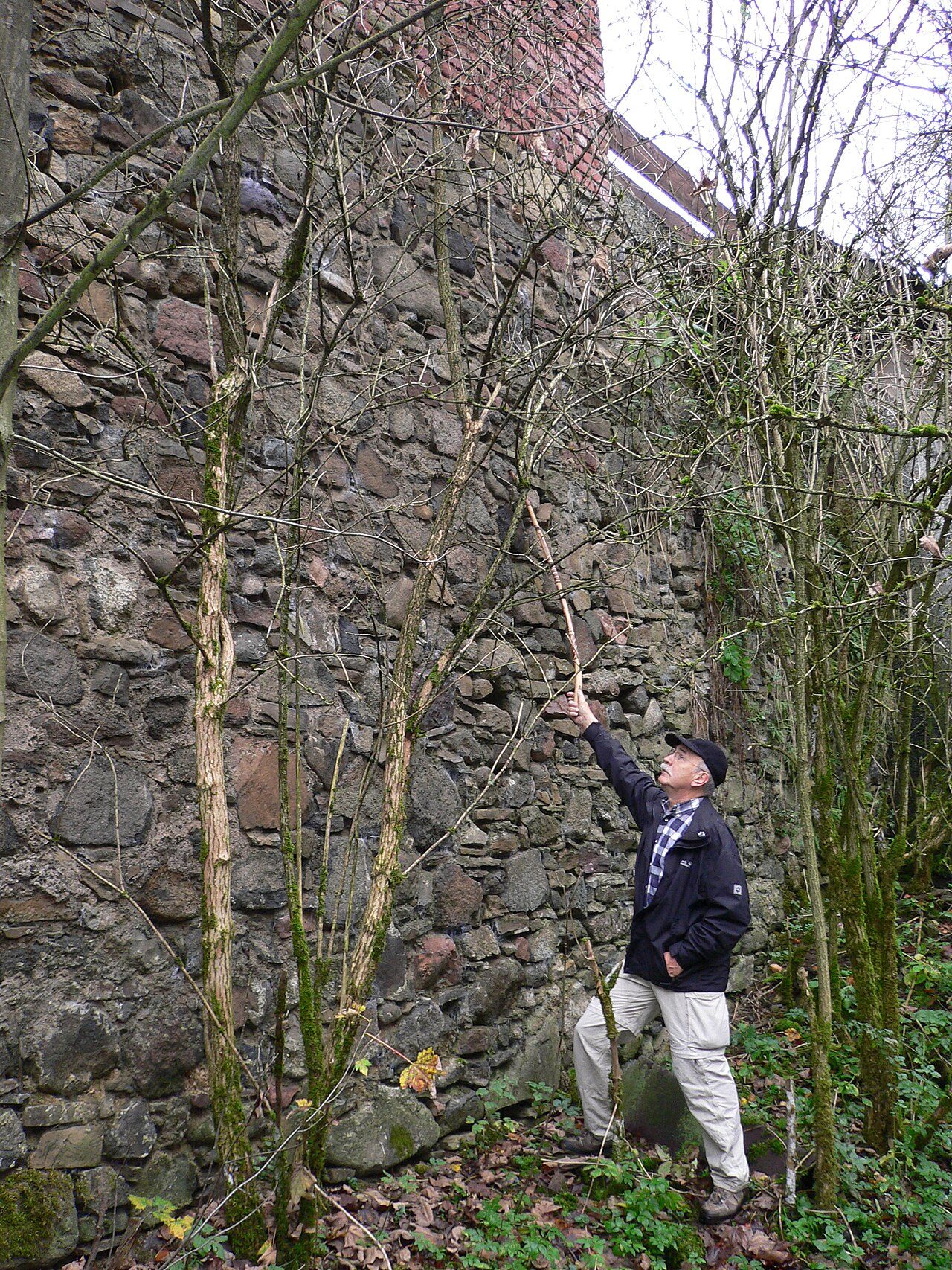
Neu-Dernbach Castle is a castle ruin on a hill at about 480 m above sea level in the locality of Dernbach, a district of the municipality of Bad Endbach in the Hessian district of Marburg-Biedenkopf.
The hilltop castle was built before 1350 by the Lords/Knights "von Dernbach" with the support of the Haincher line of the Lords "von Bicken" and pledged to the Landgrave of Hesse, who immediately re-pledged it to the "von Dernbach" in 1350.
Of the former castle complex, meager remains of the outer wall and rudiments of two shell towers (corner towers) in the castle wall are still preserved.
After the end of the more than 100-year-long Dernbach Feud (approx. 1230 to 1336), the Dernbachs left their former ancestral seat in Alt-Dernbach, a farm settlement with a small moated castle, presumably only a motte, on the Aar west of Herbornseelbach. Alt-Dernbach, first mentioned in 1263, was located at the ford of the "Hohen-Straße" coming from the Schelderwald and leading to Herborn through the Aar. The co-heirs of Dernbach also had to sell their extensive possessions and rights in the Herborn Mark to the Counts of Nassau after the end of the feuds in 1333. The Dernbach co-heirs also included the Dernbach family branches who lived at Vetzberg Castle. They sometimes called themselves "von Dernbach," "von Vetzberg" without and with an added name such as "Rode," "Holzapfel," "Krig," or "Mul."
Kuno von Dernbach married Countess Margarete von Solms in 1354 and received as a dowry, with the consent of the Landgrave, the villages of Günterod and Krumbach, as well as the new village of Dernbach from the Landgrave. Furthermore, after the territory of the "Obergericht" Blankenstein (coinciding with today's municipality of Bad Endbach) had finally come to Hesse, the Dernbachs received estates in the surrounding villages (eleven alone in Wommelshausen) that had previously belonged to opponents of the Landgrave.
The castle belonged to two family branches, namely the "von Dernbach" and the "von Dernbach called Graul" (Grauel/Graul > byname). In 1540, Peter von Dernbach, known as Graul, sold his share of the castle to the Hessian Landgrave and moved to Wiesenfeld to his relative, the Hessian provost Philipp von Dernbach, who had taken over the former Commandery of the Knights Hospitaller there. The family branch remaining in Dernbach, the "von und zu Dernbach," already lived outside in the castle estate at this time. The castle, which was already considered old and dilapidated in 1570, continued to decay. The last representative of his lineage who lived at the ancestral seat in Dernbach was Peter Philipp Friederich von und zu Dernbach (* 1678, godfather of the Prince-Bishop of Würzburg). He died after a riding accident on January 2, 1729, leaving only an illegitimate son, Johannes Schneider (1706-1791), known as "Junker Hans," who lived as a princely forester in Dernbach. His line has continued through his daughter Elisabetha Margaretha to this day.
In 1748, the enfeoffed family branch died out with Friedrich Ludwig Christian von Dernbach, a 40-year-old captain of the Landgrave of Hesse-Kassel's guard. He was married to Amalie von Breidenstein. The couple had no children. Hesse confiscated the castle and the associated lands as an expired fief, built a new manor house in 1750, and leased the lands. The manor house has also long since disappeared. The last farm buildings were demolished in the mid-19th century.
Significant Family Members+
A son of Peter von Dernbach, known as Graul, who moved to Wiesenfeld in 1540, the Evangelical-Lutheran baptized Balthasar von Dernbach, known as Graul, came to his uncle, Abbot Wilhelm Hartmann von Klauer zu Wohra (1568–1570), in Fulda at the age of 12. He was raised Catholic there and was elected Prince-Abbot of Fulda in 1570 at the age of 22. His nephew Peter Philipp von Dernbach, known as Graul, studied in Rome, was elected Prince-Bishop of Bamberg and Duke in Franconia in 1672, and additionally Prince-Bishop of Würzburg in 1675. He obtained from Emperor Leopold I, whom he knew personally from their shared time as vice-dom of the Diocese of Bamberg in Carinthia, the elevation of his family to the Imperial Baronial status and for himself and his nephews the elevation to the Imperial Count status, with seat in Wiesentheid. However, his nephews all died without surviving descendants. The heiress of the Imperial County of Wiesentheid (between Würzburg and Schweinfurt) with its extensive possessions was the only 17-year-old Maria Eleonore, née Countess von Hatzfeld-Gleichen, widow of Johann Otto von Dernbach, known as Graul zu Wiesentheid. She married Count Franz von Schönborn and brought her rich inheritance into the marriage. The Counts von Schönborn thus became the heirs of the Counts von Dernbach.
The "most venerable Bishop of Würzburg and Bamberg," Peter Philipp von Dernbach, is named as the godfather of Peter Philipp Friederich von und zu Dernbach, baptized Evangelical-Lutheran on April 14, 1678, in the baptismal register of the Hartenrod (municipality of Bad Endbach) church book.
The Last Dernbach Woman+
The last descendant of the Lords von Dernbach, Therese Freiin von Dernbach, born in 1885 in Frankfurt a.M., daughter of Wilhelm August Ludwig Freiherr von Dernbach, died as the married Freifrau von Schorlemer on November 1, 1965, in a retirement home in Weilburg. Her only son died in 1946 in an accident while a French prisoner of war.
Take Mobile History with you
You are reading this text for free. Premium adds what matters on the road: descriptions read aloud, sites found through your camera, whole regions taken offline.
- Every description, including the ~17,700 Premium sites
- Audio guide: have descriptions read to you on location
- AR finder: see sites through your camera, with distance and bearing
- Unlimited saved sites
14 days free, then from €2.99 a month. Cancel anytime.
Source: Wikipedia · Licence: CC BY-SA 4.0 · Image: H2OMy at German Wikipedia / Public domain via Wikimedia Commons
This description draws on the facts documented in the linked Wikipedia article; Wikipedia content is licensed under CC BY-SA 4.0. Wording and editing: Mobile History.
Location: 50.7806, 8.5058