The remains of the Castle can be visited
RuinKlingenberg
Clingenburg Castle (Ruin)
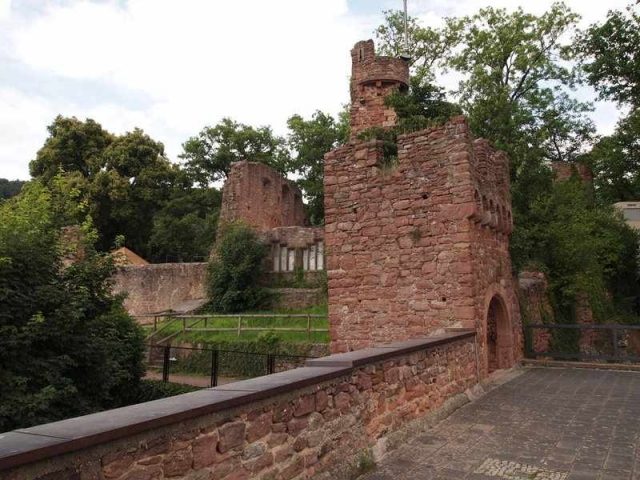
The Clingenburg is a Staufer hilltop castle built by Conradus Colbo from the House of Schenken von Limpurg on the right bank of the Main river in the municipality of Klingenberg am Main in the Miltenberg district in Bavaria, Germany. The extensive ruins of the Clingenburg rise about 40 meters above the core of the town of Klingenberg on the western edge of the Spessart. Between the town and the Clingenburg lies a terraced vineyard, where the Klingenberger Rotwein (red wine) grows on its steep slopes. The Franconian Red Wine Hiking Trail passes the castle ruins, leading about 500 meters upstream to an observation tower rebuilt in the 1990s.
The Schenken von Limpurg
Conradus Colbo, one of the Schenken von Limpurg and cupbearer to Emperor Frederick Barbarossa, built the Clingenburg around the year 1100 in place of the small Old Castle in the Clinge below the former early medieval Hainburg. In 1177, this name first appeared in a document issued in Venice, in which Conradus Colbo referred to himself as Conradus prinzerna de Clingenburg. The neighboring castles in Collenberg and Stadtprozelten also belonged to the influential Schenken von Limpurg. In the mid-13th century, three Schenken still lived at Clingenburg: Albert, who later joined the Teutonic Order; Walter, who moved to the Nuremberg-Hersbruck area after his marriage to Elisabeth von Königstein-Reicheneck; and Conrad with his wife Guda. Shortly before his death in 1246 in Augsburg, Conrad also attended the wedding of Conrad IV of Hohenstaufen to Elisabeth von Wittelsbach.
The Bickenbacher
Conrad's widow, Guda von Clingenburg, brought the entire property around Klingenberg into her second marriage with Conrad von Bickenbach from Burg Bickenbach, today Schloss Alsbach on the Bergstraße. He was a nobleman and minnesinger loyal to the Pope and anti-Staufer, in contrast to the Schenken. This marriage founded the new House of Bickenbach, from which many influential men and women, such as canons, abbesses, a prince-abbot, and a master of the Teutonic Order, emerged over the following 250 years. The Bickenbacher married into many influential families in the Rhine-Main region. For example, the ancestress of the House of Dalberg was a Bickenbacher, as was the mother of the Archbishop of Mainz, Dietrich von Erbach. Despite extensive kinship, the House of Bickenbach died out with the death of Ronrad VIII in 1486 or Monrad VII in 1497 (differing sources). For some of the Bickenbacher, the Church of St. Michaelis in the village of Grubingen, which was later abandoned around 1630, served as their burial place.
Archbishopric of Mainz
After the extinction of the Bickenbach family, the Archbishopric of Mainz initially acquired parts of the uninhabited castle and its surroundings. By 1500, the castle, town, and lordship of Clingenburg were entirely in the possession of Mainz. The Archbishopric appointed the bailiff Johann Leonhard Kottwitz von Aulenbach as administrator, but he soon moved into the town castle he had built and left the Clingenburg to decay. The legend that the castle was destroyed by French troops cannot be substantiated.
Current Use+
Around 1870, high profits from the municipal clay pits enabled Klingenberg to acquire the remains of the castle and its surroundings and have them prepared as a festival ground, where castle plays and theater performances have taken place irregularly since 1891. Distinguished guests, such as Bavarian kings, also attended these events.
The tradition of the castle festivals briefly revived from 1926 to 1928, when the Andreas Hofer Festivals and the Wilhelm Tell Festivals were held.
Around 1968, the city had the remaining moat filled in to create parking spaces for a planned castle restaurant. Surprisingly, the State Office for Monument Preservation approved the integration of the modern-style restaurant into the ruins of the Clingenburg. From 1969 to 1979, the castle courtyard was filled with theatrical life by the amateur actors Bickenbach.
Since 1994, theater performances have again taken place at the Clingenburg. The Clingenburg Festival brings musicals, operas, plays, and concerts to the open-air stage between the high wall remnants of the former palace for eight weeks every summer. The castle festivals are accompanied by classical concerts and cabaret in the Klingenberg town castle. Around May 1st each year, the Historic Wine Festival takes place at the Clingenburg.
Description+
Of the original Staufer castle, only the archway and the massive foundations of the round keep remain. The restaurant is situated between the foundations of the former kitchen and servants' quarters. To the side of its dominant valley-facing window front extends a wide viewing terrace, from which the vineyards immediately slope down towards the town.
Of the predecessor buildings, the early medieval Hainburg within a Celtic ring fort and the Old Castle, only earth changes, ramparts, and an artificially elevated hill can still be found.
Image source: www.wehrbauten.de
Take Mobile History with you
You are reading this text for free. Premium adds what matters on the road: descriptions read aloud, sites found through your camera, whole regions taken offline.
- Every description, including the ~17,700 Premium sites
- Audio guide: have descriptions read to you on location
- AR finder: see sites through your camera, with distance and bearing
- Unlimited saved sites
14 days free, then from €2.99 a month. Cancel anytime.
Source: Wikipedia · Licence: CC BY-SA 4.0
This description draws on the facts documented in the linked Wikipedia article; Wikipedia content is licensed under CC BY-SA 4.0. Wording and editing: Mobile History.
Location: 49.7825, 9.1843