The remains of the Castle can be visited
CastleTrin
Canaschal Castle (Ruin) (Trin)
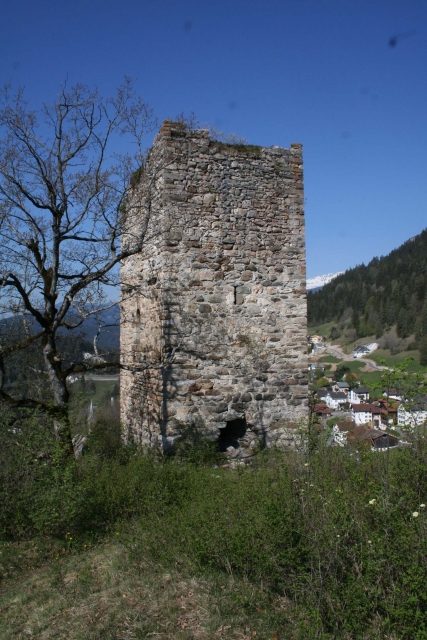
The ruin of Canaschal Castle is one of two castles in the municipality of Trin, a municipality in the Imboden district of the canton of Graubünden in Switzerland, above the former main traffic artery halfway between Reichenau and Flims. The other complex was Crap Sogn Parcazi.
Location+
The ruin is located in the southeastern part of the village on the small hill Canaschal and is easily accessible on foot in a few minutes.
Complex+
Only the square western main tower with its footprint of just under ten by ten meters remains of the original complex. The wall thickness on the ground floor is 2.2 meters. Of the three floors, the upper two were added later, which is clearly visible from the different masonry. The walls consist of large blocks, the corners of bossed ashlar. The high entrance with a well-preserved round arch was in the southeast wall on the second floor and was accessible via an arcaded walkway, as some beam remnants show. At the southeast corner, about two meters above ground level, a bossed ashlar shows a human face, which, however, is barely recognizable as such. Inside, a fireplace niche with a smoke vent shows that the tower was inhabited. The tower can be entered through an opening that was subsequently broken in.
On July 2, 1470, when Vogt Capol, appointed as administrator, and his wife were invited to the Lords of Reichenau, the castle burned down; the reason was negligence in handling fire. The Vogt's two children and the maid are said to have died in the fire. The castle was probably abandoned thereafter.
Of a second tower, about the same size, presumably of older origin and unknown height on the east side, only wall remnants remain. The two towers could have been connected by a wall.
The history of the castle on Canaschal is closely linked to the history of the Lordship of Hohentrins. In feudal times, Trin, together with Tamins and Reichenau, formed the Lordship of Hohentrins. The actual Hohentrins Castle, which was previously assumed to be in the western tower of Canaschal, was, according to excavation results, located at Crap Sogn Parcazi west of the village.
However, who built Canaschal is not known. According to an uncertain source (Hans Erni (II Signuradi da Trin, 1945)), Pippin the Younger, the father of Charlemagne, is said to have built Camaschal between 714 and 718.
After the extinction of the Lords of Hohentrins, the lordship and castle first passed to the Barons of Wildenberg, later into the possession of the Lords of Werdenberg-Heiligenberg, who, however, mortgaged it twice to the Barons of Rhäzüns in the second half of the 14th century.
After the death of Count Hugo V of Werdenberg, the Lordship of Hohentrins passed in 1428 to his nephew from Southern Baden, Peter von Hewen, who was married to Anna von Werdenberg (Heinrich von Hewen). Hohentrins remained in the possession of the Hewen family until 1568, then passed to Johann von Planta and fifteen years later to Rudolf von Schauenstein in Haldenstein. In 1616, the municipality of Trin was able to buy itself out of the lordship, whereupon the seat of the Lordship of Hohentrins was moved to Reichenau.
Take Mobile History with you
You are reading this text for free. Premium adds what matters on the road: descriptions read aloud, sites found through your camera, whole regions taken offline.
- Every description, including the ~17,700 Premium sites
- Audio guide: have descriptions read to you on location
- AR finder: see sites through your camera, with distance and bearing
- Unlimited saved sites
14 days free, then from €2.99 a month. Cancel anytime.
Source: Wikipedia · Licence: CC BY-SA 4.0
This description draws on the facts documented in the linked Wikipedia article; Wikipedia content is licensed under CC BY-SA 4.0. Wording and editing: Mobile History.
Location: 46.8281, 9.3656