The remains of the castle, which was after 1945 senselessly destroyed, can be visited.
RuinBlankenberg
Blankenberg Castle (Ruin)
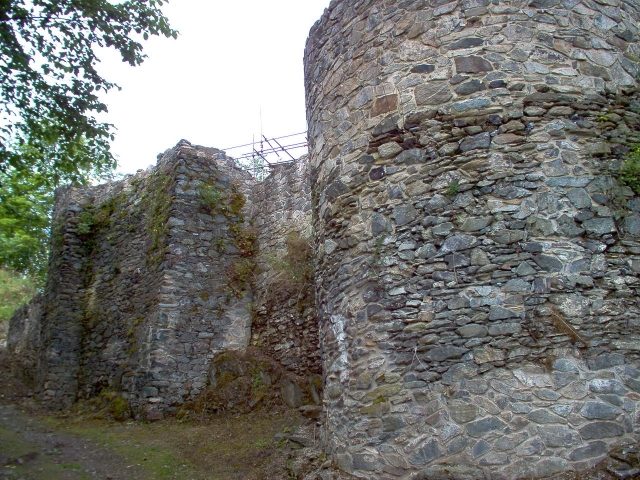
The castle originally belonged to a series of defensive fortresses on the Saale, was originally an imperial fief, and then had various owners over the centuries.
The assumption that it was built as a coercive castle against the Sorbs is far-fetched. More likely is the assumption of a Major von Herzberg, which is based on tactical considerations and places the emergence of castles on the upper Saale in the time of the struggles between Staufer and Welfen.
The Egerland was most threatened by an attack by the Welfen, an important factor in the domestic and imperial policy of the Staufer. To protect it, Emperor Frederick I created the Vogtland between the Saale and Mulde, which formed a strong obstacle in the steeply sloping Saale valley to the west and northwest. For this purpose, the castles on the right bank of the upper Saale were probably also built on the emperor's orders. The left flank of the main defensive line was secured by the upper Saale when the river crossings were blocked.
With the beginning of the modern era, the castle, like all castles, had lost its original purpose as a defensive structure. They slowly became palaces, where comfort took precedence over security and fortification. The palace was a residential building with rounded corners; it had Romanesque masonry, which had been poorly restored in recent times. The towering main building was made of slate slabs and stood on a rock block, which was separated from the rest of the terrain by a still visible moat. Externally, seven massive buttresses dominated, and the lower floors had only light slits and embrasures. Only the upper floors had windows. The medieval castle was gradually transformed into a palace-like structure by its owners, both inside and out. The outer areas formed a large courtyard for the management of the manor. For the palace residents, Sunday service took place in the palace chapel belonging to the palace.
Until the end of the Second World War, the defiant structure of the castle remained almost unchanged. In connection with the expropriations by the land reform, the then Soviet occupation force issued Order No. 209 for the demolition of noble residences. Thus, on June 14, 1948, the Old Castle, as it was popularly called, was blown up after more than 700 years of history.
Until the political change in 1989, the pile of rubble almost fell into oblivion. Only at the beginning of the 1990s did committed citizens come together and, since 1995, under expert guidance, uncover the remains of the castle. Thus, the jousting ground with the newly bricked gate is again clearly recognizable. The retaining walls were partly rebuilt; a castle garden with a pavilion was laid out. The cross vault of the manor building was restored, and a small collection of finds from the excavations was set up there. In 2007, on the occasion of the 775th anniversary, a 1:10 scale model of the castle was placed on a rondel at the foot of the ruin.
Take Mobile History with you
You are reading this text for free. Premium adds what matters on the road: descriptions read aloud, sites found through your camera, whole regions taken offline.
- Every description, including the ~17,700 Premium sites
- Audio guide: have descriptions read to you on location
- AR finder: see sites through your camera, with distance and bearing
- Unlimited saved sites
14 days free, then from €2.99 a month. Cancel anytime.
Source: Wikipedia · Licence: CC BY-SA 4.0
This description draws on the facts documented in the linked Wikipedia article; Wikipedia content is licensed under CC BY-SA 4.0. Wording and editing: Mobile History.
Location: 50.4009, 11.7152