The remains of the Castle can be visited
RuinEisenbach
Bacheburg Castle (Ruin)
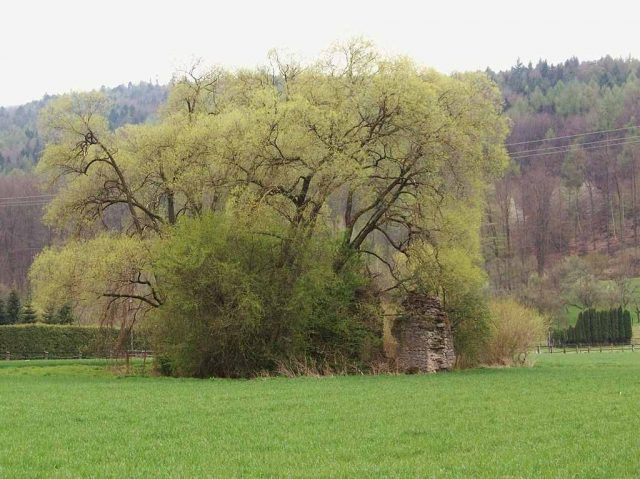
The Bacheburg was a medieval moated castle of the lower nobility Bache von Neustadt, located between Mömlingen and Eisenbach in the Miltenberg district in Bavaria, directly on the state border with Hesse (Odenwaldkreis).
The castle ruin (also called Untere Burg - Lower Castle) is located on an open field about 150 m southwest of the Mümling in today's Obernburg district of Neustädterhof, halfway and east of the access road from the B426 to Neustädterhof. It is probably the successor to a motte or hillfort (called Obere Burg - Upper Castle) that existed until about 1400 on the Schneirersbuckel behind the Neustädter Hof. This was built on an artificially raised mound and probably looked similar to the still preserved Templerhaus in Amorbach. Just as the old castle was destroyed in conflicts with the House of Erbach, only forty years later the second castle also met its end in a conflict with an Erbacher.
The so-called Bacheburg was built in 1403 by Jorg Bache von Nuwenstat, who later named himself after his castle. Nuwenstat here does not refer to today's Breuberg district of Neustadt (newly founded in 1378), but to the much older Neustadt (first mentioned in 1113) and thus to the Obernburg district now known as Neustädter Hof. The castle was built on ancestral property, near the church of Neustädter Hof, demolished in 1863, which was probably the family's burial place. In one of two former stone slabs, which today stands at the Mömlingen church, the Bache coat of arms is said to have been carved in the 19th century.
Jorg Bache had probably tried with risky efforts, in that time very unfavorable for the knightly nobility, to avert the financial ruin of his house and to secure a life befitting his family's status. According to several documents, he was forced to enfeoff his small castle to the Counts of Wertheim as the then lords of Breuberg Castle. Nevertheless, he had his wife's rights to the building secured, which was probably intended as a widow's residence.
Jorg was married to Agnes von Erlebach. Through her, the knight came into Bamberg feudal property, and thus also into legal relations with the neighboring church, which belonged to the Bamberg Cathedral Provostry. The couple's sense of status is attested by a four-coat-of-arms stone, which once adorned the entrance of the moated castle and is now walled into the backyard of the Obernburg Roman Museum. It shows the parental coats of arms of the two, on the left the Schelris von Wasserlos and von Erlenbach (Agnes's mother and father), on the right the Raups (or von Sulzbach) and the Bache (Jorg's mother and father).
According to a document from 1434, Jorg Bache, probably after disputes over the Pfaffstangengut, a manorial farm in the former village of Hausen unter der Sonne (today a deserted village), was excommunicated by the dean and chapter of the Aschaffenburg Collegiate Church. In this context, the capture of the then local priest of Wenigumstadt by one of his sons, named Hans Bache, probably also stands. It is known that Jorg's sons Hans and Madern attacked and probably robbed travelers who were under the escort of the Archbishop of Mainz in the following years. One of the reasons was probably the disputes and the lack of money that occurred after their father's excommunication. In 1440, the castle was therefore taken and destroyed by riders of the Archbishop of Mainz Dietrich Schenk von Erbach. Hans Bache, as the main culprit, had to remain under house arrest in the burned-down castle for a year. In 1441, the two sons sold the (remaining) property at Neustädter Hof. Hans became a Wertheim castleman at Breuberg, Madern a Palatine servant at Veste Otzberg. With the destruction of the castle by fire, all wooden building parts burned, so that the building was largely uninhabitable.
Around 1700, the old walls of the robber knight ruin were used as a retreat and shelter by a robber known as "Belljouseph" (Beggar Joseph). In 1750, an entire gang of thieves was imprisoned in the castle ruin. At the end of the 18th century, the moated castle was further destroyed. A tenant farmer used the stones of the still quite high walls, which were dismantled and used for the repair of the Mömling bridge and for bank protection. Other more resistant parts are said to have been blown up.
Today, only small parts of the castle remain as a ruin. A visit is only possible outside of agricultural cultivation (after harvest and in winter). It is the last of the four castles in the Eisenbach area; the predecessor castle and the two castles in the village of Eisenbach itself no longer exist today.
Unfortunately, no conservation measures are carried out for the remains of the Bacheburg, nor is its significance in the Middle Ages highlighted with information boards.
The castle was a small moated castle. The two lower floors were made of stone, above which the construction was half-timbered. The castle was surrounded by a moat about six meters wide. Silting remains of the moat are still visible.
After the destructions of the 18th and 19th centuries, only the small remnant of the Bacheburg remained, which can be seen in the field today. This includes the archway with remnants of the gatehouse on the northwest side, which provided access to the forecourt via a drawbridge. In the almost square castle, only in the southeastern corner was another house, no longer existing today, attached to the defensive wall. At the northeastern end, remains of the curtain wall can still be seen today.
Its coat of arms shows a black horizontal bar in the lower field, and a growing lion in the upper field. It refers to several lower noble families of the Mümling valley, who had "Bach" in their name and who existed around Breuberg Castle and attest to similar family coats of arms, such as the family von Rosenbach and the Bache von Nalsbach.
Take Mobile History with you
You are reading this text for free. Premium adds what matters on the road: descriptions read aloud, sites found through your camera, whole regions taken offline.
- Every description, including the ~17,700 Premium sites
- Audio guide: have descriptions read to you on location
- AR finder: see sites through your camera, with distance and bearing
- Unlimited saved sites
14 days free, then from €2.99 a month. Cancel anytime.
Source: Wikipedia · Licence: CC BY-SA 4.0
This description draws on the facts documented in the linked Wikipedia article; Wikipedia content is licensed under CC BY-SA 4.0. Wording and editing: Mobile History.
Location: 49.8416, 9.0938