The remains of the Castle can be visited
RuinHilders
Auersburg Castle (Ruin) (Hilders)
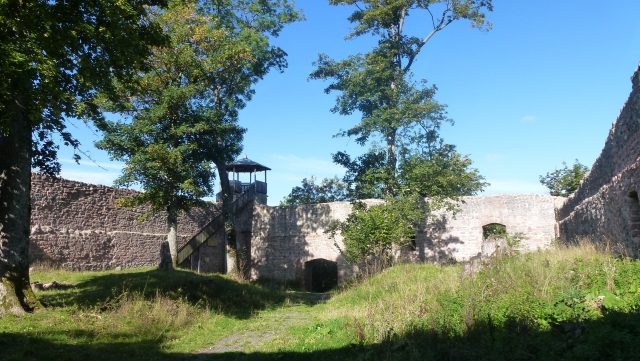
The Auersburg ruin is a castle ruin in the municipality of Hilders in the district of Fulda in Hesse. The complex now serves as a shelter and viewing platform.
The ruin is surrounded by forest on the southwest slope of the 757 m high Auersberg in the Rhön, at the end of a popular hiking trail north of Hilders. Built in a defensively unfavorable position on a front slope, it was probably intended from the outset only as a seat of power or an administrative center.
Although first mentioned in a document in 1214, the origins of the castle go back much further. The area around Hilders came into the possession of Regenher von Weid around 914 through an exchange of goods from Fulda Abbey, who probably built the first castle on the Auersberg. Around 1120, this was renewed or rebuilt in the style of a small knight's castle, probably by the Hennebergs, who had by then acquired the area, as a seat of power for a younger brother or as an administrative seat for one of their bailiffs. After that, its history in this border area between several rival spiritual and secular lordships was extremely varied.
In 1214, a Lord von Nithardshusen (= Neidhartshausen) from the House of Henneberg sold the complex to Fulda Abbey, which granted it as a fief to its own followers. In 1270, the castle was demonstrably in the possession of the Lords von der Tann as a Fulda fief.
After Fulda Prince-Abbot Bertho IV and Würzburg Bishop Berthold II von Sternberg had agreed to settle a long-standing feud over their border area, which began in 1282, the Auersburg found itself in Würzburg's possession in 1290. (A Würzburg priest had been active in Hilders since 1255.) Soon after, around 1325, the castle returned to the Hennebergs through purchase, who had been collegiate bailiffs and burgraves of Würzburg until the middle of the 13th century. Count Berthold VII von Henneberg-Schleusingen, who was elevated to prince in 1310, used the oppressive indebtedness of the prince-bishopric, the disputes between the clergy and the Würzburg citizenry, and the dispute between Hermann II Hummel von Lichtenberg and Otto II von Wolfskeel over the bishop's seat to acquire the castle, but then allowed it to gradually fall into disrepair.
In 1342, Bishop Otto II von Wolfskeel bought back the castle and the Auersberg office, and Hilders became the administrative seat of the Würzburg bailiff. Prince-Bishop Albrecht II von Hohenlohe had the dilapidated castle completely rebuilt in 1354 as an administrative castle to secure the border of his territory against the Hennebergs. In 1419, Johann II von Brunn, Prince-Bishop of Würzburg and Duke of Franconia, had to pledge the newly built Auersberg Castle to the Brothers von Eberstein and the Lords von der Tann. This pledge was renewed in 1454. This led to considerable disputes in 1477 between the Ebersteins, notorious for their belligerence, and the Lords von der Tann, which finally had to be settled by Prince-Bishop Rudolf II von Scherenberg.
During the Palatine Peasants' War, the interior buildings were set on fire and destroyed by passing peasants in the week from April 17 to 25, 1525. The castle was only hastily repaired and was thereafter only partially habitable. It was not until 1579 that Prince-Bishop Julius Echter von Mespelbrunn had the habitable part repaired again. At the same time, the Lords von der Tann lost their share in the office and cent court, but retained hunting and fishing rights in the Auersberg office as tenants. Only six years later, in 1585, the administrative seat was moved to Hilders. During the Thirty Years' War, the decaying castle repeatedly served as a refuge for the locals.
In 1686, the remaining interior buildings were demolished, and the complex practically served as a quarry. Only the surrounding walls remained. Around 1790, the outer curtain wall was also torn down to obtain building material for new constructions such as the parish church in Hilders. The fields and meadows laid out before and behind the castle since 1722 were abandoned and reforested.
In 1803, the Auersberg ruin and the Hilders administrative district came to Bavaria as part of the secularization. In 1848, the Royal Bavarian government prohibited further removal of stones. The entrance was uncovered and the front part of the interior was cleared of rubble. The first castle festival was celebrated in the thus tidied-up ruin. Further clearing work began in 1865.
After the German Unification War, the Hilders area with the Auersberg castle ruin came to Prussia in 1867.
From 1876 onwards, clearing and maintenance work was carried out seriously and systematically by members of the Rhönklub (Hilders/Tann section). In this year, the first repairs to the masonry also took place. On June 24, 1879, the restored entrance, a wooden observation tower, and access to the remains of an old vaulted cellar and the inner castle were inaugurated. Further major repairs were carried out in 1914, 1932, and 1940, as well as between 1957 and 1969. During this time, the wooden observation tower from 1879 was replaced by a solid staircase, missing masonry was added, and the wall was repointed. In 2007 and 2008, the wall was renovated by the state of Hesse, and the observation tower from 1969 was completely rebuilt.
Complex+
Of the polygonal ruin, only the surrounding wall with its loopholes on the attack side remained. The eastern attack side is separated from the slope by a ditch. The castle probably never had a keep, and only a remnant of a tower on the access side of the castle is still preserved. Except for a cellar, all other buildings have disappeared. Remains of the rampart and the ditch are still recognizable. Within the castle complex there is a monument to the Rhön poet Dr. Julius Türck.
Legends+
Various legends surround the Auersburg, such as that of the Ghost of the Auersburg and that of the Last Auersbergers.
Take Mobile History with you
You are reading this text for free. Premium adds what matters on the road: descriptions read aloud, sites found through your camera, whole regions taken offline.
- Every description, including the ~17,700 Premium sites
- Audio guide: have descriptions read to you on location
- AR finder: see sites through your camera, with distance and bearing
- Unlimited saved sites
14 days free, then from €2.99 a month. Cancel anytime.
Source: Wikipedia · Licence: CC BY-SA 4.0
This description draws on the facts documented in the linked Wikipedia article; Wikipedia content is licensed under CC BY-SA 4.0. Wording and editing: Mobile History.
Location: 50.5888, 9.9970