The remains of the Castle can be visited
RuinAue
Aue Castle (Ruin)
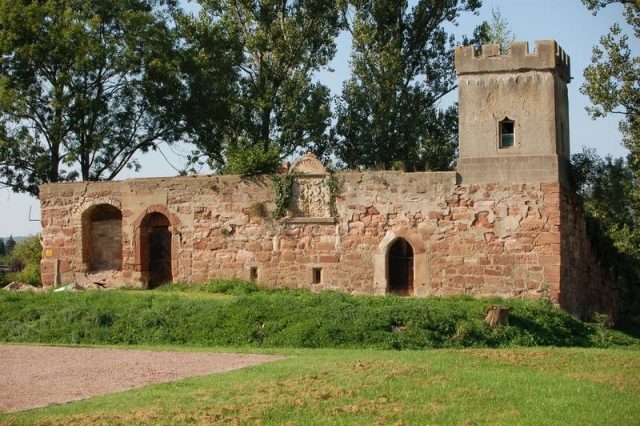
The Auer Wasserburg is the ruin of a former manor house at about 190 meters above sea level on the outskirts of Aue, a district of Wanfried in the Werra-Meißner-Kreis. The area belongs to North Hesse and is located directly on the border with Thuringia.
Construction of the lowland castle probably began around 1200, with the noble family of Aue being mentioned as the first documented reference in 1272, and in the 14th century, the knight Albert von Aue was a castellan in Eschwege.
The Lords of Aue died out in 1435, and at the end of the 16th century, the Lords of Eschwege built another manor house.
The castle was destroyed by Croatian troops during the Thirty Years' War. It was set on fire in 1637 and burned down to the stone ground floor. After that, it was not rebuilt.
In 2004, the castle ruin was the subject of archaeological investigations by the Hessian State Office for Monument Preservation. It originally represented a moated castle with a U-shaped floor plan, surrounded by a moat that is now silted up.
The Renaissance building was designed with multiple stories, the upper floors in clay half-timbered construction stood on a stone ground floor, which was still completely preserved. It was equipped with massive stone walls and covered with vaulted ceilings.
The rooms were still partially accessible. The fire debris from the upper floors lay on the vaults and had not been removed since the destruction, and the floors were not rebuilt. The upper part mainly contained broken roof tiles and clay walls.
Numerous small finds, metal objects, remains of door locks, door hinges, hooks, and hinges of various sizes were found on the limestone floor of the basement, which had been hardened by the fire. Parts of a knight's armor also came to light, as well as shattered glass finds from the bull's-eye panes of the windows and from vessels. Particularly noteworthy are the stove tiles from numerous stoves from the second half of the 16th century, so-called Reformation stoves with leaf tiles depicting biblical motifs. It is possible that the stoves were deliberately destroyed by the Croats because they represented a Protestant iconographic program. A sandstone portal, still partially preserved, bears witness to the former splendor of the castle. The investigations are ongoing.
Take Mobile History with you
You are reading this text for free. Premium adds what matters on the road: descriptions read aloud, sites found through your camera, whole regions taken offline.
- Every description, including the ~17,700 Premium sites
- Audio guide: have descriptions read to you on location
- AR finder: see sites through your camera, with distance and bearing
- Unlimited saved sites
14 days free, then from €2.99 a month. Cancel anytime.
Source: Wikipedia · Licence: CC BY-SA 4.0
This description draws on the facts documented in the linked Wikipedia article; Wikipedia content is licensed under CC BY-SA 4.0. Wording and editing: Mobile History.
Location: 51.1797, 10.1284