The remains of the Castle can be visited
RuinAmöneburg
Amöneburg Castle (Ruin)
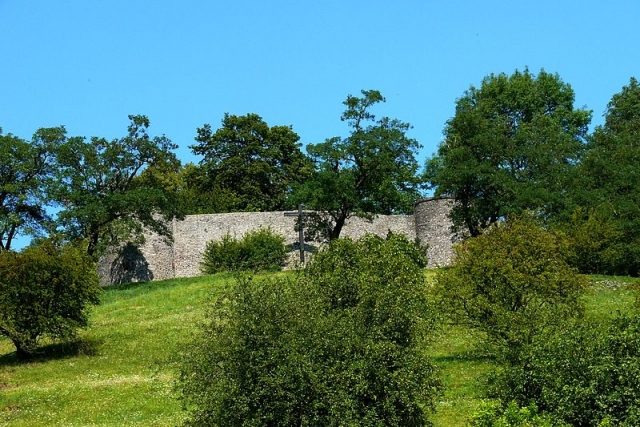
Amöneburg Castle, part of the municipal area of Amöneburg, is located a few kilometers east of Marburg in Hesse. The castle's name derives from the Celtic name "Amana" of the Ohm river.
Amöneburg is situated on the 365 m above sea level mountain of the same name. The mountain on which Amöneburg Castle stands is a basalt dome that formed about eight million years ago and belongs to a series of smaller volcanic vents, presumably offshoots of the Vogelsberg mountains. The mountain rises about 150 meters above the Amöneburg Basin.
Here, as with most volcanoes of this type, only subordinate basalt lava was erupted. Volcanic activity often began with gas explosions and the production of pyroclastic material. Only after this expulsion did the basalt lava flow out. On the steep eastern face of the mountain, meter-long basalt columns can be found.
Below the castle flows the Ohm river, which here traverses the Amöneburg Basin.
Even in Merovingian times, a fortress existed on the mountain. When Boniface began missionary work among the pagan-Christian population in and around Amöneburg in 721, he used the Frankish fortress of Amöneburg as his domicile. A visible expression of his missionary work was the establishment of a small monastery and a church within the castle complex. The church, like many early baptismal churches, was dedicated to the Archangel Michael.
During the Carolingian era, an extensive hilltop castle was built on the mountain. Its location was favored by its proximity to important long-distance roads (Lange Hessen, Weinstraße). From the 9th century onwards, the castle lost its importance.
In 1145, a new castle was built on the mountaintop by the Archdiocese of Mainz and its newly appointed burgrave Poppo von Reichenbach und Hollende. As early as 1165, this was destroyed by Landgrave Ludwig of Thuringia on behalf of Emperor Frederick I, but reconstruction immediately followed. The reason for the destruction was the support of the Archbishop of Mainz for Pope Alexander III.
A pledging to Kuno von Münzenberg is reported in 1183. In 1222, the castle was again occupied by Mainz castlemen, and from 1273, Amöneburg was the seat of the Mainz bailiff and thus the administrative center of the archdiocese's Upper Hessian possessions.
During the Thirty Years' War, Amöneburg was occupied several times. In 1621, General Christian von Braunschweig-Wolfenbüttel conquered the castle. On November 6, 1640, the castle was recaptured by imperial troops. On June 19, 1646, the castle was again conquered and subsequently destroyed by Hessian and Swedish troops under General Carl Gustav Wrangel. Between 1650 and 1675, the castle was partially renovated.
In the Seven Years' War in 1762, it was destroyed once more. In 1797, the castle hill was occupied by French troops during the First Coalition War.
In 1839, the castle buildings were finally demolished due to dilapidation.
Today, only the remains of residential buildings and parts of the curtain wall with flanking towers can be seen.
Layout+
Parts of the castle are still preserved, including remains of the keep, several cellars, outer walls of buildings, and the extensive zwinger with its outer towers. The zwinger towers feature loopholes for firearms. Originally, the castle had a three-wing complex consisting of a long building, a stable building, and a kitchen building, surrounded by a curtain wall. The castle was connected to the town fortifications of Amöneburg and was built from locally available basalt. Window and door frames are made of sandstone.
The freely accessible castle ruin serves every summer as the backdrop for the so-called OpenEyes Film Festival.
Take Mobile History with you
You are reading this text for free. Premium adds what matters on the road: descriptions read aloud, sites found through your camera, whole regions taken offline.
- Every description, including the ~17,700 Premium sites
- Audio guide: have descriptions read to you on location
- AR finder: see sites through your camera, with distance and bearing
- Unlimited saved sites
14 days free, then from €2.99 a month. Cancel anytime.
Source: Wikipedia · Licence: CC BY-SA 4.0
This description draws on the facts documented in the linked Wikipedia article; Wikipedia content is licensed under CC BY-SA 4.0. Wording and editing: Mobile History.
Location: 50.7963, 8.9214