The remains of the Castle can be visited
CastleWinterthur
Alt-Wülflingen Castle (Ruin) (Winterthur)
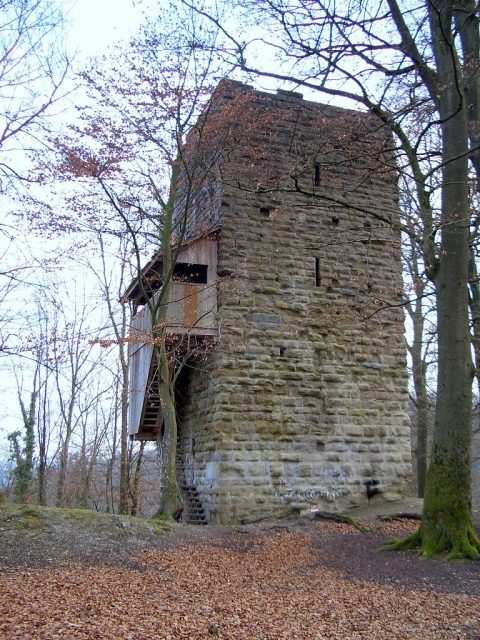
The castle ruin Alt-Wülflingen is hidden in the forest on a hill above the Totentäli near Winterthur in Switzerland. From its 18 m high, well-restored tower, which can be climbed inside via two spiral staircases, one has a beautiful view of the Töss and the Brühlberg, which separates the two city districts of Wülflingen and Töss. It is located 650 meters northeast of the Hoh-Wülflingen castle site (which was then called Neuburg), separated by the Totentäli.
Beginnings
The village of Wülflingen was an Alemannic foundation and was first mentioned in a document in 897 as "Wulfilinga", presumably named after the Alemannic leader Wulfilo or Wilfilo. The place seems to have been the seat of a comital family at least since the 10th century, which owned Wülflingen, Embrach, and Buch am Irchel as allodial and free property. Only Willebirg von Wülflingen is known by name from the family; she lived in the first half of the 11th century and was married to Count Luito (or Lütold) von Mömpelgard. Her son Hunfried (Umfredus) became a canon in Strasbourg; he founded the collegiate church of St. Peter in Embrach and transferred it to the Diocese of Strasbourg. In 1044, he donated his paternal inheritance to it, which included land in Alsace and Embrach. Hunfried became Chancellor to Emperor Henry III in 1046 and Archbishop of Ravenna in 1046. Willebirg's daughter Adelheid married Count Rudolf von Achalm, through whom the family of Achalm came into possession of the lordship of Wülflingen. Rudolf and his brother Egino built Achalm Castle in Württemberg. Adelheid and Rudolf had three surviving sons, of whom Lütold (Luitold) inhabited Achalm Castle and Cuno (Kuno) inhabited Alt-Wülflingen Castle, while Werner became Bishop of Strasbourg (1065-1079).
When a fortified seat was built on the castle hill near Wülflingen is unclear. However, Wülflingen Castle must have already existed by the middle of the 11th century. Before that, at least a refuge castle seems to have stood on the mountain, which was expanded. From 1055 to 1056, Count Kuno von Achalm, on behalf of Emperor Henry III, held Bishop Gebhard III of Regensburg captive here, because he was supposed to have conspired against the ruler. Kuno resided at the castle and from then on called himself Kuno von Wülflingen.
In 1089, the brothers Luitold von Achalm and Kuno von Wülflingen founded the Zwiefalten Monastery and endowed it, among other things, with Wülflingen Castle. In this context, they compensated their sister Willebirg and her son Werner von Maden with extensive possessions in Swabia and Alsace to prevent future claims on Zwiefalten. Count Kuno died in 1092, and Zwiefalten Abbey renounced Alt-Wülflingen in favor of Luitold. After Luitold died in 1098 without sons, the castle and lordship of Wülflingen passed to the sons of his sister Mathilde von Horburg, the Counts of Horburg in Upper Alsace. From them, it passed to the Counts of Habsburg, who inherited the Counts of Kyburg in 1264.
In 1155 and 1169, a Rudolf von Wülflingen and his son Hermann are mentioned in documents. They do not seem to have held a comital title, and their relationship to the older Wülflingers is not certain.
Change of Ownership and New Construction
By 1239 at the latest, the castle and lordship, along with high jurisdiction, were in the hands of the Counts of Habsburg-Kyburg, who built the mighty tower that still stands today. With a footprint of 7.3 x 7.3 meters, the building has walls up to 2.25 meters thick made of sandstone ashlar blocks. Around it were subsequently grouped the residential wing, now only faintly recognizable, the inner castle courtyard, and other ancillary buildings. At the foot of the mountain, on the Töss, were barns and stables.
The Habsburgs enfeoffed the lordship to various nobles. One of them was Konrad von Wülflingen, who, as a vassal of this powerful comital family, held various important positions, such as bailiff of Sempach around 1257. Around 1290, the Lords of Hettlingen held the castle fief. From 1315, it was the Lords of Seen. They renewed the complex and rendered important military services for their Habsburg liege lords. Due to financial difficulties, Duke Leopold III pledged the lordship to Hartmann von Seen in 1376 and did not redeem it. After Hartmann von Seen fell in the Battle of Sempach in 1386 and his son in the Battle of Stoss in 1405, Hartmann's son-in-law, Ulrich VIII von Landenberg-Greifensee, inherited the castle and made it his residence.
Late Period
Towards the end of the 15th century, the lordship came through marriage to Konrad von Rümlang, who was often involved in disputes and lived beyond his means. His son and successor, Hans Konrad von Rümlang, also embroiled in numerous conflicts and deeply in debt, sold the entire tithe of Wülflingen to the city of Winterthur in 1515; he pledged the judicial lordship to the municipality of Wülflingen. Rümlang could no longer pay his debts in 1524 and was, by decision of the Council of Zurich, beheaded in October 1529 for fraud.
In 1528, Hans Steiner from Pfungen acquired the castle and lordship from the municipality of Wülflingen. In 1596, a large part of the castle's inhabitants fell victim to the plague, including the lord of the castle, Sebastian Steiner. An attempt by the Steiner family to sell the castle to the city of Winterthur in 1634 failed due to Zurich's objection. In the same year, the Zurich families Escher and Meiss acquired the complex. Since the old castle was no longer suitable as a residence, the Eschers built Wülflingen Castle in the village of Wülflingen in 1644, using material from the old castle.
The judicial lordship of Wülflingen existed until 1760, when Zurich took over the sovereign rights, while the castle and estate fell to the city of Winterthur. The tower was used as a prison until at least 1764. Then decay began. The manor house was also demolished in 1834. The ancillary buildings fell into disrepair, and the material was used for new constructions in the area in the 19th century. An earthquake in November 1911 caused further damage. In 1895, the tower received a sloping tile roof. In 1936, the battlements were secured and a ground-level entrance, which had been subsequently broken into the tower wall, was closed. In 1983/84, the tower was again renovated and made accessible again via the old high entrance and an internal staircase.
Take Mobile History with you
You are reading this text for free. Premium adds what matters on the road: descriptions read aloud, sites found through your camera, whole regions taken offline.
- Every description, including the ~17,700 Premium sites
- Audio guide: have descriptions read to you on location
- AR finder: see sites through your camera, with distance and bearing
- Unlimited saved sites
14 days free, then from €2.99 a month. Cancel anytime.
Source: Wikipedia · Licence: CC BY-SA 4.0
This description draws on the facts documented in the linked Wikipedia article; Wikipedia content is licensed under CC BY-SA 4.0. Wording and editing: Mobile History.
Location: 47.4998, 8.6881