The Gate can be visited
Town FortificationRostock
Town Fortification Rostock-Stein Gate
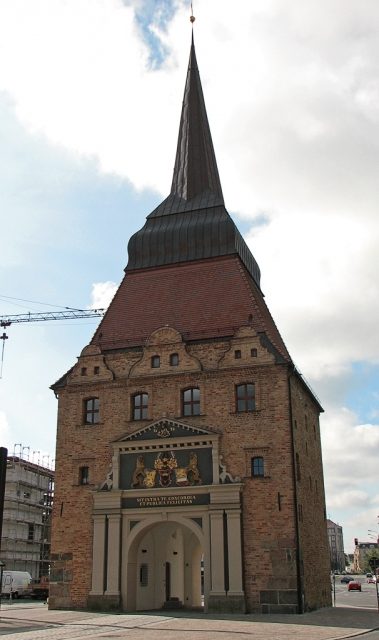
The Steintor in its current form is a gate built between 1574 and 1577 in the Renaissance architectural style, located in the south of Rostock's historic city fortifications. Along with the Kröpeliner Tor, Petritor, and Mühlentor, it was one of the city's four main gates and part of the 22 gates belonging to the former city wall.
First Gate
Built in 1279, the gate soon replaced the slightly more easterly Kuhtor as the city's main portal, a role it maintained throughout the Middle Ages. It is probable that its size was similar to the early Kröpeliner Tor, which was built at the same time. It was constructed as part of the fortification of the city of Rostock with a wall, towers, and gates, after the three original city centers united in 1265. The Steintor still leads directly via Steinstraße to the Neuer Markt, which is the city center and where both the Town Hall and St. Mary's Church are located. The princes could ride into the city without detours on this paved (stone) street, which was specially prepared for them.
However, the Steintor in its original form stood for barely 300 years. During conflicts between Rostock and Schwerin in 1565, one issue was the introduction of a beer tax in favor of the dukes. After Rostock refused Johann Albrecht I the formal oath of homage, he rode into the city with 500 horsemen through the Steintor and in 1566 had the Steintor, its outer gate, the Zwingerhof with its gate, a part of the city wall from the Wiekhaus at the Dominican monastery to the Kuhtor, and the "Turm auf dem Rammelsberg," the predecessor of today's Lagebuschturm (or Fangelturm) with ramparts, moats, and bridges, as well as parts of the east and south sides of the monastery, razed. From these stones, he had a fortress built in today's Rosengarten. Only the First Rostock Inheritance Treaty of September 21, 1573, which guaranteed the territorial princes hereditary rule over the city for centuries, thus binding Rostock for a long time, and also recognized them as the highest judges, ended the conflict.
Second Gate
After the citizens bought the right from the duke, they razed the fortress the following spring. From 1574 to 1577, the expensive reconstruction of the wall, as well as the Lagebuschturm and the Steintor, took place in the style of the Dutch Renaissance. A rarity for this period is that the responsible builders for the new construction can be directly traced. The gate was built under the direction of Antonius Wahrholt, with the sculptor Hans Borgloh also involved, Hinrich Kate as the master carpenter, and Otto as the master of earthworks for the ramparts.
The depiction of the gate on the Vicke-Schorler-Rolle shows its form at that time. The aedicule above the gate passage extends over the entire width of the building. In Schorler's depiction, unlike today, there are also cartouches next to the lions bearing coats of arms. In the left one, the text reads: Wer Gott vertrawt hat wohl gebawt. (He who trusts God has built well. - after the beginning of a hymn by Joachim Magdeburg, 1572), in the right one: Durch stilsein und hoffen werdet ihr sterck. (Through quietness and hope you will be strong. - after Isaiah 30:15). The inscription below the coats of arms also differs from today's – although the meanings are not significantly different. Both refer directly to the conflict with the duke that led to the demolition of the old gate. In Schorler's depiction, it reads: Dominus confortet seras portarum et benedicat / filiis tuis. Intra te concordia, publica felicitas perpetua. (The Lord strengthen the bolts of the gates and bless your children within you. May there be harmony within you and lasting public prosperity). The first part is a rephrasing of a statement into a plea from Psalm 147:13 of the Bible, which reads: Quoniam confortavit seras portarum tuarum; benedixit filiis tuis in te. (according to Luther: For he (Yahweh) strengthens the bolts of your (Jerusalem's) gates, and blesses your children within you.) In the line below, Schorler's depiction reads: Gemeiner Fried ein schoner stand, dadurch erhelt man stadt und land. (Common peace a beautiful state, thereby one preserves city and country.) It can be assumed that this part was additionally inserted by Schorler.
In its current version, the gate's inscription simply reads: "Sit intra te concordia et publica felicitas." – May harmony and public prosperity prevail within your walls.
On Schorler's depiction, the roof is made of shingles instead of slate.
The field side deliberately bears only the city and state coat of arms in a small rectangle. Also visible are the stones for the portcullis and the loopholes. This simplicity on the side facing away from the city showed defensiveness and demonstrated strength. Wealth, on the other hand, was depicted on the city side. Two lions there bear three historic coats of arms: the coat of arms with the griffin (coat of arms of the princes), one with the bull's head (the great city seal), and the tricolored shield with griffin (the Hanseatic city coat of arms). Below it is the city's motto.
Towards the field side of the gate, there was also the Zwinger, a wide round tower, which was demolished in 1849. Furthermore, the gate long had a direct connection to the city wall, which was not preserved due to the street layout. Extensive restoration of the building was necessary after the destruction caused by the Royal Air Force bombardment in 1942. The spire was destroyed, and the gate was burned out down to its enclosing walls. Reconstruction took place from 1950 to 1956 in its original form by master builder Grützmacher. In 2005, the missing connection to the city wall was symbolically restored by twelve green-glowing steles at night on the east side.
Take Mobile History with you
You are reading this text for free. Premium adds what matters on the road: descriptions read aloud, sites found through your camera, whole regions taken offline.
- Every description, including the ~17,700 Premium sites
- Audio guide: have descriptions read to you on location
- AR finder: see sites through your camera, with distance and bearing
- Unlimited saved sites
14 days free, then from €2.99 a month. Cancel anytime.
Source: Wikipedia · Licence: CC BY-SA 4.0 · Image: https://commons.wikimedia.org/wiki/File:Rostock_Steintor_1.jpg
This description draws on the facts documented in the linked Wikipedia article; Wikipedia content is licensed under CC BY-SA 4.0. Wording and editing: Mobile History.
Location: 54.0866, 12.1409