The Gate can be visited
Town FortificationRostock
Town Fortification Rostock-Kuh Gate
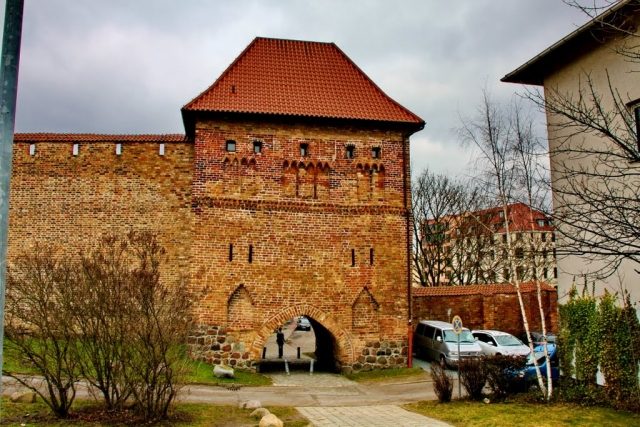
The Kuhtor is not only the oldest of the four remaining gates of the former 22 gates of the historic Rostock city fortifications, but also one of the oldest buildings in Rostock and probably the oldest preserved city gate in Northern Germany.
In 1262, the early Gothic gate tower, which led to the road to Bützow and Werle, was first mentioned in a document, but was very soon replaced by the Steintor as the city's most important southern exit gate. Only cattle were now led through it to the Warnow meadows, which is how it got its name.
The four-story defensive tower is 8 by 9 meters wide and has a wall thickness of 2 meters. The gate has a width of 3.5 and a height of 3 meters.
Towards the end of the 14th century, the field side was bricked up. Only during the period of the city's disputes with the regional lords, which culminated in the First Rostock Inheritance Treaty – when part of the fortifications, including the Steintor and the tower on the Rammelsberg, were demolished – was it reopened as a city gate. When the city council decided in 1608 to use it as a light prison (as a so-called civil custody), after the renewed closure of the field side, the city side was also closed.
At the base and foundation of the Kuhtor, the massive stones, typical of the architecture of late medieval fortifications, are still very clearly visible today. In addition, there are embrasures and indentations where scaffolding was attached in the Middle Ages when repair work was necessary. In case of war, these indentations could also be extended to breakthroughs for battlements.
Later, the gate was made usable as a dwelling. The city's gunsmith lived in it from 1671 onwards. In 1825, it was completely converted into a residential building and, after some time, was also completely surrounded by houses. Until 1937, the city provided it as housing for city employees, craftsmen, and day laborers. Only in 1938 was it partially reconstructed, for example, the archway on the field side with the early Gothic pointed arch, the blind arches, and the German band, but four years later it was severely damaged by bombs. The roof truss was destroyed and the gate completely burned out. From 1962 to 1964, the building, which had remained uncovered until then, received its new roof. Only in 1984 was it fully reconstructed. After it served as the seat of the district board of the Writers' Association of the GDR from 1985 to 1990. On November 9, 1990, the Literaturförderkreis Kuhtor e.V. was founded. Until 1993, however, the gate still belonged to the city's cultural office. From 1998 to 2000, it was then fundamentally reconstructed once again and, upon reopening, handed over to the Literaturförderkreis as an independent sponsor. The house then housed the Literaturhaus Rostock with the Literaturrat M-V e.V., as well as the Risse e.V. until the end of 2009. Since the beginning of 2010, it has been the seat of the Mediationsstelle Rostock, the office for conflict resolution and systemic family therapy of Straube Managementberatung.
Take Mobile History with you
You are reading this text for free. Premium adds what matters on the road: descriptions read aloud, sites found through your camera, whole regions taken offline.
- Every description, including the ~17,700 Premium sites
- Audio guide: have descriptions read to you on location
- AR finder: see sites through your camera, with distance and bearing
- Unlimited saved sites
14 days free, then from €2.99 a month. Cancel anytime.
Source: Wikipedia · Licence: CC BY-SA 4.0 · Image: Rainer Gindele
This description draws on the facts documented in the linked Wikipedia article; Wikipedia content is licensed under CC BY-SA 4.0. Wording and editing: Mobile History.
Location: 54.0867, 12.1436